Stock Analysis · Viking Therapeutics Inc (VKTX)
Overview
Viking Therapeutics is a clinical-stage biotechnology company focused on developing medicines for metabolic and endocrine disorders. In simple terms, it is trying to create new drug candidates for very large health problems such as obesity, fatty liver disease, and other conditions linked to metabolism. The company does not yet sell an approved product, so its value today comes mainly from the progress of its research pipeline rather than from commercial sales.
Its most important programs are in obesity and related diseases. The lead asset is VK2735, being developed in injectable and oral forms for obesity and weight management. Viking is also advancing VK2809 for metabolic dysfunction-associated steatohepatitis, or MASH, a liver disease closely tied to obesity and diabetes. Other pipeline programs are earlier stage and currently matter less to the company’s near-term outlook.
Because Viking remains in the development stage, revenue is currently minimal to nonexistent in normal operating terms. Recent annual filings show no meaningful recurring product revenue. That means the business model is still based on spending cash on research in hopes of creating future licensing deals, partnerships, or eventually approved products.
The revenue mix is therefore very limited at this stage:
- Product revenue: 0% in recent annual results, because Viking has no approved commercial drug.
- Collaboration or licensing revenue: no meaningful recurring contribution recently disclosed as an ongoing source.
- Interest and other income: a modest contribution from cash balances and investments, but not a core business driver.
That structure makes Viking very different from an established pharmaceutical company. For now, the company is essentially converting investor capital into clinical data, intellectual property, and optionality around future deals or approvals. The cost base is dominated by research and development, and that has risen sharply as its lead obesity program has moved forward.
The operating pattern is clear: revenue has stayed close to zero while research spending has accelerated from tens of millions of dollars a few years ago to well above $300 million in 2025. Administrative costs also increased, but research remains the main expense and the main reason losses widened. That is typical for a biotech entering larger and more expensive clinical trials.
Key Figures
| Metric | Value | Sector ⓘ |
|---|---|---|
| Date | Oct 24, 2026 | |
| Context | ||
| Sector | Healthcare | |
| Industry | Biotechnology | |
| Market Cap ⓘ | $3.35B | |
| Beta ⓘ | 0.65 | |
Value (Cheapness) | ||
| P/E Ratio ⓘ | N/A | 25.42 |
| P/B Ratio ⓘ | 7.33 | 3.08 |
| FCF Yield ⓘ | -12.47% | 3.12% |
| Dividend Yield ⓘ | N/A | 1.85% |
| EBIT / EV ⓘ | -12.26% | 0.56% |
| PEG ⓘ | -0.03 | |
Growth (Business expansion) | ||
| Revenue Growth ⓘ | N/A | 7.50% |
| RPS Growth (5Y CAGR) ⓘ | N/A | 8.60% |
| EPS Growth (5Y CAGR) ⓘ | N/A | -17.73% |
| BVPS Growth (5Y CAGR) ⓘ | 21.36% | 3.72% |
| Margin Growth (5Y Trend) ⓘ | N/A | -0.57% |
| FCF Growth (5Y CAGR) ⓘ | N/A | 0.96% |
| DPS Growth (5Y CAGR) ⓘ | N/A | 6.69% |
Quality (Business durability) | ||
| ROIC (Latest) ⓘ | -73.75% | 3.17% |
| ROA (Latest) ⓘ | -84.80% | 2.98% |
| ROIC (5Y Median) ⓘ | -30.92% | 4.56% |
| ROA (5Y Median) ⓘ | -31.99% | 1.87% |
| Net Debt / EBIT (Latest) ⓘ | N/A | 1.34 |
| Net Debt / EBIT (5Y Median) ⓘ | N/A | 1.86 |
| Net Debt / EBITDA (Latest) ⓘ | N/A | 1.00 |
| Net Debt / Assets ⓘ | -23.31% | 5.06% |
| EBITDA / Interest ⓘ | N/A | 9.55 |
| Operating Margin (Latest) ⓘ | N/A | 9.25% |
| Operating Margin (5Y Median) ⓘ | N/A | 7.33% |
| Debt to Equity (Latest) ⓘ | 1.00% | 26.68% |
| Profit Margin (Latest) ⓘ | N/A | 3.34% |
| Free Cash Flow (Latest) ⓘ | -$418.44M | |
Momentum (Price trend) | ||
| 3Y Return ⓘ | +148.84% | +51.61% |
| 12M Return (excl. last month) ⓘ | +55.62% | +19.90% |
| 6M Return ⓘ | -24.58% | +10.10% |
| Price vs. 200-Day MA ⓘ | -20.77% | +6.44% |
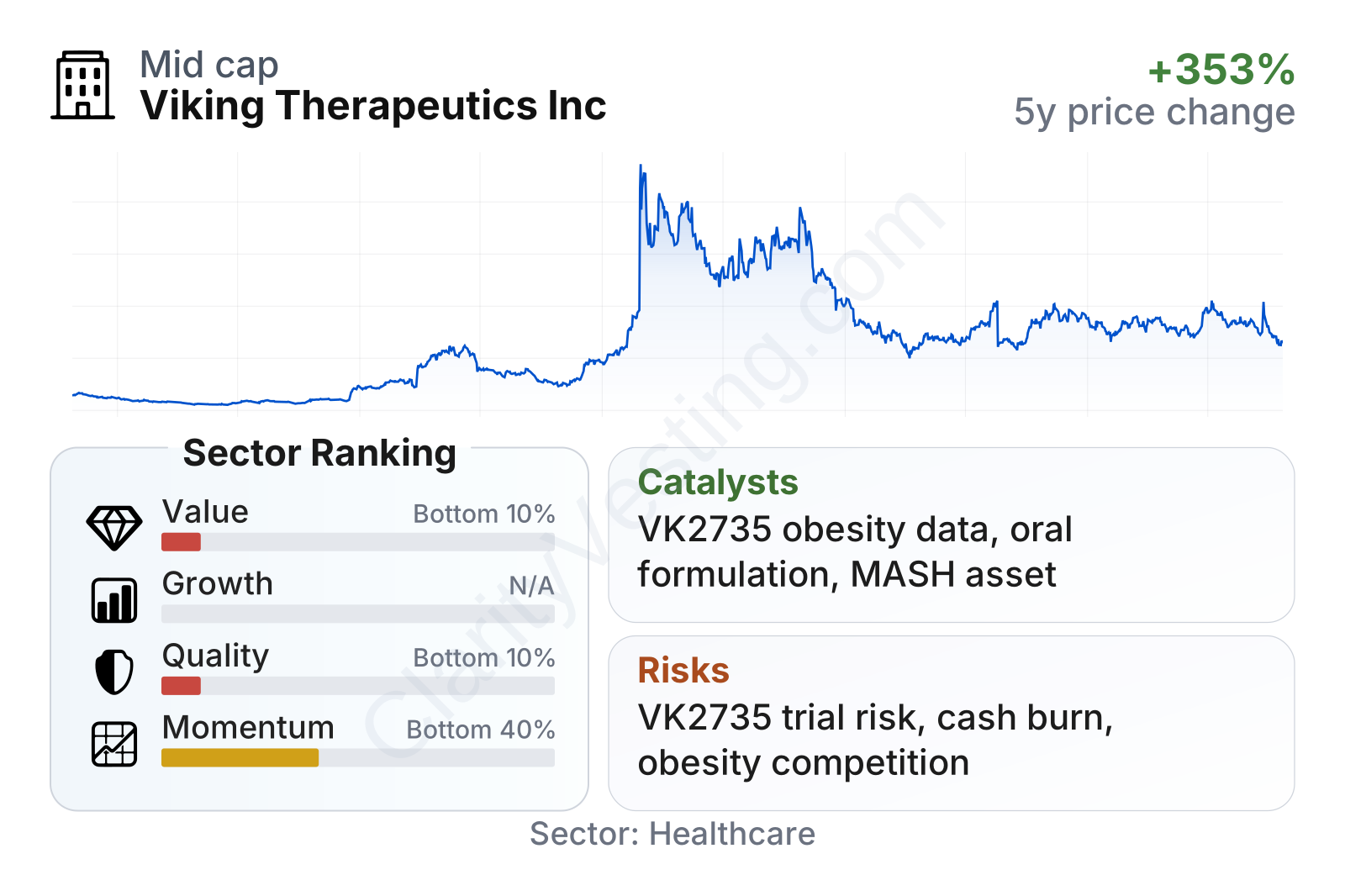
Viking is a mid-sized biotech by market value, with a share price history that has been highly volatile. The stock surged dramatically during the obesity-drug enthusiasm of 2024, then gave back a large part of those gains before stabilizing and recovering somewhat in 2026. That kind of movement shows how strongly the market is pricing clinical expectations rather than present-day business results.
The latest metrics table reflects that profile. On traditional valuation and quality measures, Viking sits near the bottom of the healthcare sector because it has no product revenue, negative free cash flow, and deeply negative returns on capital and assets. On the other hand, its balance sheet leverage is unusually low, with debt far below the sector median, which is an important cushion for a pre-revenue biotech. Momentum looks more balanced: long-term share performance has been strong, but shorter-term signals have been less impressive than the broader healthcare group.
Growth
Viking operates in one of the fastest-growing areas in healthcare: obesity and metabolic disease. This is a very large market with rising medical need, growing physician adoption, and strong interest from major pharmaceutical companies. Demand is not limited to weight loss alone. The same therapeutic area touches diabetes risk, heart health, sleep apnea, fatty liver disease, and other costly chronic conditions. That broadens the commercial opportunity for successful drugs.
The company’s strategy is straightforward and easy to understand. It is concentrating resources on programs where market demand is already proven and where strong clinical data can attract partners or justify further development. VK2735 is central here. A candidate available in both injectable and oral forms could matter because the obesity market is likely to support multiple products, and convenience differences can influence adoption. Viking’s liver disease program, VK2809, gives it a second potential growth path in another major unmet-need category.
A key recent opportunity came from Viking’s continued progress with VK2735 and the broader industry validation of obesity medicines. Large drugmakers have shown increasing willingness to pay for promising metabolic assets, which raises the strategic value of companies with credible clinical programs. Viking has repeatedly been discussed in that context because it offers exposure to one of the market’s most attractive therapeutic categories without already being tied to a major commercial franchise.
The main constraint on growth is that Viking’s expansion is not yet visible in revenue; it is visible in spending. Free cash flow has become substantially more negative as the company funds larger trials and manufacturing preparation. In practical terms, the growth case depends on future milestones such as favorable clinical results, regulatory advancement, or a partnership, not on near-term sales acceleration. That is common in biotech, but it makes the growth profile more binary than in ordinary operating businesses.
Risks
This article is for informational purposes only and does not constitute financial advice. Some content is AI-generated. See Disclaimer


