Stock Analysis · Telefonica Brasil SA (VIV)
Overview
Telefonica Brasil S.A., known commercially as Vivo, is one of Brazil’s largest telecommunications companies. It provides mobile phone services, broadband internet, pay TV, fixed-line voice, corporate connectivity, digital services, and IT-related solutions. In practical terms, the company sells connectivity to households, mobile access to consumers, and network and technology services to businesses and public-sector clients.
The business is increasingly centered on mobile and fiber broadband. Mobile is the largest activity, supported by postpaid plans, prepaid recharges, device sales, and value-added services. Fixed services include fiber-to-the-home internet, voice, TV, and a growing mix of digital products for homes and companies. This matters for long-term analysis because Brazil’s telecom market is no longer mainly about adding basic phone users; it is more about selling better connectivity, keeping customers for longer, and expanding into higher-value services.
Based on the company’s recent annual disclosures, revenue is broadly concentrated in the following areas:
- Mobile service revenue: approximately 58% to 62% of total revenue. This includes postpaid and prepaid mobile plans, usage, interconnection, and mobile data services.
- Fixed service revenue: approximately 28% to 32%. This includes fiber broadband, fixed voice, pay TV, and related household connectivity services.
- Handset and electronics sales: approximately 8% to 10%. This covers smartphones, accessories, and other equipment sold through the company’s channels.
- Digital services, B2B, and other revenue streams: a smaller but growing portion, generally included within service categories, covering cloud, cybersecurity, IoT, data services, and enterprise solutions.
Over the last several years, the company’s revenue base has become larger and more profitable, with operating income and net income improving after a weaker period in 2022. One notable point is that revenue has continued to rise while cash generation has also remained strong, which is important in a capital-intensive industry like telecom.
The business mix shows a telecom operator that has been shifting toward recurring service revenue and stronger operating efficiency. Revenue has expanded steadily since 2021, while operating profit has improved faster than sales, suggesting that the company has been managing pricing, customer mix, and cost control reasonably well.
Key Figures
| Metric | Value | Sector ⓘ |
|---|---|---|
| Date | Nov 21, 2026 | |
| Context | ||
| Sector | Communication Services | |
| Industry | Telecom Services | |
| Market Cap ⓘ | $19.00B | |
| Beta ⓘ | 0.20 | |
Value (Cheapness) | ||
| P/E Ratio ⓘ | 15.24 | 17.77 |
| FCF Yield ⓘ | 9.84% | 7.57% |
| Dividend Yield ⓘ | 8.51% | 2.85% |
| EBIT / EV ⓘ | 8.71% | 6.92% |
| PEG ⓘ | 0.92 | |
Growth (Business expansion) | ||
| Revenue Growth ⓘ | 7.20% | 6.30% |
| RPS Growth (5Y CAGR) ⓘ | 8.49% | 4.62% |
| EPS Growth (5Y CAGR) ⓘ | -10.19% | -14.44% |
| Margin Growth (5Y Trend) ⓘ | 2.43% | 1.03% |
| FCF Growth (5Y CAGR) ⓘ | 6.43% | 5.91% |
| DPS Growth (5Y CAGR) ⓘ | -17.38% | 5.03% |
Quality (Business durability) | ||
| ROIC (Latest) ⓘ | 18.11% | 8.39% |
| ROIC (5Y Median) ⓘ | 9.39% | 8.33% |
| Net Debt / EBIT (Latest) ⓘ | 1.29 | 1.88 |
| Net Debt / EBIT (5Y Median) ⓘ | 1.91 | 2.83 |
| Net Debt / EBITDA (Latest) ⓘ | 0.53 | 1.22 |
| Net Debt / Assets ⓘ | 10.71% | 20.70% |
| EBITDA / Interest ⓘ | 12.98 | 8.41 |
| Operating Margin (Latest) ⓘ | 17.11% | 15.44% |
| Operating Margin (5Y Median) ⓘ | 13.15% | 13.32% |
| Debt to Equity (Latest) ⓘ | 31.45% | 60.11% |
| Profit Margin (Latest) ⓘ | 11.40% | 8.06% |
| Free Cash Flow (Latest) ⓘ | $1.87B | |
Momentum (Price trend) | ||
| 3Y Return ⓘ | +36.92% | +35.91% |
| 12M Return (excl. last month) ⓘ | +13.46% | +2.79% |
| 6M Return ⓘ | -12.42% | 0.00% |
| Price vs. 200-Day MA ⓘ | -11.67% | +0.03% |
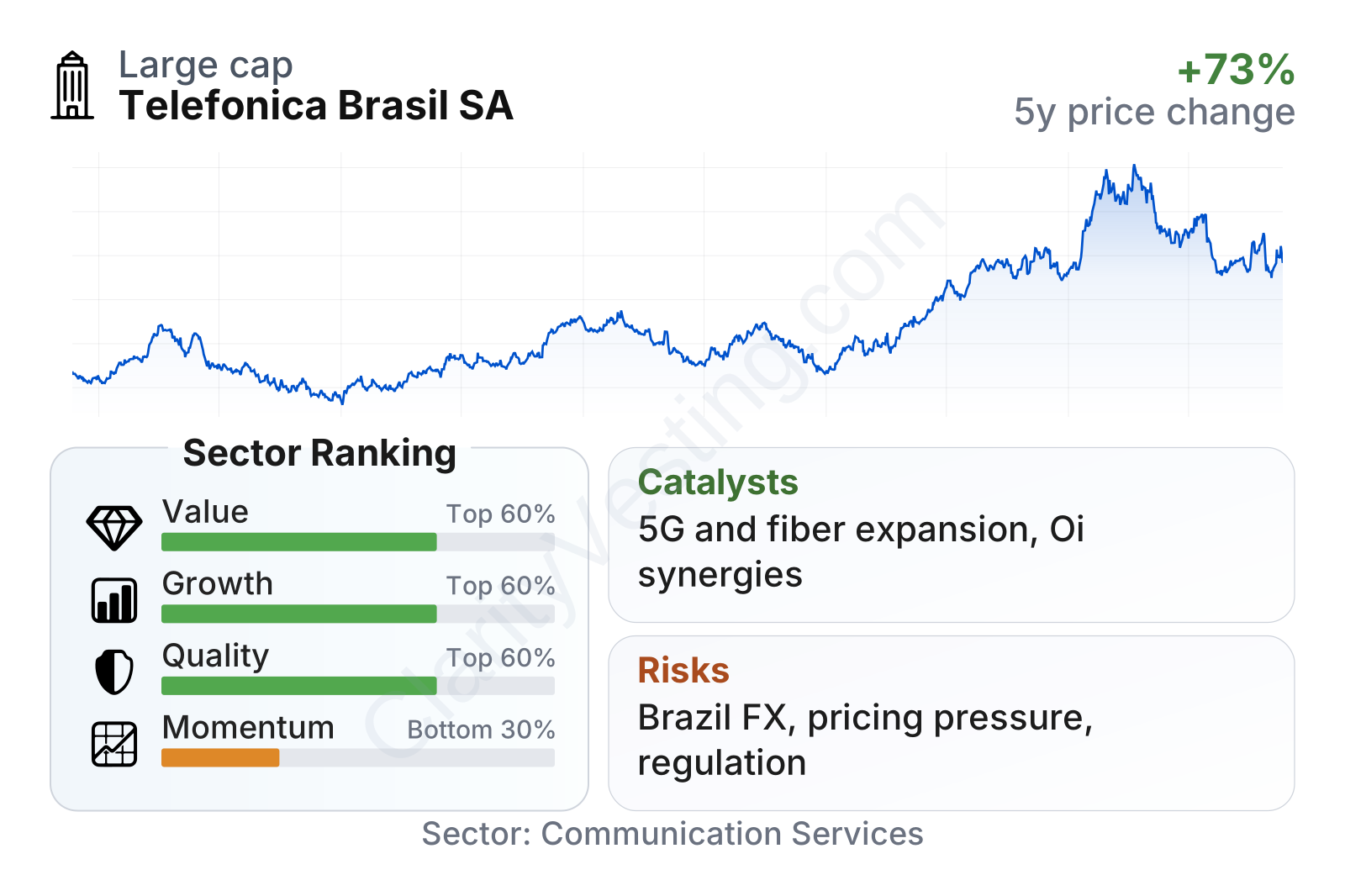
Telefonica Brasil sits in the upper half of its sector on value, growth, and quality metrics, while recent share-price momentum has been weaker. The combination of a mid-teen earnings multiple, a free cash flow yield near 10%, and a dividend yield above 8% points to a stock that is not priced like a high-growth technology name. At the same time, returns on invested capital, margins, and leverage look stronger than many sector peers, which gives the company a more solid operating profile than a typical slow-growth telecom.
The market value places the company among the larger listed telecom businesses in Latin America, and its very low beta indicates that the stock has historically moved less than the broader market. That does not remove risk, but it does fit the pattern often seen in mature network operators with recurring subscription revenue.
Growth
Telefonica Brasil operates in a sector that still has room for expansion, even though traditional telecom services are mature. The main growth engine is not basic subscriber additions anymore; it is the migration toward higher-value plans, broader fiber coverage, more data consumption, enterprise digitalization, and services built on top of connectivity such as cloud, cybersecurity, and IoT. In Brazil, demand for reliable mobile data and home broadband continues to benefit from digital consumption trends, remote work habits, streaming, online commerce, and corporate network modernization.
The company’s strategy is coherent with that environment. It has emphasized postpaid mobile, fiber rollout, customer quality, and cross-selling. That mix generally produces better revenue predictability than a model focused on prepaid users or legacy fixed-line voice. It also helps reduce churn because customers using several services from the same provider tend to be more stable over time.
Revenue growth has remained positive and fairly consistent, generally running in the mid-single-digit to high-single-digit range in recent periods. That is a healthy outcome for a large telecom operator and slightly ahead of the sector median. The pattern suggests that the company is not relying on one exceptional quarter, but rather on a sustained commercial trend.
Cash generation has also been moving upward over time, with trailing free cash flow now above the level seen a few years ago. That matters because telecom companies must keep investing in spectrum, network quality, and fiber infrastructure. Rising free cash flow after those investments is a good sign: it suggests the business is not growing at the expense of financial flexibility.
One of the clearest catalysts in recent years has been the integration of assets and customers obtained after the consolidation of Oi’s mobile operation in Brazil. That transaction strengthened market structure and helped the largest operators, including Vivo, deepen scale in mobile. Another catalyst is the ongoing expansion of fiber access and enterprise digital services, where customer relationships can support additional revenue per account over time.
Recent company communications have also highlighted continuing network investment, 5G rollout, and service bundling. These are not overnight transformations, but they support the company’s long-term effort to move from a basic connectivity provider toward a broader digital infrastructure platform.
Risks
This article is for informational purposes only and does not constitute financial advice. Some content is AI-generated. See Disclaimer


