Stock Analysis · Virtu Financial Inc (VIRT)
Overview
Virtu Financial is a market-making and trading technology company. In simple terms, it uses its own systems to stand ready to buy and sell financial instruments such as stocks, options, futures, currencies, and fixed income products. By doing this across many venues and asset classes, it helps markets stay liquid and earns money from bid-ask spreads, trading opportunities, and services sold to other market participants.
The company operates through two main business segments: Market Making and Execution Services. Market Making is the core activity and usually provides the large majority of revenue and earnings. Execution Services includes agency-based trading, workflow tools, analytics, and technology that help institutions trade more efficiently.
Based on recent company filings, Virtu’s revenue mix is broadly concentrated as follows:
- Market Making: approximately 70% to 80% of total net trading income and commissions combined. This includes trading across global equities, options, fixed income, currencies, commodities, and other products where Virtu provides liquidity.
- Execution Services: approximately 20% to 30%. This includes commissions, technology-enabled execution, analytics, and trading workflow solutions used by institutional clients.
That mix matters because Virtu is not a traditional asset manager or retail broker. Its results depend more on trading activity, market structure, and the strength of its technology platform than on rising stock prices alone. In years with elevated volatility and heavier trading volumes, the Market Making segment can expand quickly, while calmer periods can produce softer results.
The business flow over recent years shows a cyclical pattern rather than a straight line: revenue and operating profit weakened after the unusually strong trading environment of 2021, then improved again in 2024 and 2025. A notable positive change is that net income recovered strongly in 2025 as interest expense dropped sharply from the prior two years, showing how financing costs had been a major drag and then became much less burdensome.
Key Figures
| Metric | Value | Sector ⓘ |
|---|---|---|
| Date | Oct 17, 2026 | |
| Context | ||
| Sector | Financial Services | |
| Industry | Capital Markets | |
| Market Cap ⓘ | $4.90B | |
| Beta ⓘ | 0.65 | |
Value (Cheapness) | ||
| P/E Ratio ⓘ | 9.29 | 12.26 |
| P/B Ratio ⓘ | 3.54 | 1.23 |
| FCF Yield ⓘ | 8.33% | 10.40% |
| Dividend Yield ⓘ | 1.72% | 3.02% |
| EBIT / EV ⓘ | 11.02% | 8.14% |
| PEG ⓘ | -9.42 | |
Growth (Business expansion) | ||
| Revenue Growth ⓘ | 29.10% | 9.35% |
| RPS Growth (5Y CAGR) ⓘ | 15.72% | 12.19% |
| EPS Growth (5Y CAGR) ⓘ | 5.79% | -9.53% |
| BVPS Growth (5Y CAGR) ⓘ | 7.56% | 4.99% |
| Margin Growth (5Y Trend) ⓘ | -9.31% | -3.86% |
| FCF Growth (5Y CAGR) ⓘ | -20.02% | 4.81% |
| DPS Growth (5Y CAGR) ⓘ | -3.01% | 8.79% |
Quality (Business durability) | ||
| ROIC (Latest) ⓘ | 12.00% | 9.49% |
| ROE (Latest) ⓘ | 52.28% | 13.90% |
| ROA (Latest) ⓘ | 2.81% | 1.55% |
| ROIC (5Y Median) ⓘ | 16.48% | 7.86% |
| ROE (5Y Median) ⓘ | 27.35% | 12.17% |
| ROA (5Y Median) ⓘ | 2.54% | 1.30% |
| Net Debt / EBIT (Latest) ⓘ | 0.99 | 0.96 |
| Net Debt / EBIT (5Y Median) ⓘ | 3.81 | 0.73 |
| Net Debt / EBITDA (Latest) ⓘ | 0.92 | 0.92 |
| Operating Margin (Latest) ⓘ | 38.87% | 22.30% |
| Operating Margin (5Y Median) ⓘ | 40.33% | 24.63% |
| Debt to Equity (Latest) ⓘ | 140.97% | 58.56% |
| Profit Margin (Latest) ⓘ | 16.87% | 26.57% |
| Free Cash Flow (Latest) ⓘ | $407.99M | |
Momentum (Price trend) | ||
| 3Y Return ⓘ | +239.06% | +88.33% |
| 12M Return (excl. last month) ⓘ | +63.31% | +19.38% |
| 6M Return ⓘ | +14.45% | +4.75% |
| Price vs. 200-Day MA ⓘ | +13.47% | +3.50% |
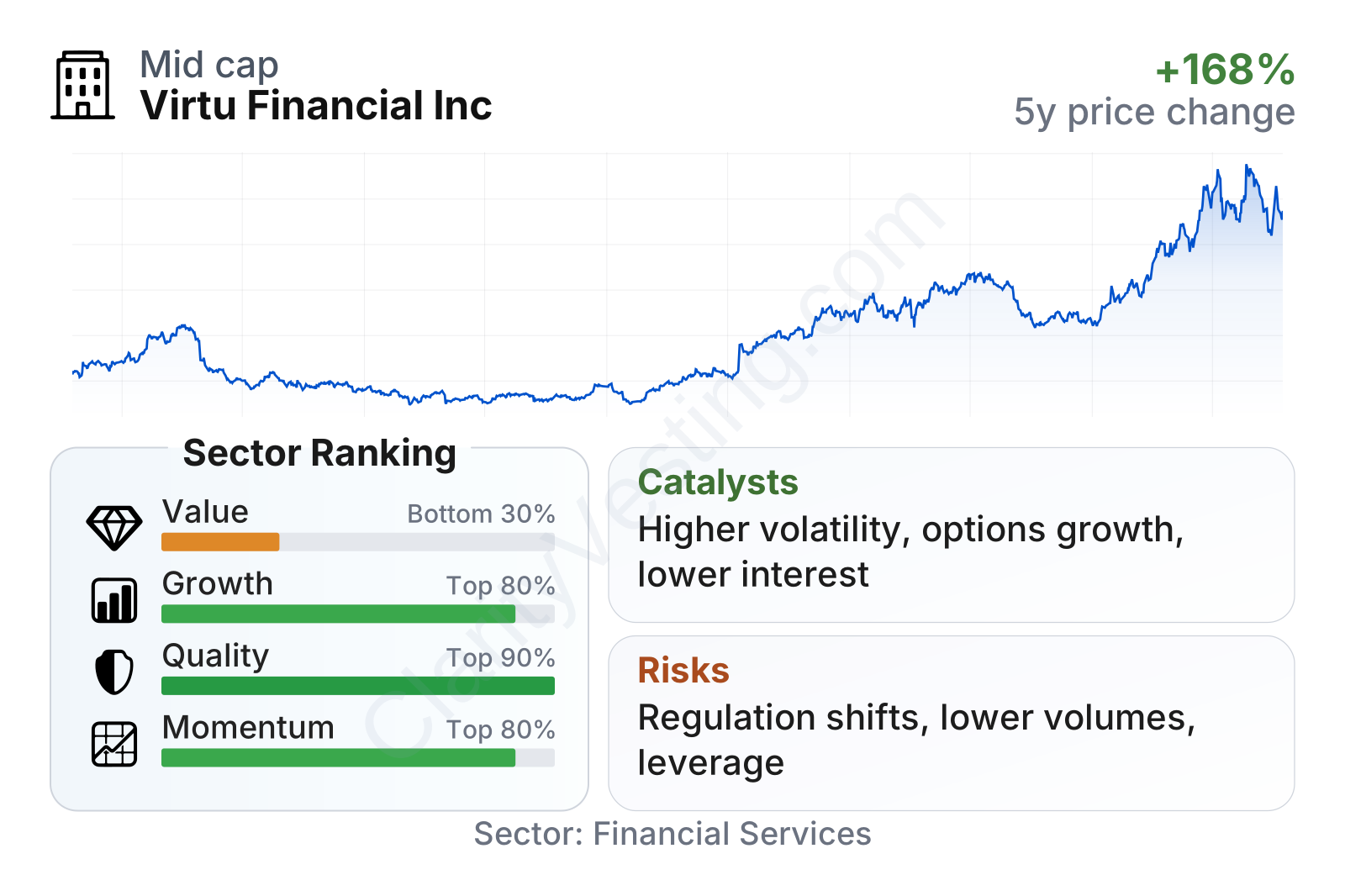
Virtu is a mid-sized capital markets company with a below-market beta of about 0.6, which suggests the stock has historically moved less than the broader market. The overall factor profile is unusual but understandable for this kind of business: growth, quality, and momentum rank well versus the sector, while value looks less attractive on a book-value basis even though earnings-based multiples remain low. In other words, the market is paying a premium to accounting equity, but not an especially high multiple of current earnings.
The stock’s longer-term price trend has been strong, especially over the last three years, which matches the rebound in profitability and the market’s more favorable view of trading firms during periods of active markets. At the same time, the dividend yield is relatively modest at under 2%, and free cash flow yield sits slightly below the sector median, so the investment case is driven more by operating performance and capital returns than by income alone.
Growth
Virtu operates in a part of financial services that should remain relevant as markets become more electronic, fragmented, and data-driven. More trading across equities, options, futures, fixed income, and foreign exchange creates more need for speed, pricing, and execution quality. This favors firms with strong infrastructure, risk controls, and the ability to connect to many venues around the world. In that sense, Virtu participates in a structurally important area, even if annual results can swing with market conditions.
The company’s strategy is logical for future expansion. It combines a scaled market-making engine with client-facing execution services, giving it exposure both to proprietary trading opportunities and to institutional trading workflows. That diversification helps because client services can provide steadier activity while market making can benefit disproportionately during volatile periods. Management has also emphasized technology, automation, and efficiency for years, which is central in a business where tiny advantages in speed and pricing can matter at very high volumes.
Recent performance supports the idea that the platform still has room to compound. Revenue growth was well above the sector median on the latest measures, and five-year growth in revenue per share, earnings per share, and book value per share has also been ahead of typical sector levels. That does not mean the path is smooth, but it does show that Virtu has been able to expand underlying value despite market cycles.
The earnings pattern is volatile but encouraging in direction. After falling from the unusually strong 2021 level into 2023, earnings recovered materially in 2024 and reached a much higher level in 2025. That rebound suggests the company can generate substantial profit when trading conditions normalize in its favor and financing pressure eases.
Book value per share has also trended upward over time, especially in the last two reported years. For a financial company, that is important because it indicates the balance sheet base supporting the business has been building rather than eroding. A rising book value alongside recovering earnings usually points to a business that is creating value even if reported profits move around from year to year.
Potential catalysts are fairly clear. A higher-volatility market backdrop, continued growth in electronic trading, rising activity in options and multi-asset markets, and further improvement in execution-services adoption could all support results. In addition, if lower interest expense remains sustainable, more of Virtu’s operating income can flow through to net income than was the case in 2022 and 2023.
Risks
This article is for informational purposes only and does not constitute financial advice. Some content is AI-generated. See Disclaimer


