Stock Analysis · Vir Biotechnology Inc (VIR)
Overview
Vir Biotechnology is a clinical-stage biotechnology company focused on infectious diseases, immune-mediated conditions, and cancer. Its model is different from that of a mature drug maker: rather than relying on a large portfolio of approved medicines, Vir invests heavily in research and partnerships to discover and develop new treatments. The company became widely known during the COVID-19 period through sotrovimab, but its longer-term pipeline now extends well beyond that single product cycle.
Today, the business is centered on advancing a set of drug candidates and platform technologies, with particular attention on chronic hepatitis delta, chronic hepatitis B, HIV, tuberculosis, and oncology-related programs. Vir has also used collaborations with larger pharmaceutical groups to gain scientific, manufacturing, and commercial support. That matters because the company’s future depends less on current sales and more on whether its pipeline can turn into approved products.
Vir’s revenue base has become much smaller than it was at the COVID-19 peak. Based on recent filings, the main sources of revenue are:
- Collaboration and licensing revenue: the clear majority of current revenue, approximately 80% to 95% in recent periods. This generally includes upfront payments, milestone recognition, and research support from partners.
- Product-related revenue and supply activity: a much smaller share, approximately 5% to 20%, mainly tied to residual activity connected with past commercial arrangements rather than a broad recurring product franchise.
- Other revenue: typically minimal or not separately meaningful in the current mix.
The bigger picture is straightforward: Vir is no longer a COVID-windfall revenue company. It is back to looking like a development-stage biotech, where partnership income helps support research, but long-term value depends on clinical success.
The financial flow over the last several years shows a sharp transition. Revenue was unusually high in 2021 and 2022, then dropped steeply in 2023 through 2025 as COVID-related economics faded. At the same time, research spending remained very large, which explains why losses widened even as the company reduced some operating costs.
Key Figures
| Metric | Value | Sector ⓘ |
|---|---|---|
| Date | Oct 10, 2026 | |
| Context | ||
| Sector | Healthcare | |
| Industry | Biotechnology | |
| Market Cap ⓘ | $1.95B | |
| Beta ⓘ | 1.59 | |
Value (Cheapness) | ||
| P/E Ratio ⓘ | N/A | 24.79 |
| P/B Ratio ⓘ | 1.91 | 2.97 |
| FCF Yield ⓘ | -10.20% | 3.11% |
| Dividend Yield ⓘ | N/A | 2.04% |
| EBIT / EV ⓘ | -19.42% | 0.57% |
| PEG ⓘ | N/A | |
Growth (Business expansion) | ||
| Revenue Growth ⓘ | 19582.50% | 7.35% |
| RPS Growth (5Y CAGR) ⓘ | -50.45% | 8.61% |
| EPS Growth (5Y CAGR) ⓘ | N/A | -18.43% |
| BVPS Growth (5Y CAGR) ⓘ | -15.29% | 3.94% |
| Margin Growth (5Y Trend) ⓘ | N/A | -0.61% |
| FCF Growth (5Y CAGR) ⓘ | N/A | 0.88% |
| DPS Growth (5Y CAGR) ⓘ | N/A | 6.74% |
Quality (Business durability) | ||
| ROIC (Latest) ⓘ | -24.04% | 3.34% |
| ROA (Latest) ⓘ | -22.53% | 2.95% |
| ROIC (5Y Median) ⓘ | -28.11% | 4.60% |
| ROA (5Y Median) ⓘ | -26.06% | 1.89% |
| Net Debt / EBIT (Latest) ⓘ | N/A | 1.36 |
| Net Debt / EBIT (5Y Median) ⓘ | N/A | 1.86 |
| Net Debt / EBITDA (Latest) ⓘ | N/A | 1.02 |
| Net Debt / Assets ⓘ | -15.27% | 5.85% |
| EBITDA / Interest ⓘ | N/A | 9.60 |
| Operating Margin (Latest) ⓘ | -92.16% | 9.19% |
| Operating Margin (5Y Median) ⓘ | -682.68% | 7.53% |
| Debt to Equity (Latest) ⓘ | 9.49% | 29.44% |
| Profit Margin (Latest) ⓘ | -83.00% | 3.52% |
| Free Cash Flow (Latest) ⓘ | -$198.76M | |
Momentum (Price trend) | ||
| 3Y Return ⓘ | +28.55% | +34.80% |
| 12M Return (excl. last month) ⓘ | +115.41% | +19.33% |
| 6M Return ⓘ | +16.81% | +7.18% |
| Price vs. 200-Day MA ⓘ | +21.78% | +3.20% |
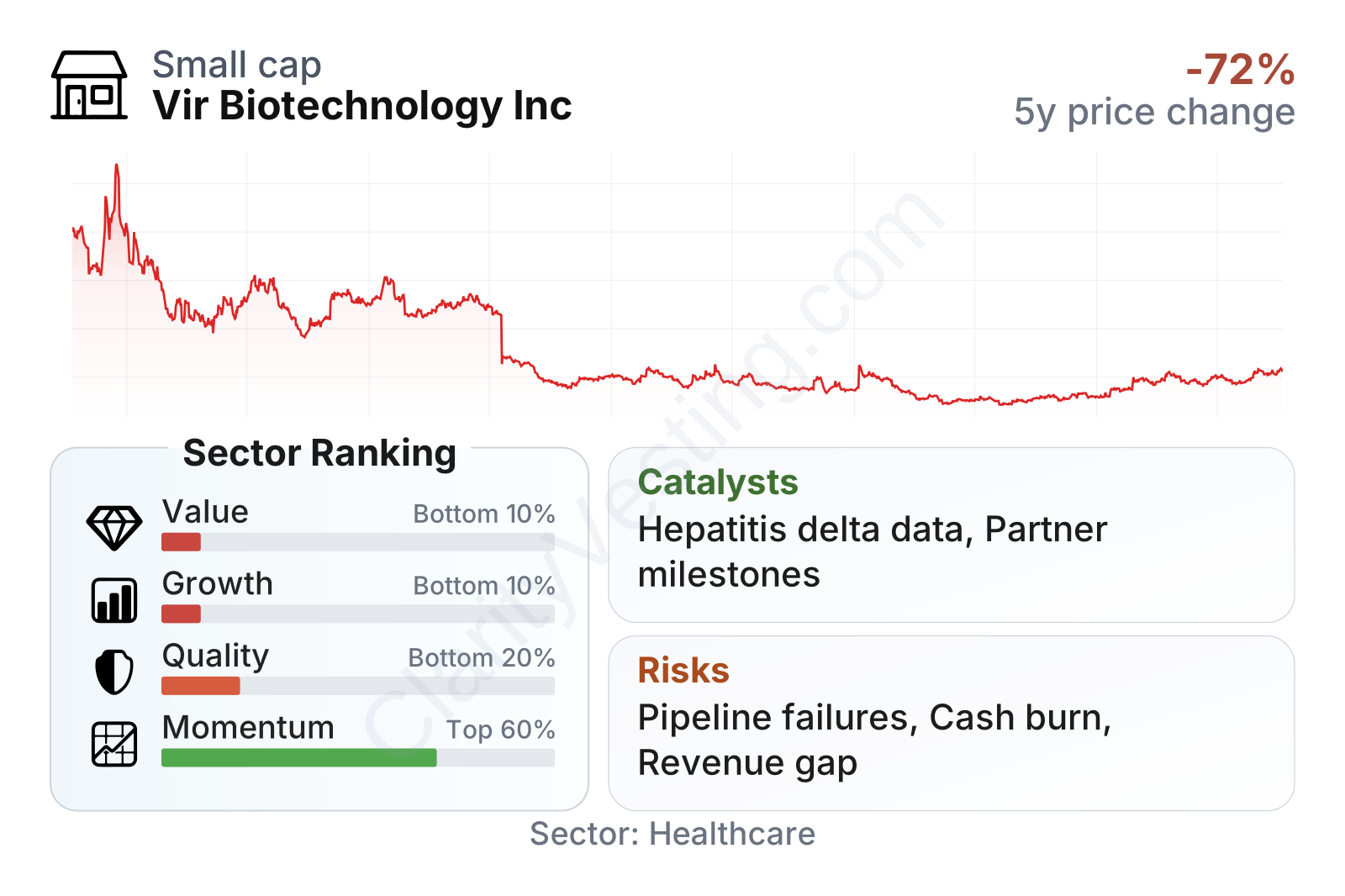
Vir is now a small-to-mid-sized biotech by market value, with above-average share price volatility. The factor profile is mixed but easy to interpret: momentum has improved, while value, growth quality, and profitability measures remain weak. The recent rebound in the stock contrasts with still-negative cash generation, negative returns on capital, and margins that remain far below sector norms.
The stock’s multiyear chart also reflects the company’s transition. Shares traded much higher during and shortly after the COVID period, then fell sharply as that revenue base disappeared. More recently, the price has recovered from depressed levels, suggesting the market is placing more weight on pipeline potential than on current earnings.
Growth
Vir operates in a sector with real structural growth potential. Infectious disease remains an important global health need, and areas such as hepatitis B, hepatitis delta, HIV, and oncology continue to attract major research funding. These are large unmet-need markets where successful therapies can become meaningful franchises. That gives Vir exposure to attractive long-term demand, even though it does not yet have a stable commercial engine.
The company’s strategy is logical for this stage of development. Vir has concentrated resources around programs where immune mechanisms and antiviral expertise may create differentiated products, while using partnerships to share risk and accelerate development. In biotechnology, this can be a sensible approach: smaller companies often gain more by pairing their science with larger partners than by trying to build everything alone.
Revenue growth has been extremely distorted by the post-pandemic reset. Recent year-over-year jumps look dramatic, but they come off a low base and do not indicate the return of a large recurring product business. For long-term analysis, clinical progress matters much more than short-term reported revenue swings.
A major catalyst is the hepatitis delta program, where Vir has highlighted tobevibart and elebsiran as a combination with potentially important clinical relevance. Hepatitis delta is a rare but serious liver disease with limited treatment options, so positive late-stage data or regulatory progress could be meaningful. The company has also continued to advance its hepatitis B and other pipeline assets, which keeps multiple shots on goal in place rather than relying on only one project.
Another favorable point is that larger pharmaceutical companies still show interest in partnering with innovative biotech firms working in complex viral disease and immunology. If Vir delivers convincing efficacy and safety results, partnerships, milestone payments, or expanded development plans could materially improve its outlook.
Cash flow remains a key constraint. Free cash flow has been deeply negative since the COVID revenue peak ended, which is common for research-stage biotech companies but still important. In practical terms, growth at Vir is driven by scientific milestones, not by self-funded operating expansion.
Recent company updates have continued to emphasize pipeline execution, program prioritization, and collaboration activity rather than near-term product sales. That is usually the right lens for understanding Vir over the next few years: the opportunity is tied to data readouts and regulatory traction, not to a conventional sales ramp already underway.
Risks
This article is for informational purposes only and does not constitute financial advice. Some content is AI-generated. See Disclaimer