Stock Analysis · VICI Properties Inc (VICI)
Overview
VICI Properties Inc is a real estate investment trust, or REIT, focused mainly on experiential real estate. In simple terms, it owns large destination properties and leases them to operators under long-term contracts. Its best-known assets are casino resorts on the Las Vegas Strip and in regional U.S. gaming markets, but the portfolio also includes entertainment, wellness, and hospitality-related properties.
The business model is straightforward: VICI buys properties, then collects rent from tenants that run the venues. Most leases are triple-net leases, which means tenants generally pay property taxes, insurance, and maintenance costs. That structure helps keep VICI’s operating costs low and makes its cash flow more predictable than many other types of real estate businesses.
Revenue is heavily concentrated in rental income from gaming properties, with a smaller contribution from financing and partnership-related income. Based on recent company disclosures, the mix is approximately:
- Lease income from gaming properties: about 90% to 95% — rent from casinos and integrated resorts, including major properties leased to operators such as Caesars Entertainment, MGM Resorts, and other regional gaming tenants.
- Lease and interest income from other experiential assets: about 3% to 7% — includes destinations tied to entertainment, hospitality, and wellness, as well as income from certain non-casino experiential investments.
- Golf-related and other income: about 1% to 3% — includes assets and arrangements connected to golf courses and other smaller property or financing streams.
What stands out is how efficiently the model converts revenue into profit. Rental revenue has climbed strongly over the last several years, while property-level costs remained very low relative to sales. Interest expense is meaningful, as expected for a capital-intensive REIT, but operating profitability remains unusually high for the broader real estate sector.
Key Figures
| Metric | Value | Sector ⓘ |
|---|---|---|
| Date | Oct 24, 2026 | |
| Context | ||
| Sector | Real Estate | |
| Industry | REIT - Diversified | |
| Market Cap ⓘ | $25.49B | |
| Beta ⓘ | 0.67 | |
Value (Cheapness) | ||
| P/E Ratio ⓘ | 9.08 | 17.85 |
| P/B Ratio ⓘ | 0.91 | 0.87 |
| FCF Yield ⓘ | 10.35% | 7.30% |
| Dividend Yield ⓘ | 7.70% | 4.83% |
| EBIT / EV ⓘ | 8.37% | 3.78% |
| PEG ⓘ | N/A | |
Growth (Business expansion) | ||
| Revenue Growth ⓘ | 5.70% | 5.35% |
| RPS Growth (5Y CAGR) ⓘ | 9.57% | 6.02% |
| EPS Growth (5Y CAGR) ⓘ | -1.26% | -10.65% |
| BVPS Growth (5Y CAGR) ⓘ | 5.26% | 0.43% |
| Margin Growth (5Y Trend) ⓘ | -2.49% | -0.69% |
| FCF Growth (5Y CAGR) ⓘ | 29.43% | 5.40% |
| DPS Growth (5Y CAGR) ⓘ | 7.32% | 5.07% |
Quality (Business durability) | ||
| ROIC (Latest) ⓘ | 8.10% | 5.69% |
| ROE (Latest) ⓘ | 9.88% | 7.37% |
| ROA (Latest) ⓘ | 5.83% | 2.85% |
| ROIC (5Y Median) ⓘ | 8.34% | 4.26% |
| ROE (5Y Median) ⓘ | 10.38% | 6.04% |
| ROA (5Y Median) ⓘ | 5.99% | 2.45% |
| Net Debt / EBIT (Latest) ⓘ | 4.81 | 7.55 |
| Net Debt / EBIT (5Y Median) ⓘ | 4.81 | 8.26 |
| Net Debt / EBITDA (Latest) ⓘ | 4.80 | 5.26 |
| Net Debt / Assets ⓘ | 36.37% | 37.45% |
| EBITDA / Interest ⓘ | 4.35 | 4.11 |
| Operating Margin (Latest) ⓘ | 89.12% | 33.86% |
| Operating Margin (5Y Median) ⓘ | 92.41% | 37.49% |
| Debt to Equity (Latest) ⓘ | 61.17% | 88.76% |
| Profit Margin (Latest) ⓘ | 67.50% | 18.94% |
| Free Cash Flow (Latest) ⓘ | $2.64B | |
Momentum (Price trend) | ||
| 3Y Return ⓘ | +5.21% | +36.33% |
| 12M Return (excl. last month) ⓘ | -18.35% | +4.32% |
| 6M Return ⓘ | -11.74% | -1.74% |
| Price vs. 200-Day MA ⓘ | -8.53% | -1.42% |
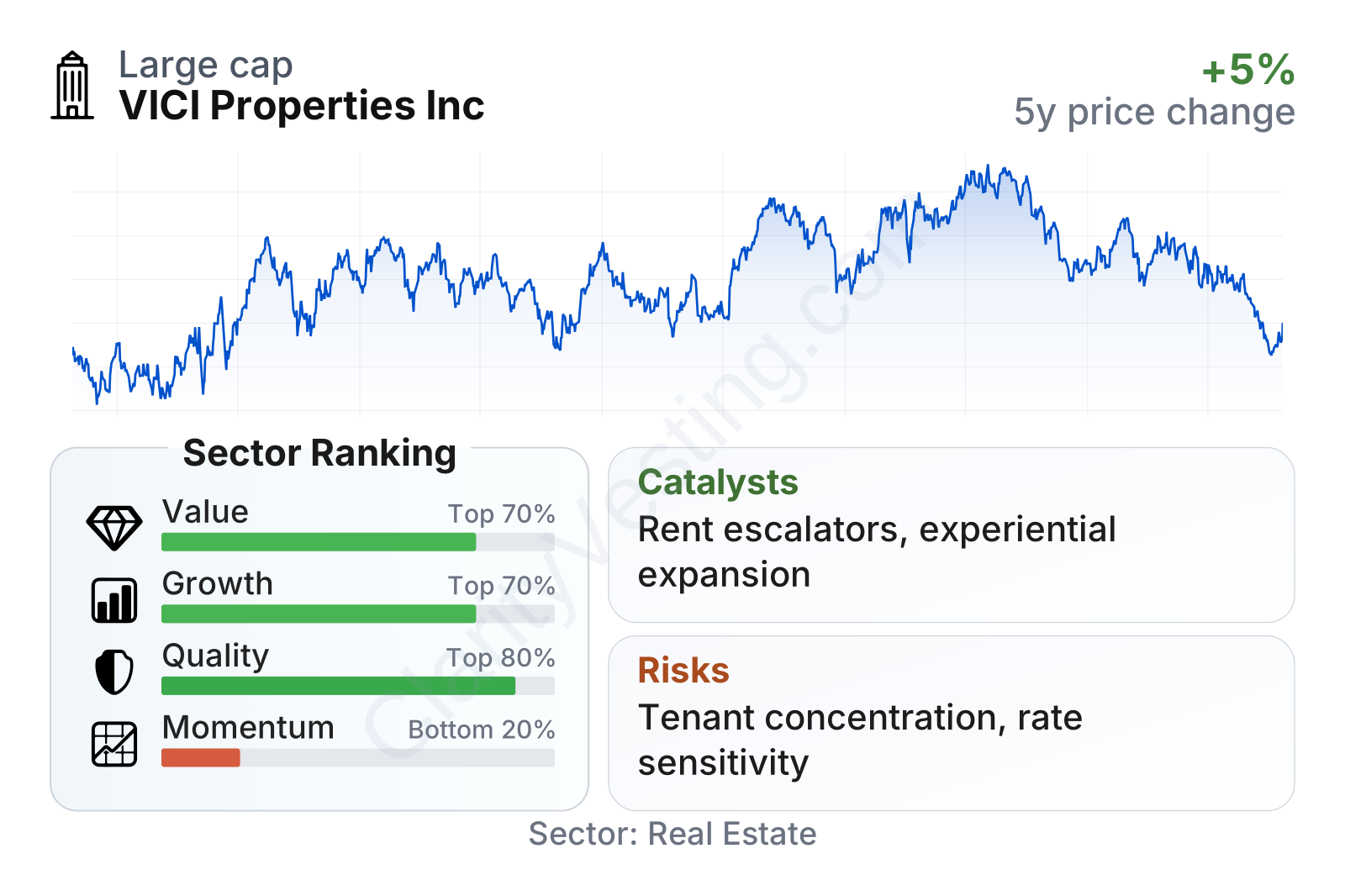
VICI is a large real estate company with a relatively low stock volatility profile, shown by a beta below 1. On valuation and income measures, it screens attractively versus much of the real estate sector: its earnings multiple is well below the sector median, its free cash flow yield is higher, and its dividend yield is notably above the sector median. Quality metrics are also strong, with returns on assets, equity, and invested capital all ahead of typical sector levels. The weak spot is market momentum, as the stock has lagged the broader real estate group over the last 6 months, 12 months, and 3 years.
Growth
VICI operates in a niche of real estate that still has room to expand. Experiential real estate has attracted capital because consumers continue to spend on travel, entertainment, gaming, and destination-based experiences even as other real estate categories face pressure from remote work or e-commerce. Casino properties in particular tend to be hard-to-replicate assets, often protected by licensing barriers, local regulation, and the enormous cost of building competing resorts.
The company’s strategy is built around long lease terms, built-in rent escalators, and selective acquisitions or financing deals with large operators. That approach makes sense for long-term growth because it combines defensive cash flow with opportunities to add properties without taking on direct operating risk. VICI does not need to run casinos well; it needs to own attractive properties and structure durable leases.
Revenue per share has trended steadily upward over the past five years, which is a useful sign for a REIT because it shows growth after accounting for the share count. The pace has moderated after the very large jump tied to major acquisitions, but the direction remains positive and ahead of the sector median over a five-year period.
Dividend growth has also been consistent, with per-share payouts increasing each year in the period shown. That matters because for a REIT, dividend expansion usually reflects confidence in recurring cash generation. VICI’s dividend yield is elevated partly because the share price has been soft, but the underlying distribution trend has still been upward.
Recent company updates have continued to support the long-term expansion case. Management has emphasized a pipeline beyond traditional casinos, including entertainment, sports-adjacent, wellness, and other experiential categories. This broader mandate could matter over time because it gives VICI more ways to deploy capital without depending entirely on a mature U.S. casino acquisition market. At the same time, major destination assets on the Las Vegas Strip remain an important embedded catalyst, since these properties benefit from convention activity, tourism, and premium event traffic that can support tenant health and future dealmaking.
Risks
This article is for informational purposes only and does not constitute financial advice. Some content is AI-generated. See Disclaimer


