Stock Analysis · Via Transportation Inc (VIA)
Overview
Via Transportation Inc develops software that helps cities, transit agencies, school systems, and private operators run transportation services more efficiently. Its platform is best known for demand-responsive transit, where routes and vehicle assignments are adjusted in real time based on rider requests. The company also provides software for paratransit, fixed-route planning, school buses, and digital tools that support booking, dispatching, and operations.
Via operates as a transportation technology company rather than a traditional automaker or pure ride-hailing platform. That distinction matters for long-term analysis: the business is built around recurring software and service relationships with public-sector and enterprise customers, while also keeping exposure to broader trends such as urban mobility, digitization of public transit, and more efficient fleet utilization.
Based on company reporting, revenue mainly comes from two broad activities:
- Software and technology platform revenue: the larger strategic profit driver, generated from licensing, platform access, and related services for transit agencies, municipalities, school transportation, and enterprise mobility customers. A precise percentage is not consistently broken out in the supplied financial summary, but recent company materials emphasize this segment as the core business model.
- Managed transportation and service-related revenue: revenue connected to operating or supporting transportation networks using Via’s technology. This can include implementation, operational support, and programs where the company is more directly involved in service delivery.
The financial profile suggests a business that has been rebuilding scale after a sharp revenue reset in 2023. Revenue recovered strongly in 2024 and 2025, while gross profit also improved, showing that customer demand remains real even though bottom-line profitability has not yet followed.
The operating picture shows an important shift over the last several years. Revenue fell sharply in 2023, then recovered in 2024 and 2025. Gross profit expanded alongside that rebound, but operating costs stayed high, especially research and development and selling expenses. In other words, the company has shown it can grow again, but it still has not converted that growth into sustained earnings.
Key Figures
| Metric | Value | Sector ⓘ |
|---|---|---|
| Date | Oct 10, 2026 | |
| Context | ||
| Sector | Technology | |
| Industry | Software - Application | |
| Market Cap ⓘ | $2.52B | |
| Beta ⓘ | N/A | |
Value (Cheapness) | ||
| P/E Ratio ⓘ | N/A | 30.74 |
| FCF Yield ⓘ | -1.92% | 4.05% |
| Dividend Yield ⓘ | N/A | 1.29% |
| EBIT / EV ⓘ | -4.49% | 2.81% |
| PEG ⓘ | N/A | |
Growth (Business expansion) | ||
| Revenue Growth ⓘ | 26.70% | 15.80% |
| RPS Growth (5Y CAGR) ⓘ | -54.84% | 8.56% |
| EPS Growth (5Y CAGR) ⓘ | N/A | -11.61% |
| Margin Growth (5Y Trend) ⓘ | N/A | 0.49% |
| FCF Growth (5Y CAGR) ⓘ | N/A | 9.80% |
| DPS Growth (5Y CAGR) ⓘ | -60.59% | 7.74% |
Quality (Business durability) | ||
| ROIC (Latest) ⓘ | -11.87% | 9.39% |
| ROIC (5Y Median) ⓘ | N/A | 8.35% |
| Net Debt / EBIT (Latest) ⓘ | N/A | 0.50 |
| Net Debt / EBIT (5Y Median) ⓘ | N/A | 0.51 |
| Net Debt / EBITDA (Latest) ⓘ | N/A | 0.28 |
| Net Debt / Assets ⓘ | -44.25% | 3.46% |
| EBITDA / Interest ⓘ | N/A | 13.31 |
| Operating Margin (Latest) ⓘ | -19.10% | 9.77% |
| Operating Margin (5Y Median) ⓘ | -19.91% | 8.53% |
| Debt to Equity (Latest) ⓘ | 2.92% | 34.80% |
| Profit Margin (Latest) ⓘ | -20.04% | 7.13% |
| Free Cash Flow (Latest) ⓘ | -$48.33M | |
Momentum (Price trend) | ||
| 3Y Return ⓘ | N/A | +54.57% |
| 12M Return (excl. last month) ⓘ | N/A | +16.76% |
| 6M Return ⓘ | +93.17% | +22.43% |
| Price vs. 200-Day MA ⓘ | +49.77% | +8.85% |
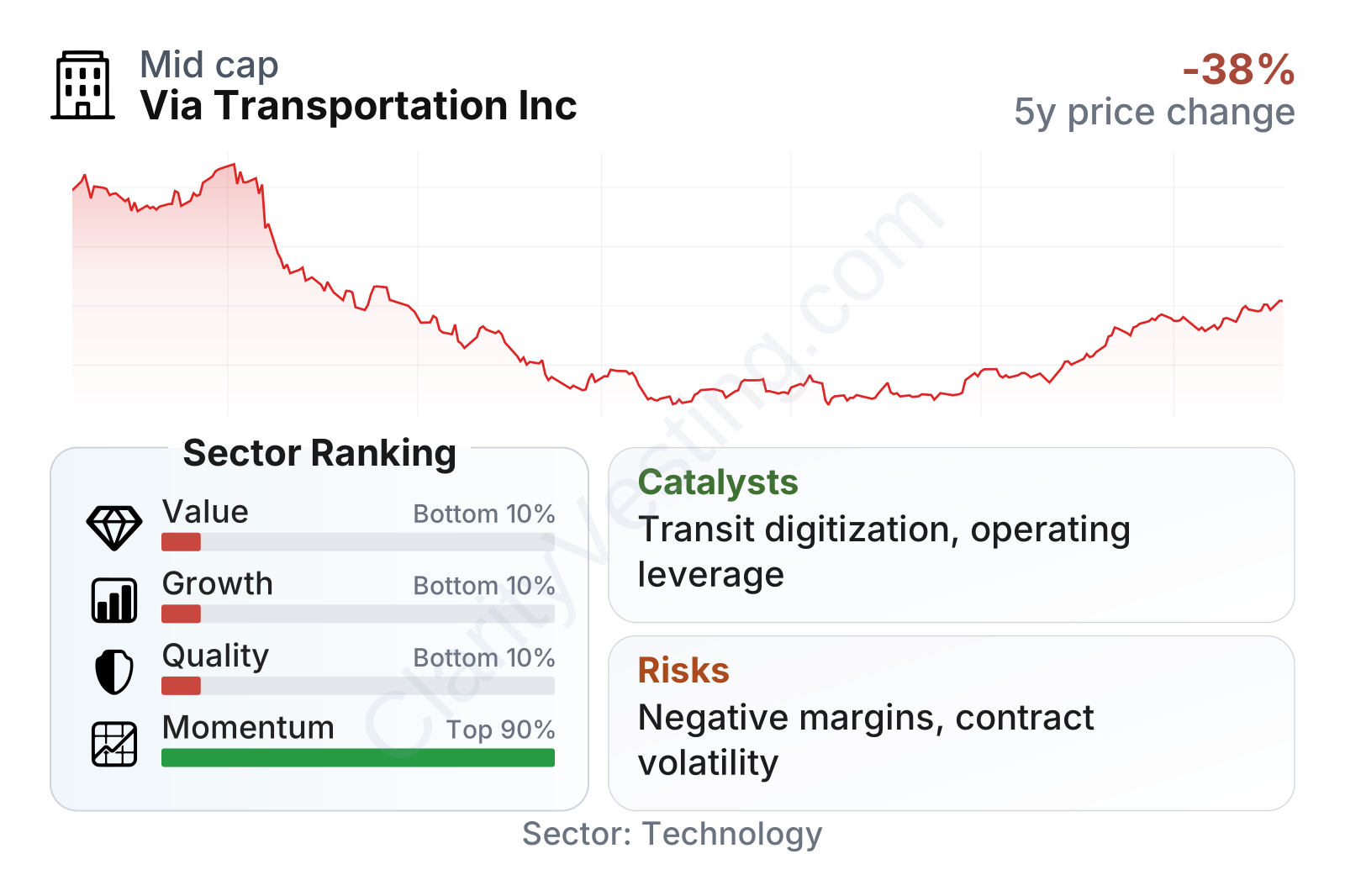
The market is treating Via like a company with renewed momentum rather than a mature software business. Recent revenue growth has been stronger than the sector median, and the stock’s short-term performance has been very strong after a steep decline earlier in the period shown. At the same time, the broader scorecard remains weak: value, quality, and longer-term growth metrics rank near the bottom of the sector because margins are negative, free cash flow is still below zero, and five-year per-share trends remain poor. This creates a split profile: strong recent improvement, but still a financially unfinished business.
Growth
Via operates in a sector with credible long-term tailwinds. Public transit agencies and school systems are under pressure to do more with limited budgets, driver shortages remain a challenge in many markets, and transportation planners increasingly want software that can optimize routes, improve service levels, and reduce underused capacity. These conditions support demand for platform-based mobility tools, especially for demand-responsive transit and specialized transportation.
The company’s strategy also makes sense in that context. Instead of trying to compete head-on with consumer ride-hailing apps for mass-market trips, Via focuses on governments, public agencies, and institutional transportation buyers. That can create longer sales cycles, but it also tends to produce stickier contracts and a clearer need for operational software. If the platform becomes embedded in local transit systems or school transportation programs, switching can become inconvenient and politically difficult, which may support retention.
A major recent positive sign is the rebound in annual revenue from about $249 million in 2023 to about $338 million in 2024 and roughly $434 million in 2025. That kind of recovery suggests that the underlying demand environment is intact and that Via has been able to win or expand programs after a difficult period. Gross profit has also increased over that span, indicating that growth is not coming only from low-quality volume.
Another potential catalyst is the company’s positioning around software-led transit modernization. Cities are experimenting with on-demand shuttles, microtransit, paratransit optimization, and integrated digital booking systems. Via is already established in these niches, which could matter if public agencies accelerate digital upgrades or if tighter budgets push operators toward route optimization software that lowers waste.
Because Via is not yet consistently profitable, the most meaningful growth catalyst is not simply more contracts. It is the possibility that scale finally begins to improve operating leverage. If revenue continues to expand while research, development, and administrative costs grow much more slowly, the business model could look materially different over time.
Risks
This article is for informational purposes only and does not constitute financial advice. Some content is AI-generated. See Disclaimer