Stock Analysis · Corporación Inmobiliaria Vesta S.A.B. de C.V (VESTF)
Overview
Corporación Inmobiliaria Vesta S.A.B. de C.V. is a Mexican real estate company focused on industrial properties. In simple terms, it develops, owns, leases, and manages buildings used for logistics, warehousing, e-commerce distribution, light manufacturing, and related industrial activity. Its portfolio is concentrated in Mexico’s main industrial corridors, with exposure to regions connected to exports, cross-border trade, and domestic distribution.
The business model is relatively straightforward: Vesta builds or acquires industrial buildings, rents them to corporate tenants under lease contracts, and generates recurring rental income. It can also earn value from development gains and property revaluation, but the core economic engine is leasing industrial real estate.
The company’s revenue mix is mainly centered on rental operations, with a smaller contribution from related services and other property income. Based on company reporting structure and operating model, the revenue base can be summarized approximately as follows:
- Rental revenue: about 90% to 95% — lease payments from industrial buildings, including logistics, distribution, and manufacturing facilities.
- Property management and other real-estate-related income: about 5% to 10% — reimbursements, services, and other operating income tied to the portfolio.
What stands out is the scalability of the model. Once buildings are leased, incremental revenue tends to carry attractive margins because ongoing operating costs are comparatively limited. Over the last several years, revenue has expanded steadily, while gross profit has remained very high relative to sales, which is typical of a well-run industrial landlord.
There is also a geographic and customer-quality angle that matters. Vesta serves multinational and regional companies that need strategically located industrial space in Mexico, making the business closely tied to nearshoring, manufacturing relocation, and supply-chain reconfiguration across North America.
The company’s financial flow shows a business with relatively low direct property operating costs compared with revenue, which supports strong gross profitability. Revenue and gross profit have both trended upward over time, while interest expense has remained meaningful but manageable for a property owner using debt to expand.
Key Figures
| Metric | Value | Sector ⓘ |
|---|---|---|
| Date | Oct 17, 2026 | |
| Context | ||
| Sector | Real Estate | |
| Industry | Real Estate - Diversified | |
| Market Cap ⓘ | $3.67B | |
| Beta ⓘ | 0.26 | |
Value (Cheapness) | ||
| P/E Ratio ⓘ | 8.59 | 17.38 |
| P/B Ratio ⓘ | 1.17 | 0.85 |
| FCF Yield ⓘ | 4.49% | 7.38% |
| Dividend Yield ⓘ | 2.15% | 4.85% |
| EBIT / EV ⓘ | 9.27% | 3.78% |
| PEG ⓘ | N/A | |
Growth (Business expansion) | ||
| Revenue Growth ⓘ | 16.80% | 5.30% |
| RPS Growth (5Y CAGR) ⓘ | 129.77% | 6.02% |
| EPS Growth (5Y CAGR) ⓘ | -10.94% | -11.37% |
| BVPS Growth (5Y CAGR) ⓘ | 128.68% | 0.45% |
| Margin Growth (5Y Trend) ⓘ | -90.45% | -0.22% |
| FCF Growth (5Y CAGR) ⓘ | 12.44% | 5.40% |
| DPS Growth (5Y CAGR) ⓘ | 105.70% | 5.02% |
Quality (Business durability) | ||
| ROIC (Latest) ⓘ | N/A | 5.69% |
| ROE (Latest) ⓘ | 14.17% | 7.56% |
| ROA (Latest) ⓘ | 8.59% | 2.85% |
| ROIC (5Y Median) ⓘ | 9.60% | 4.22% |
| ROE (5Y Median) ⓘ | 13.58% | 6.03% |
| ROA (5Y Median) ⓘ | 6.94% | 2.44% |
| Net Debt / EBIT (Latest) ⓘ | 1.88 | 7.59 |
| Net Debt / EBIT (5Y Median) ⓘ | 1.57 | 8.40 |
| Net Debt / EBITDA (Latest) ⓘ | 1.87 | 5.27 |
| Net Debt / Assets ⓘ | 15.99% | 37.76% |
| EBITDA / Interest ⓘ | 5.91 | 4.10 |
| Operating Margin (Latest) ⓘ | 124.77% | 35.29% |
| Operating Margin (5Y Median) ⓘ | 190.00% | 37.31% |
| Debt to Equity (Latest) ⓘ | 37.43% | 88.87% |
| Profit Margin (Latest) ⓘ | 132.16% | 19.61% |
| Free Cash Flow (Latest) ⓘ | $164.62M | |
Momentum (Price trend) | ||
| 3Y Return ⓘ | +20.87% | +30.75% |
| 12M Return (excl. last month) ⓘ | +113.20% | +4.36% |
| 6M Return ⓘ | +30.69% | -2.52% |
| Price vs. 200-Day MA ⓘ | +24.05% | -2.34% |
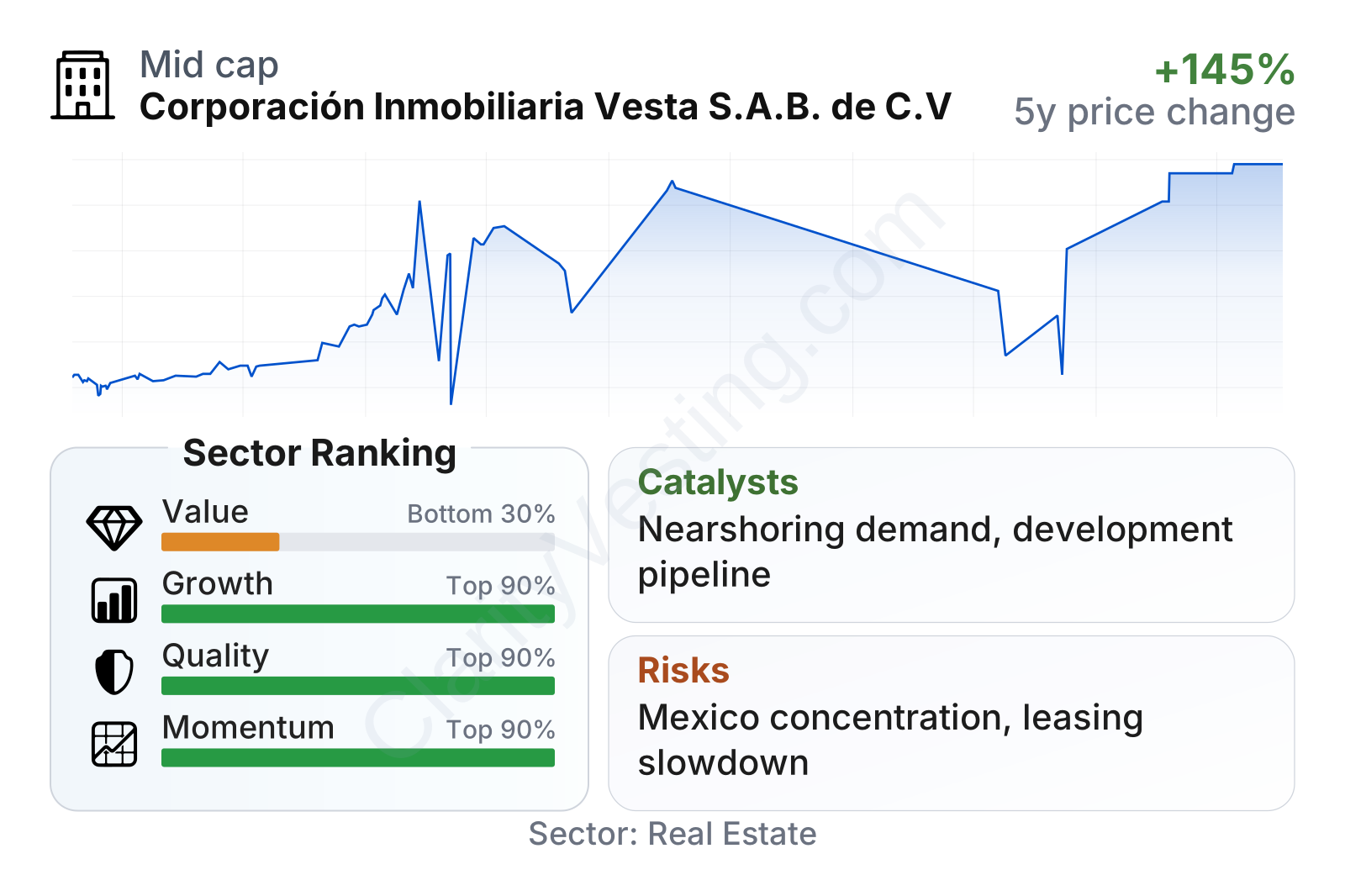
Vesta is a mid-sized real estate company with unusually strong quality and growth characteristics relative to much of its sector. The metrics point to a business that combines high returns on assets and equity with modest leverage for a property company. Growth indicators are especially strong versus sector norms, although some margin trends have become less favorable after earlier exceptional levels. On valuation, the picture is mixed: earnings-based multiples look low, but book-based valuation is less obviously discounted.
Growth
Vesta operates in one of the more attractive corners of real estate: industrial property in Mexico. This segment has been supported by long-term themes such as nearshoring, supply-chain diversification, growth in e-commerce logistics, and manufacturing investment linked to North American trade. Those drivers matter because they create demand not just for land, but for modern, well-located industrial buildings that can be delivered quickly and leased to high-quality tenants.
The company’s strategy fits that backdrop well. Vesta has focused on development and expansion in major industrial hubs rather than spreading itself across unrelated property types. That specialization can be a meaningful advantage because industrial real estate requires local market knowledge, tenant relationships, and disciplined site selection. For a long-term business analysis, this focus makes more sense than a broad but less differentiated property portfolio.
Revenue per share has trended upward over the period, showing that growth has not come only from issuing more capital or adding assets for size alone. The pace of expansion appears much stronger than the sector median, which supports the view that Vesta has been capturing demand in a favorable market rather than simply moving in line with the broader real estate cycle.
Another relevant point is cash distribution capacity. Real estate companies are often judged not only by asset growth, but also by their ability to convert operating performance into cash returns over time.
Dividend per share has shown uneven year-to-year movement, which is common in real estate, but the longer-term direction has improved significantly. The trailing dividend yield is not especially high compared with many real estate peers, suggesting the market may currently be valuing Vesta more for growth and asset quality than for income alone.
Recent corporate communications have continued to emphasize development activity, portfolio expansion, and execution tied to industrial demand in Mexico. That matters because one of the clearest catalysts for the company is the possibility that nearshoring demand remains structurally durable rather than temporary. If multinational tenants continue adding manufacturing and logistics capacity in Mexico, Vesta’s development pipeline and existing footprint are positioned to benefit.
Risks
This article is for informational purposes only and does not constitute financial advice. Some content is AI-generated. See Disclaimer


