Stock Analysis · Vera Therapeutics Inc (VERA)
Overview
Vera Therapeutics is a clinical-stage biotechnology company focused on immune-mediated kidney diseases. Its lead program is atacicept, a fusion protein designed to block two immune signaling molecules, BLyS and APRIL, which are involved in abnormal antibody production. The company’s main target is IgA nephropathy, a chronic kidney disease that can progress to kidney failure, and it is also studying atacicept in other autoimmune kidney conditions such as primary membranous nephropathy and lupus nephritis.
This is still a development-stage business, so its economics look very different from a commercial pharmaceutical company. Vera does not yet have recurring product sales. In recent filings, revenue has been minimal or absent and has not been driven by marketed medicines.
The company’s revenue mix is therefore very simple at this stage:
- Product revenue: 0% in the most recent full-year period, because Vera does not yet have an approved commercial product.
- Collaboration, license, or other operating revenue: not a meaningful recurring source based on recent annual results; small amounts have appeared in some prior periods but have not formed a stable revenue base.
- Interest and other non-operating income: not revenue in the strict operating sense, but an important support item while cash is held on the balance sheet.
The important point for long-term readers is that Vera’s current value rests mainly on the future commercial potential of atacicept rather than on present-day sales. Operating spending has been concentrated in research and development, which is typical for a biotech company approaching late-stage clinical milestones. Over the last several years, research spending has expanded sharply, showing that the business is moving deeper into expensive clinical development rather than scaling an existing product franchise.
The operating profile reflects a company investing heavily before launch. Research and development has become the dominant expense line, while revenue has remained negligible. That pattern is common in clinical-stage biotech: today’s losses are tied less to weak demand and more to the cost of proving whether the lead drug can become a viable medicine.
Key Figures
| Metric | Value | Sector ⓘ |
|---|---|---|
| Date | Oct 17, 2026 | |
| Context | ||
| Sector | Healthcare | |
| Industry | Biotechnology | |
| Market Cap ⓘ | $1.93B | |
| Beta ⓘ | 1.05 | |
Value (Cheapness) | ||
| P/E Ratio ⓘ | N/A | 24.79 |
| P/B Ratio ⓘ | 5.03 | 3.08 |
| FCF Yield ⓘ | -17.60% | 3.15% |
| Dividend Yield ⓘ | N/A | 1.94% |
| EBIT / EV ⓘ | -20.13% | 0.57% |
| PEG ⓘ | N/A | |
Growth (Business expansion) | ||
| Revenue Growth ⓘ | N/A | 7.45% |
| RPS Growth (5Y CAGR) ⓘ | N/A | 8.61% |
| EPS Growth (5Y CAGR) ⓘ | -1.13% | -17.81% |
| BVPS Growth (5Y CAGR) ⓘ | 16.10% | 3.72% |
| Margin Growth (5Y Trend) ⓘ | N/A | -0.62% |
| FCF Growth (5Y CAGR) ⓘ | N/A | 1.04% |
| DPS Growth (5Y CAGR) ⓘ | N/A | 6.77% |
Quality (Business durability) | ||
| ROIC (Latest) ⓘ | -55.66% | 3.24% |
| ROA (Latest) ⓘ | -76.52% | 3.01% |
| ROIC (5Y Median) ⓘ | -45.82% | 4.60% |
| ROA (5Y Median) ⓘ | -47.16% | 1.89% |
| Net Debt / EBIT (Latest) ⓘ | N/A | 1.34 |
| Net Debt / EBIT (5Y Median) ⓘ | N/A | 1.84 |
| Net Debt / EBITDA (Latest) ⓘ | N/A | 1.00 |
| Net Debt / Assets ⓘ | 4.94% | 5.45% |
| EBITDA / Interest ⓘ | N/A | 9.64 |
| Operating Margin (Latest) ⓘ | N/A | 9.27% |
| Operating Margin (5Y Median) ⓘ | N/A | 7.38% |
| Debt to Equity (Latest) ⓘ | 18.45% | 28.58% |
| Profit Margin (Latest) ⓘ | N/A | 3.59% |
| Free Cash Flow (Latest) ⓘ | -$339.06M | |
Momentum (Price trend) | ||
| 3Y Return ⓘ | +176.31% | +42.80% |
| 12M Return (excl. last month) ⓘ | +38.90% | +18.50% |
| 6M Return ⓘ | -34.25% | +7.57% |
| Price vs. 200-Day MA ⓘ | -24.80% | +5.12% |
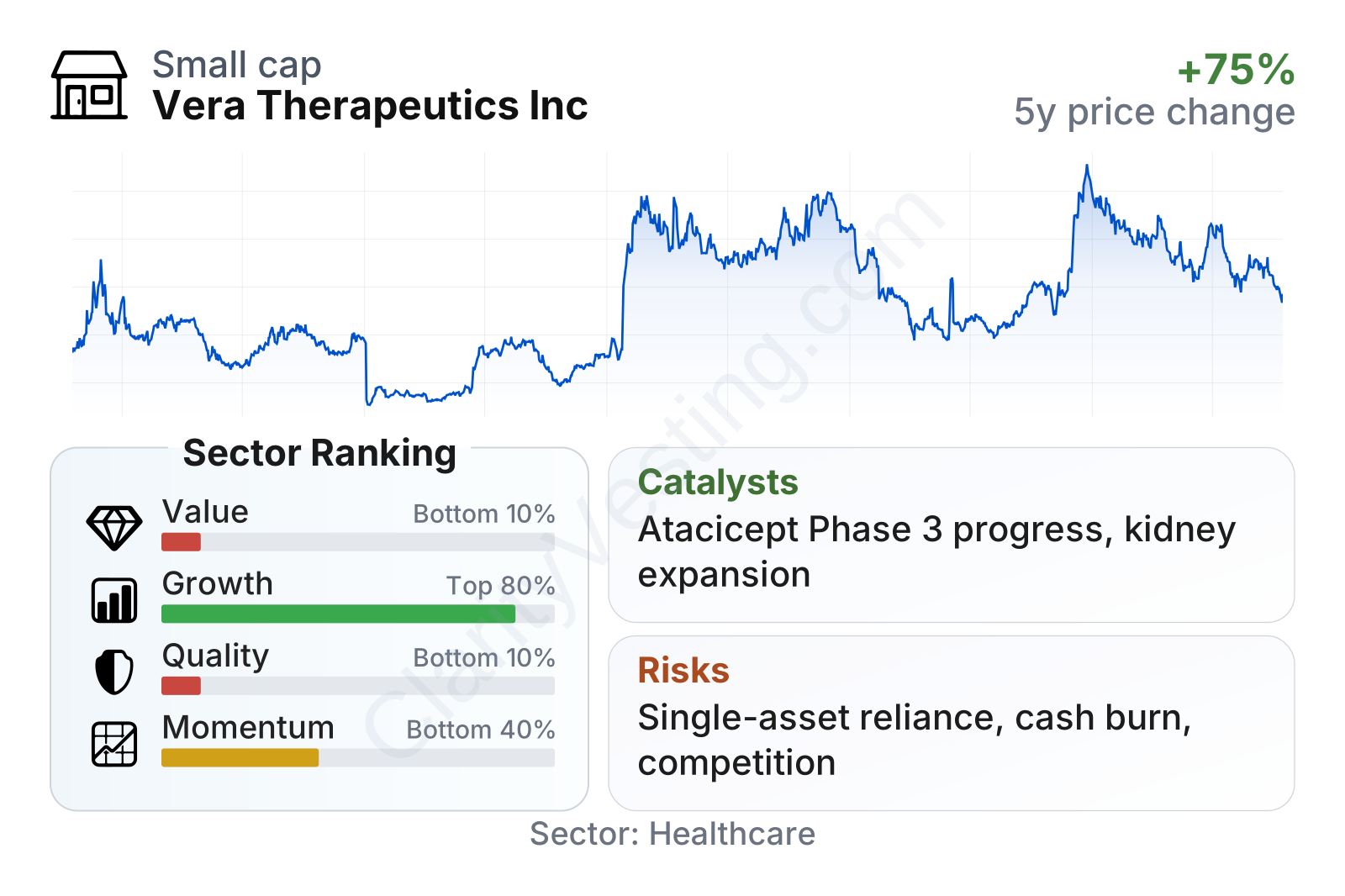
Vera is a mid-sized biotech by market value, but financially it still behaves like an early commercial-stage candidate rather than an established drug company. The stock has delivered a strong multi-year return overall, yet it has also been highly volatile, with large swings tied to clinical expectations. On relative metrics, valuation looks expensive versus the broader healthcare sector because the company has no earnings, no meaningful free cash flow, and no product revenue to anchor traditional multiples. Quality measures also screen weak, but that mostly reflects the current business stage: returns on capital and assets are deeply negative because the company is spending heavily before generating sales. Growth factors look better than quality or value because book value has expanded and the company has attracted capital to fund development, though revenue growth remains uninformative until a product reaches market.
Growth
Vera operates in a part of healthcare with genuine long-term demand drivers. Kidney diseases with autoimmune causes remain areas of high unmet need, and physicians have limited options that directly address the immune mechanisms behind these conditions. IgA nephropathy in particular has become a more active development market, with regulators, doctors, and drugmakers paying closer attention as new therapies emerge. That means Vera is participating in a growing therapeutic category, not a stagnant niche.
The company’s strategy is coherent. Instead of spreading resources across many unrelated programs, Vera has centered the business on atacicept and on indications where the same biological mechanism may apply. That focus can be efficient if clinical results remain supportive, because success in one kidney disease may strengthen the scientific case in others. The most important growth catalyst is therefore straightforward: positive late-stage development progress for atacicept, especially in IgA nephropathy, could move the company from a research narrative toward a commercial one.
Recent company updates have reinforced that atacicept remains the core value driver. Public disclosures in 2026 have continued to emphasize advancement of the pivotal program in IgA nephropathy and broader development work in related kidney diseases. For a company with no approved products, that kind of progress matters more than near-term sales figures. The entire growth case depends on whether the drug can produce durable efficacy, acceptable safety, and a regulatory path that supports launch.
The cash flow trend shows the other side of that opportunity. Free cash flow has become increasingly negative, with outflows accelerating as trials advance. That is not unusual for a biotech entering more expensive stages of development, but it does mean growth is being financed by cash reserves and capital markets rather than by operations. If the clinical program succeeds, this spending can be viewed as building a future franchise; if not, the same spending becomes difficult to recover.
Risks
This article is for informational purposes only and does not constitute financial advice. Some content is AI-generated. See Disclaimer


