Stock Analysis · Veracyte Inc (VCYT)
Overview
Veracyte is a diagnostics company focused on helping doctors make earlier and more confident decisions in cancer care and certain lung diseases. Its main business is genomic testing: it analyzes tissue or cell samples to estimate whether a nodule or tumor is likely to be benign or aggressive, and whether specific treatments may work. The goal is to reduce unnecessary surgeries, guide treatment selection, and support more personalized care.
The company operates across several clinical areas, with thyroid testing historically serving as an important foundation, while lung, breast, prostate, and bladder cancer testing have become larger contributors over time. Veracyte also sells testing platforms and related products to laboratories and biopharma customers, which adds another revenue stream beyond patient testing.
Based on recent company reporting, Veracyte’s revenue is primarily split between testing services and product sales. Approximate revenue sources are:
- Testing revenue: about 75% to 80% of total revenue. This includes genomic tests such as Afirma for thyroid nodules, Decipher for prostate cancer, Percepta for lung cancer evaluation, and other oncology-related assays.
- Product revenue: about 20% to 25% of total revenue. This includes instruments, reagents, and other genomic platforms and tools sold to laboratories and biopharma customers, including spatial genomics-related products.
That mix matters because testing revenue tends to be recurring and clinically embedded, while product revenue can broaden the company’s reach and create cross-selling opportunities in research and drug development.
Over the last several years, the business has become meaningfully larger and more profitable. Revenue has climbed from roughly $220 million in 2021 to more than $500 million in 2025, while the company moved from losses to positive operating income and net income. Gross profit has also expanded steadily, showing that scale is improving the economics of the model.
The business mix has been improving in a favorable way: revenue and gross profit have risen consistently, while operating costs have grown more slowly than sales in the most recent year. A notable shift is that selling and administrative spending became much more efficient in 2025 after a heavier cost phase in 2023 and 2024, helping profits turn meaningfully positive.
Key Figures
| Metric | Value | Sector ⓘ |
|---|---|---|
| Date | Oct 17, 2026 | |
| Context | ||
| Sector | Healthcare | |
| Industry | Diagnostics & Research | |
| Market Cap ⓘ | $3.50B | |
| Beta ⓘ | 1.95 | |
Value (Cheapness) | ||
| P/E Ratio ⓘ | 31.08 | 24.79 |
| P/B Ratio ⓘ | 2.63 | 3.08 |
| FCF Yield ⓘ | 4.73% | 3.15% |
| Dividend Yield ⓘ | N/A | 1.94% |
| EBIT / EV ⓘ | 3.54% | 0.57% |
| PEG ⓘ | N/A | |
Growth (Business expansion) | ||
| Revenue Growth ⓘ | 15.50% | 7.45% |
| RPS Growth (5Y CAGR) ⓘ | 18.70% | 8.61% |
| EPS Growth (5Y CAGR) ⓘ | N/A | -17.81% |
| BVPS Growth (5Y CAGR) ⓘ | 0.16% | 3.72% |
| Margin Growth (5Y Trend) ⓘ | N/A | -0.62% |
| FCF Growth (5Y CAGR) ⓘ | N/A | 1.04% |
| DPS Growth (5Y CAGR) ⓘ | N/A | 6.77% |
Quality (Business durability) | ||
| ROIC (Latest) ⓘ | 8.64% | 3.24% |
| ROA (Latest) ⓘ | 8.02% | 3.01% |
| ROIC (5Y Median) ⓘ | -5.25% | 4.60% |
| ROA (5Y Median) ⓘ | -3.12% | 1.89% |
| Net Debt / EBIT (Latest) ⓘ | -2.38 | 1.34 |
| Net Debt / EBIT (5Y Median) ⓘ | N/A | 1.84 |
| Net Debt / EBITDA (Latest) ⓘ | -2.00 | 1.00 |
| Net Debt / Assets ⓘ | -17.45% | 5.45% |
| EBITDA / Interest ⓘ | N/A | 9.64 |
| Operating Margin (Latest) ⓘ | 19.39% | 9.27% |
| Operating Margin (5Y Median) ⓘ | -12.22% | 7.38% |
| Debt to Equity (Latest) ⓘ | 2.89% | 28.58% |
| Profit Margin (Latest) ⓘ | 20.37% | 3.59% |
| Free Cash Flow (Latest) ⓘ | $165.46M | |
Momentum (Price trend) | ||
| 3Y Return ⓘ | +108.60% | +42.80% |
| 12M Return (excl. last month) ⓘ | +25.95% | +18.50% |
| 6M Return ⓘ | +30.41% | +7.57% |
| Price vs. 200-Day MA ⓘ | +4.24% | +5.12% |
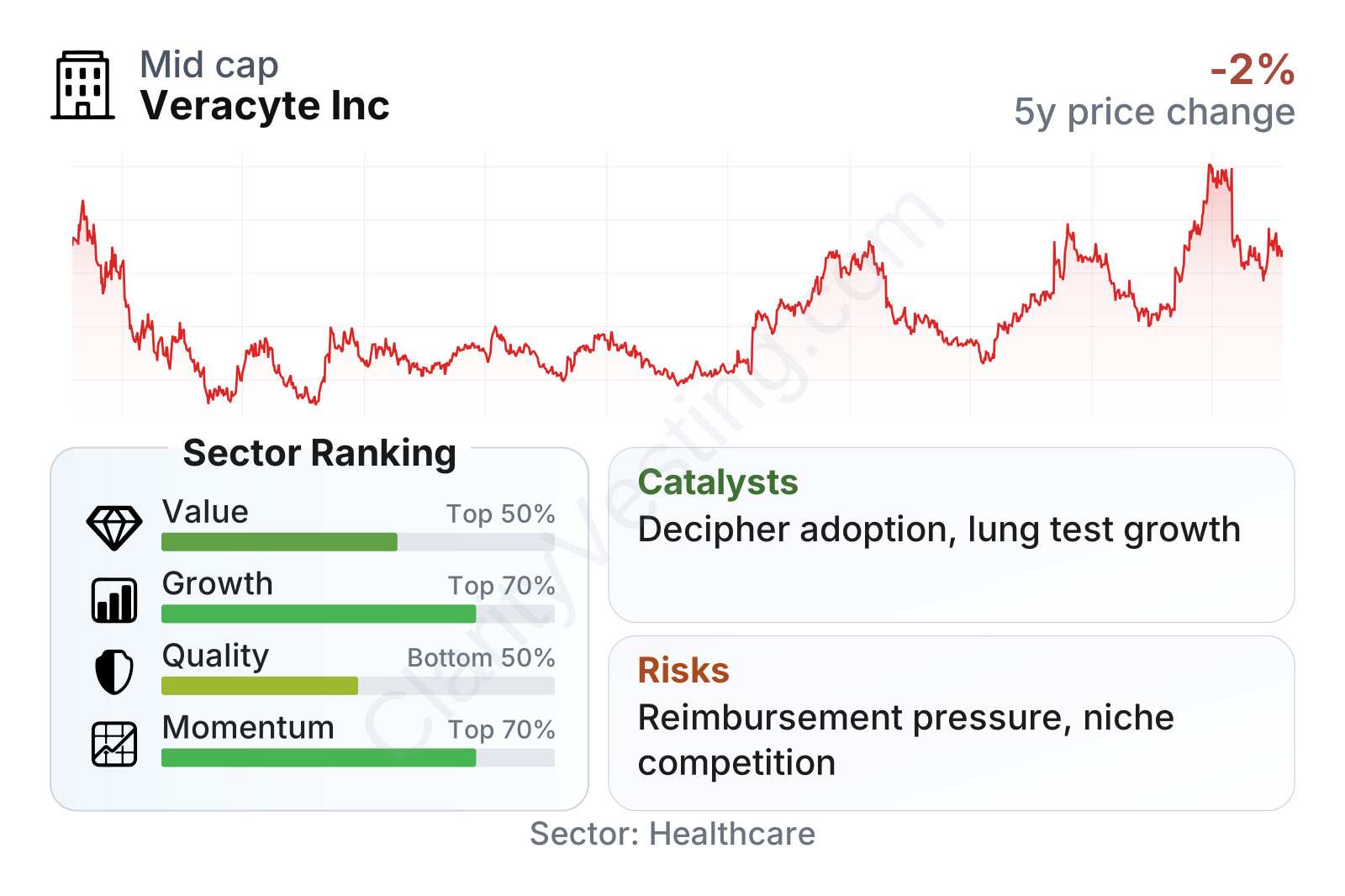
Veracyte sits in the mid-cap range within healthcare and has shown strong share-price momentum, but also above-average volatility, with a beta close to 2. On fundamentals, the picture is mixed but improving: growth is above the sector median, profitability and cash generation are currently strong, and leverage is very low. The weaker area is long-term consistency, since much of this quality improvement is relatively recent rather than established over a full five-year cycle.
The stock history also reflects that transition. Shares went through a sharp decline in 2022, a long rebuilding phase, and then a strong recovery into 2026. That pattern is typical of a company that moved from a growth-only narrative toward a more balanced profile that now includes earnings and cash flow.
Growth
Veracyte operates in a part of healthcare with attractive long-term drivers. Cancer diagnosis is moving toward more precise molecular tools, and doctors increasingly want evidence that can reduce unnecessary procedures and improve treatment decisions. That creates room for specialized diagnostics companies that can build strong clinical data, win guideline support, and secure reimbursement.
Veracyte’s strategy broadly fits that trend. It has assembled a portfolio of branded tests across several cancer types rather than relying on a single assay. That matters because it spreads risk across multiple disease areas and gives the company more ways to deepen relationships with physicians, health systems, and laboratories. The acquisition of Decipher expanded its reach in prostate cancer, while its legacy Afirma franchise remains a well-known product in thyroid care.
Growth has remained solid even after the company’s earlier post-acquisition surge normalized. Recent year-over-year revenue growth has generally stayed in the mid-teens to low-twenties percentage range, clearly above the broader sector median. That is a good sign for a diagnostics company of this size, especially now that growth is being paired with profitability rather than funded only by rising expenses.
Cash generation is another important improvement. Free cash flow has moved from negative territory a few years ago to well above $150 million on a trailing basis. This suggests the business is no longer dependent on external funding for day-to-day expansion and has more flexibility to invest in commercial execution, product development, and selective acquisitions.
Several catalysts could support future expansion. First, increased adoption of Decipher in prostate cancer remains important because treatment decisions in that market are complex and large in volume. Second, broader use of lung-related tests such as Percepta could benefit from ongoing efforts to improve early cancer assessment. Third, the company’s product and biopharma tools business provides an additional path to growth tied to research activity and precision medicine development rather than only clinical testing volumes.
Recent company updates have also pointed to continuing test volume growth and expanding profitability, which is significant because it suggests demand is not being bought at the expense of margins. For long-term analysis, that is often more meaningful than rapid top-line growth alone.
Risks
This article is for informational purposes only and does not constitute financial advice. Some content is AI-generated. See Disclaimer


