Stock Analysis · Vinci SA (VCISY)
Overview
Vinci is a large French infrastructure and concessions group with activities that are easy to understand in everyday life: it builds and maintains roads, rail and public facilities, operates airports, and runs motorway networks under long-term concessions. In practice, Vinci sits at the intersection of construction, transportation infrastructure, and essential services. That mix matters because it gives the company exposure to both project-based activity, which can be cyclical, and recurring cash generation from assets that people use every day.
The group is organized around three main businesses. Based on the latest full-year company reporting, revenue is primarily generated by contracting activities, while concessions contribute a smaller share of sales but an outsized share of profit and cash flow.
- VINCI Energies: approximately 27% of revenue. This division provides energy infrastructure, industrial services, digital solutions, and building systems, including electrical engineering, telecom networks, and efficiency-related services.
- Cobra IS: approximately 21% of revenue. This business focuses on engineering, procurement, and construction, especially in energy infrastructure, transmission lines, renewable projects, and complex industrial works.
- VINCI Construction: approximately 20% of revenue. It covers building construction, civil engineering, transport infrastructure, hydraulic works, and related activities.
- VINCI Autoroutes: approximately 10% of revenue. This segment operates toll motorways in France under concession agreements and tends to be one of the group’s strongest profit contributors.
- VINCI Airports: approximately 6% of revenue. It operates airports in Europe, the Americas, and Asia, earning income from passenger traffic, airport services, and commercial activities.
- Other activities and eliminations: the remainder comes from smaller operations and intra-group adjustments.
This revenue mix understates the strategic importance of concessions. Airports and motorways typically produce higher margins than construction activities, so they carry more weight in earnings and cash generation than in sales alone. Over the last several years, the company has also become more diversified internationally and more exposed to energy infrastructure, especially through Cobra IS.
The business flow shows a group that has expanded meaningfully since 2021, with revenue rising from roughly €50 billion to the mid-€70 billion range by 2025, while operating income and net income also moved higher. That pattern supports the idea that Vinci has not just grown in size, but has also preserved solid profitability as it scaled.
Key Figures
| Metric | Value | Sector ⓘ |
|---|---|---|
| Date | Oct 10, 2026 | |
| Context | ||
| Sector | Industrials | |
| Industry | Engineering & Construction | |
| Market Cap ⓘ | $66.81B | |
| Beta ⓘ | 0.74 | |
Value (Cheapness) | ||
| P/E Ratio ⓘ | 11.68 | 22.32 |
| P/B Ratio ⓘ | 2.52 | 1.98 |
| FCF Yield ⓘ | 24.06% | 6.34% |
| Dividend Yield ⓘ | 4.76% | 1.95% |
| EBIT / EV ⓘ | N/A | 4.71% |
| PEG ⓘ | 2.13 | |
Growth (Business expansion) | ||
| Revenue Growth ⓘ | 2.30% | 9.25% |
| RPS Growth (5Y CAGR) ⓘ | 11.23% | 7.75% |
| EPS Growth (5Y CAGR) ⓘ | -11.21% | -13.37% |
| BVPS Growth (5Y CAGR) ⓘ | 4.80% | 6.12% |
| Margin Growth (5Y Trend) ⓘ | 3.61% | 0.81% |
| FCF Growth (5Y CAGR) ⓘ | 8.68% | 11.01% |
| DPS Growth (5Y CAGR) ⓘ | 14.20% | 9.48% |
Quality (Business durability) | ||
| ROIC (Latest) ⓘ | -13.32% | 10.70% |
| ROA (Latest) ⓘ | 7.43% | 5.38% |
| ROIC (5Y Median) ⓘ | 9.27% | 9.26% |
| ROA (5Y Median) ⓘ | 3.92% | 4.94% |
| Net Debt / EBIT (Latest) ⓘ | N/A | 2.08 |
| Net Debt / EBIT (5Y Median) ⓘ | 2.71 | 2.29 |
| Net Debt / EBITDA (Latest) ⓘ | N/A | 1.43 |
| Net Debt / Assets ⓘ | 19.54% | 19.34% |
| EBITDA / Interest ⓘ | N/A | 9.54 |
| Operating Margin (Latest) ⓘ | -7.86% | 10.34% |
| Operating Margin (5Y Median) ⓘ | 11.50% | 10.29% |
| Debt to Equity (Latest) ⓘ | 135.17% | 65.52% |
| Profit Margin (Latest) ⓘ | 6.71% | 6.63% |
| Free Cash Flow (Latest) ⓘ | $16.07B | |
Momentum (Price trend) | ||
| 3Y Return ⓘ | +25.98% | +61.33% |
| 12M Return (excl. last month) ⓘ | +1.11% | +14.82% |
| 6M Return ⓘ | -18.64% | +3.53% |
| Price vs. 200-Day MA ⓘ | -14.90% | +0.88% |
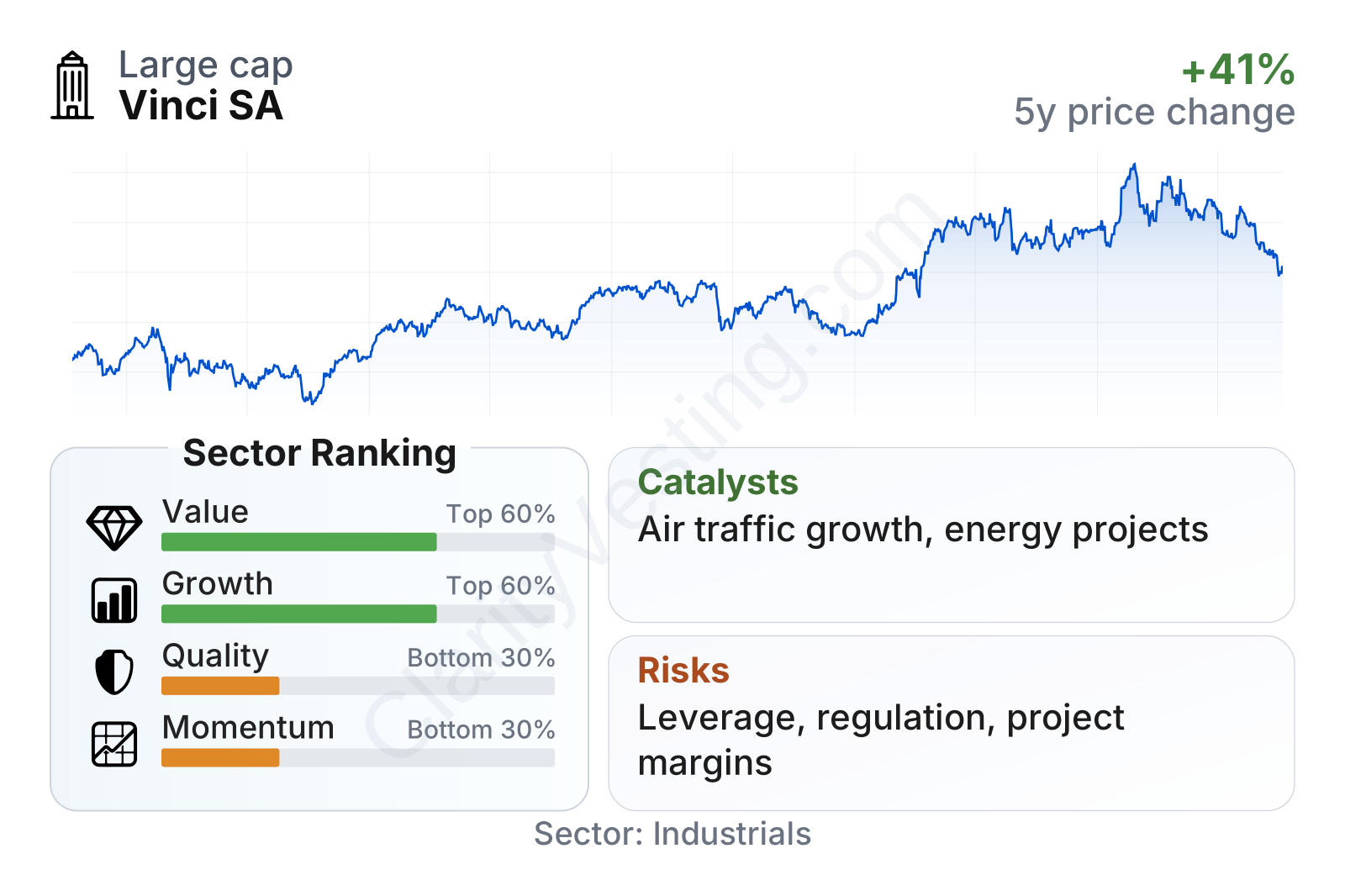
Vinci stands out as a very large infrastructure operator with a relatively low share-price volatility profile, as reflected by a beta below 1. On valuation metrics, the stock trades at an earnings multiple well below the sector median, while its free cash flow yield and dividend yield are notably stronger than typical peers. The weaker points in the table are quality and momentum: leverage is higher than the sector norm, and the stock’s recent performance has lagged much of the industrials universe even though longer-term business growth has remained respectable.
Growth
Vinci operates in sectors with durable long-term demand rather than explosive short-term expansion. Infrastructure maintenance, power networks, mobility assets, airport operations, and energy transition projects all benefit from structural needs that tend to last for decades. Governments still need roads, airports need upgrading, grids need reinforcement, and renewable power requires new transmission and related engineering work. This does not make Vinci a high-growth technology company, but it does place the group in markets where spending is likely to remain significant.
The company’s strategy is coherent for that environment. Its concessions business generates recurring cash, while the contracting businesses create exposure to broader investment cycles in electrification, industrial modernization, and transport infrastructure. Cobra IS is particularly important because it expands Vinci’s role in high-voltage lines, renewable-related infrastructure, and international energy projects. That gives the group a clearer link to one of the strongest industrial investment themes in Europe and beyond.
Growth has clearly normalized after the strong post-pandemic rebound. Year-over-year revenue expansion was very high in 2022, then slowed into high single digits in 2023 and further into low single digits more recently. That moderation suggests Vinci is now in a steadier phase, where gains rely less on recovery effects and more on pricing, selective project wins, traffic growth, and acquisitions.
Cash generation has remained a major strength. Free cash flow moved up materially through the period shown, reaching a very high level for a company in this sector. For a capital-intensive group, that matters because it provides room for dividends, debt management, bolt-on acquisitions, and investment in future concessions or energy infrastructure without needing constant external financing.
Recent company reporting has also pointed to a high order book in contracting activities and continued passenger traffic growth in airports. Those are important signals. A large backlog helps support visibility in construction and energy services, while airport traffic can lift both aeronautical and commercial income. In addition, public investment plans tied to decarbonization, grid resilience, and transportation networks create a supportive backdrop for Vinci’s engineering and concessions portfolio.
Risks
This article is for informational purposes only and does not constitute financial advice. Some content is AI-generated. See Disclaimer


