Stock Analysis · Vericel Corp Ord (VCEL)
Overview
Vericel is a regenerative medicine company focused on advanced therapies that repair damaged cartilage, tendons, and severe burns. Its products are used in specialized areas where standard treatments often deliver weaker long-term results. The business is more commercial than many biotechnology peers because it already sells approved products rather than depending mainly on early-stage research.
The company’s revenue is concentrated in a small number of products. Based on recent company filings and annual reporting, the mix is approximately:
- MACI: about 72% of revenue. MACI is an autologous cell therapy used to repair symptomatic cartilage defects of the knee.
- Epicel: about 17% of revenue. Epicel is a permanent skin replacement for patients with deep dermal or full-thickness burns.
- NexoBrid: about 11% of revenue. NexoBrid is a biologic product for removal of eschar in severe thermal burns.
That mix matters because MACI is the main economic engine, while Epicel and NexoBrid add exposure to the burn-care market. The company’s revenue base is therefore not broadly diversified, but it is tied to products with established clinical use and reimbursement pathways.
The business model has also been improving. Over the last several years, revenue has risen steadily, gross profit has expanded, and the company moved from operating losses to operating profit. Selling and administrative costs are still heavy, which is common for a specialized commercial healthcare company, but the trend has become more favorable as revenue scales.
The overall picture is a company that has moved beyond the development stage and is now trying to turn a focused product portfolio into a larger and more consistently profitable franchise.
Key Figures
| Metric | Value | Sector ⓘ |
|---|---|---|
| Date | Oct 17, 2026 | |
| Context | ||
| Sector | Healthcare | |
| Industry | Biotechnology | |
| Market Cap ⓘ | $2.06B | |
| Beta ⓘ | 1.02 | |
Value (Cheapness) | ||
| P/E Ratio ⓘ | 85.64 | 24.79 |
| P/B Ratio ⓘ | 5.65 | 3.08 |
| FCF Yield ⓘ | 2.41% | 3.15% |
| Dividend Yield ⓘ | N/A | 1.94% |
| EBIT / EV ⓘ | 1.34% | 0.57% |
| PEG ⓘ | N/A | |
Growth (Business expansion) | ||
| Revenue Growth ⓘ | 22.50% | 7.45% |
| RPS Growth (5Y CAGR) ⓘ | 12.09% | 8.61% |
| EPS Growth (5Y CAGR) ⓘ | -33.05% | -17.81% |
| BVPS Growth (5Y CAGR) ⓘ | 16.73% | 3.72% |
| Margin Growth (5Y Trend) ⓘ | N/A | -0.62% |
| FCF Growth (5Y CAGR) ⓘ | 4.04% | 1.04% |
| DPS Growth (5Y CAGR) ⓘ | N/A | 6.77% |
Quality (Business durability) | ||
| ROIC (Latest) ⓘ | 6.99% | 3.24% |
| ROA (Latest) ⓘ | 5.07% | 3.01% |
| ROIC (5Y Median) ⓘ | -0.66% | 4.60% |
| ROA (5Y Median) ⓘ | -1.02% | 1.89% |
| Net Debt / EBIT (Latest) ⓘ | -1.28 | 1.34 |
| Net Debt / EBIT (5Y Median) ⓘ | N/A | 1.84 |
| Net Debt / EBITDA (Latest) ⓘ | -0.85 | 1.00 |
| Net Debt / Assets ⓘ | -6.53% | 5.45% |
| EBITDA / Interest ⓘ | 60.64 | 9.64 |
| Operating Margin (Latest) ⓘ | 8.39% | 9.27% |
| Operating Margin (5Y Median) ⓘ | -0.90% | 7.38% |
| Debt to Equity (Latest) ⓘ | 25.01% | 28.58% |
| Profit Margin (Latest) ⓘ | 7.91% | 3.59% |
| Free Cash Flow (Latest) ⓘ | $49.64M | |
Momentum (Price trend) | ||
| 3Y Return ⓘ | +22.23% | +42.80% |
| 12M Return (excl. last month) ⓘ | +26.42% | +18.50% |
| 6M Return ⓘ | +15.97% | +7.57% |
| Price vs. 200-Day MA ⓘ | +6.72% | +5.12% |
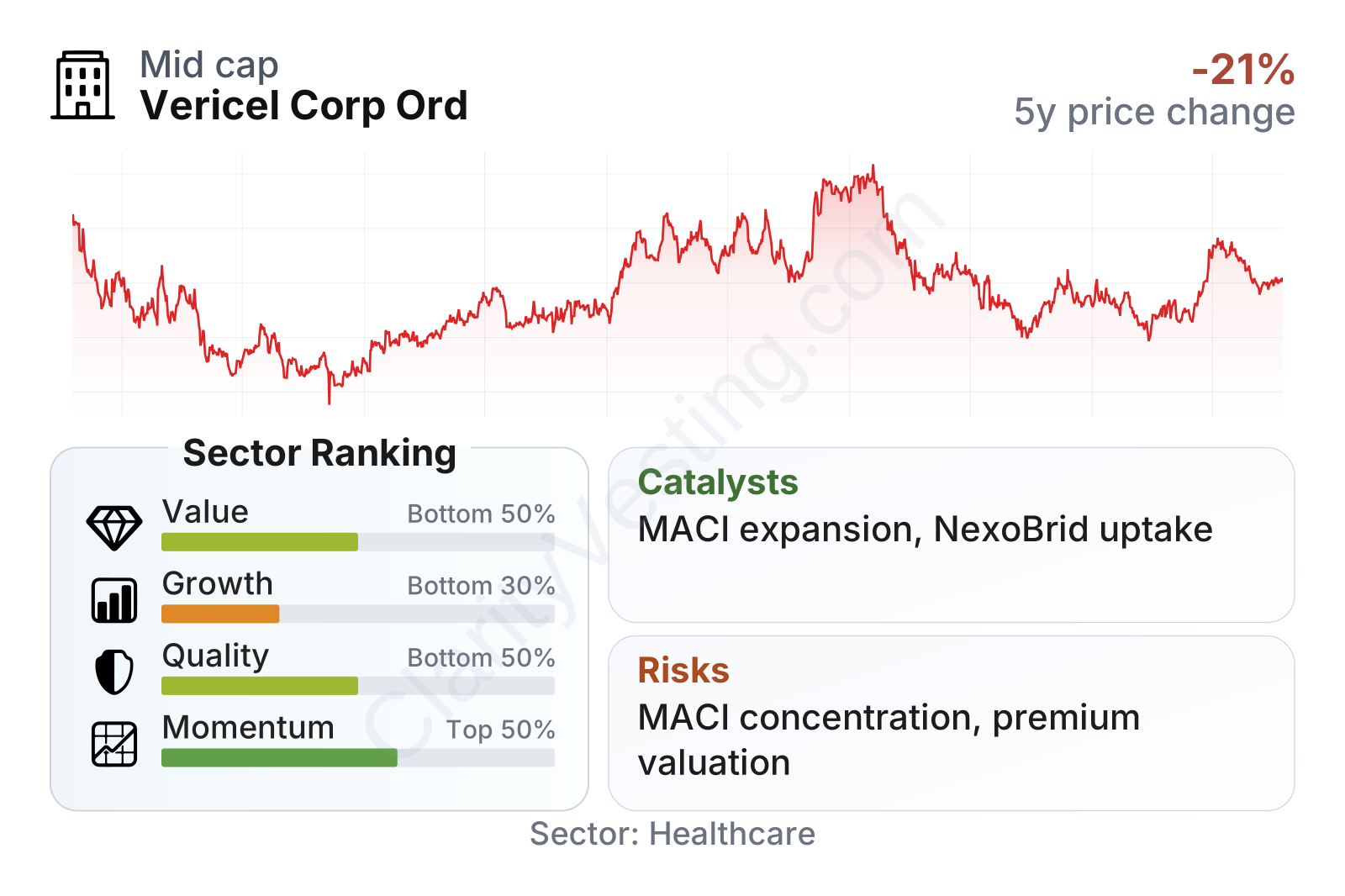
Vericel is a mid-sized healthcare company with a market value around $2 billion and share-price volatility close to the broader market. The most notable feature in the current metrics is the contrast between strong operating progress and a demanding valuation. Revenue growth remains well above the sector median, profitability has turned positive, and returns on capital and assets are above many biotechnology peers. At the same time, the valuation multiples remain elevated, which means the market is already recognizing much of that improvement.
Balance-sheet quality looks solid. The company carries moderate debt relative to equity, while net debt metrics indicate it holds more cash than debt on a net basis. Momentum has improved over the last six months, but longer-term share performance has been more uneven.
Growth
Vericel operates in segments of healthcare that have attractive long-term drivers. Cartilage repair, sports medicine, and advanced burn care benefit from aging but active populations, better surgical techniques, and continued interest in treatments that preserve function rather than simply manage pain. These are not mass-market categories, yet they can still support meaningful growth because pricing, reimbursement, and clinical differentiation matter more than sheer patient volume.
The company’s strategy is fairly coherent. MACI remains the centerpiece, and management has been working to expand surgeon adoption, increase penetration in existing knee cartilage procedures, and broaden awareness among sports medicine specialists. Burn care offers a second platform through Epicel and NexoBrid, which gives Vericel a broader hospital presence and relationships with specialized treatment centers.
Recent growth has been strong by healthcare standards. Year-over-year revenue expansion has generally stayed in the double digits and recently moved above 20%, clearly ahead of the sector median. Over a five-year view, sales per share have also grown faster than the typical company in the industry. This supports the view that Vericel is benefiting from real commercial traction rather than one-time accounting effects.
Cash generation is another positive change. Free cash flow, which was modest a few years ago, has expanded sharply and now sits in a clearly positive range. That matters because it gives the company more flexibility to invest in sales expansion, manufacturing, and pipeline development without relying heavily on outside financing.
A meaningful catalyst is the effort to broaden MACI’s addressable market. The company has highlighted work around earlier intervention and less invasive delivery approaches, including arthroscopic administration. If adoption becomes easier for surgeons and more convenient for patients, that could increase procedure volume beyond the current niche. In burn care, greater uptake of NexoBrid can also improve the value of Vericel’s commercial infrastructure because the same hospital relationships can support multiple products.
Recent company communications have also pointed to continued execution in MACI, rising profitability, and ongoing clinical and commercial investment. For a long-term business case, the key issue is whether Vericel can keep translating specialized leadership into broader penetration while maintaining disciplined spending.
Risks
This article is for informational purposes only and does not constitute financial advice. Some content is AI-generated. See Disclaimer


