Stock Analysis · Vår Energi AS (VARRY)
Overview
Vår Energi is a Norwegian upstream energy company focused on finding, developing, and producing oil and natural gas on the Norwegian continental shelf. In simple terms, it makes money by extracting hydrocarbons from offshore fields and selling them into European and global energy markets. The company has built a portfolio that combines long-producing assets, newer developments, and exploration prospects, with operations centered in one of the world’s most stable petroleum jurisdictions.
Its revenue is heavily concentrated in the sale of petroleum volumes rather than in downstream refining, chemicals, or power generation. Based on the company’s reporting structure and business model, the main sources of revenue are approximately:
- Crude oil sales: about 65% to 75% of revenue. This is typically the largest contributor and includes production from operated and non-operated offshore fields.
- Natural gas sales: about 20% to 30% of revenue. Gas has become increasingly important for European supply security, especially for Norway-based producers.
- Natural gas liquids and other petroleum-related revenue: about 3% to 8%. This usually includes condensate, NGLs, and certain lifting or tariff-related items depending on the period.
Geographically, the business is far less diversified than the largest global oil companies, because nearly all producing assets are tied to Norway’s offshore basin. That concentration creates dependence on a single region, but it also means exposure to a transparent legal framework, established infrastructure, and relatively low political risk compared with many other oil-producing areas.
The broader financial flow shows a business with strong gross profitability, very limited corporate overhead, and earnings that can swing sharply with commodity prices, tax effects, and project timing. Revenue recovered after the 2023 decline and improved further in 2025, while net income remained much more volatile than operating income, which is common in this industry.
Key Figures
| Metric | Value | Sector ⓘ |
|---|---|---|
| Date | Oct 17, 2026 | |
| Context | ||
| Sector | Energy | |
| Industry | Oil & Gas E&P | |
| Market Cap ⓘ | $13.60B | |
| Beta ⓘ | -0.48 | |
Value (Cheapness) | ||
| P/E Ratio ⓘ | 10.28 | 15.44 |
| P/B Ratio ⓘ | 14.15 | 1.73 |
| FCF Yield ⓘ | 17.28% | 8.20% |
| Dividend Yield ⓘ | 9.29% | 3.59% |
| EBIT / EV ⓘ | N/A | 7.46% |
| PEG ⓘ | N/A | |
Growth (Business expansion) | ||
| Revenue Growth ⓘ | 102.70% | 26.90% |
| RPS Growth (5Y CAGR) ⓘ | 7.15% | 6.90% |
| EPS Growth (5Y CAGR) ⓘ | 47.33% | -15.73% |
| BVPS Growth (5Y CAGR) ⓘ | -22.04% | 6.07% |
| Margin Growth (5Y Trend) ⓘ | -4.03% | 0.58% |
| FCF Growth (5Y CAGR) ⓘ | -4.33% | 1.86% |
| DPS Growth (5Y CAGR) ⓘ | 5.35% | 16.79% |
Quality (Business durability) | ||
| ROIC (Latest) ⓘ | N/A | 11.40% |
| ROA (Latest) ⓘ | N/A | 6.06% |
| ROIC (5Y Median) ⓘ | N/A | 10.30% |
| ROA (5Y Median) ⓘ | 3.27% | 5.42% |
| Net Debt / EBIT (Latest) ⓘ | N/A | 1.64 |
| Net Debt / EBIT (5Y Median) ⓘ | 0.95 | 1.83 |
| Net Debt / EBITDA (Latest) ⓘ | N/A | 1.08 |
| Net Debt / Assets ⓘ | 11.39% | 17.29% |
| EBITDA / Interest ⓘ | N/A | 9.64 |
| Operating Margin (Latest) ⓘ | N/A | 16.27% |
| Operating Margin (5Y Median) ⓘ | 52.62% | 20.39% |
| Debt to Equity (Latest) ⓘ | N/A | 54.76% |
| Profit Margin (Latest) ⓘ | 13.02% | 8.82% |
| Free Cash Flow (Latest) ⓘ | $2.35B | |
Momentum (Price trend) | ||
| 3Y Return ⓘ | +166.47% | +67.38% |
| 12M Return (excl. last month) ⓘ | +97.08% | +49.19% |
| 6M Return ⓘ | +28.50% | +7.07% |
| Price vs. 200-Day MA ⓘ | +24.70% | +9.56% |
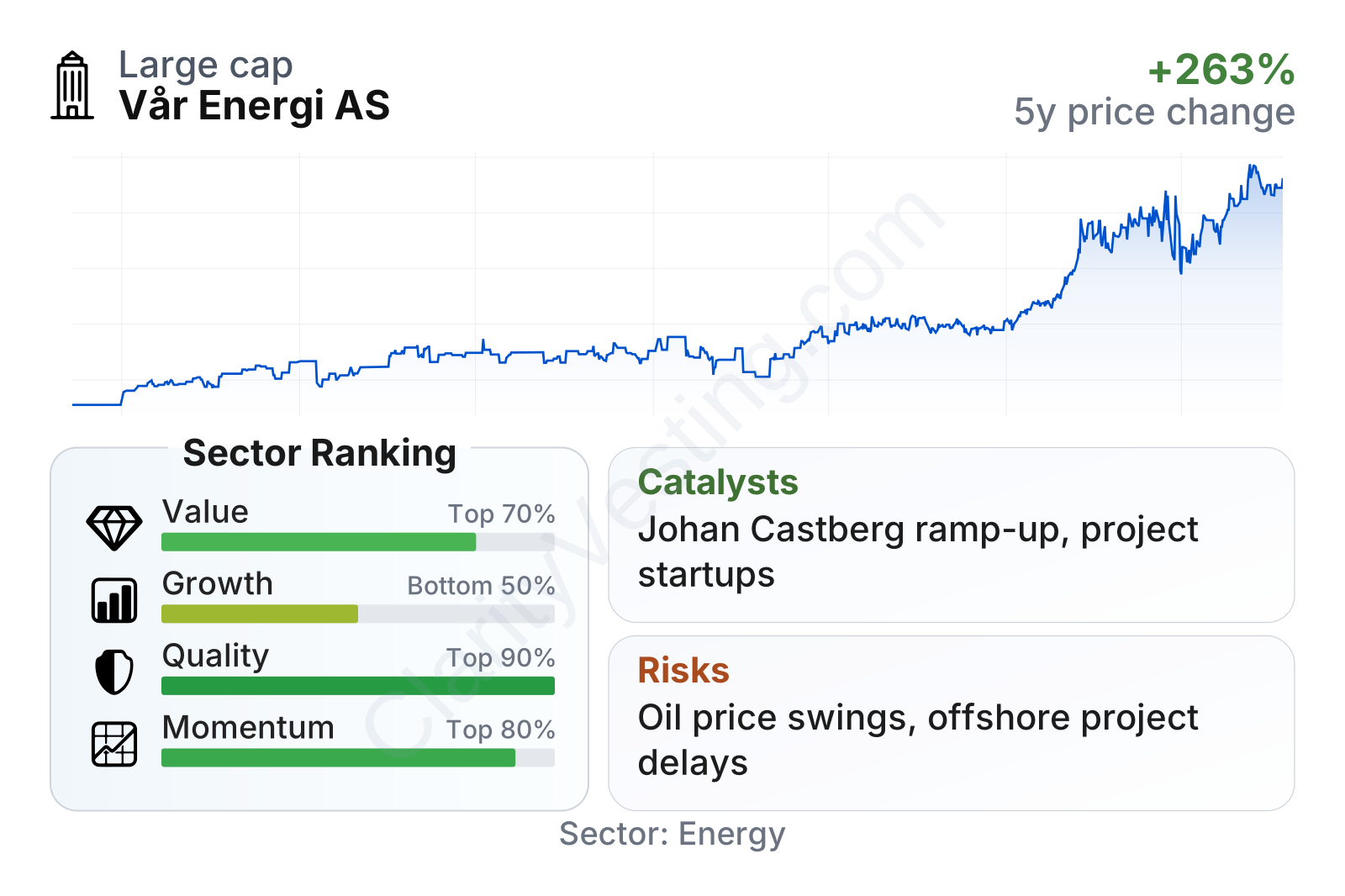
Vår Energi currently sits in the large-cap range within European upstream energy, with market performance that has been notably stronger than much of the sector over the last three years. On valuation, the stock trades at an earnings multiple below the sector median, while free cash flow yield and dividend yield are both materially above typical peers. That combination points to a market that still applies caution despite healthy cash generation.
The more unusual figure is price-to-book, which is far above the sector median. For an oil and gas producer, that can reflect accounting effects, asset carrying values, and how the market views reserve quality and cash generation rather than simple balance-sheet book value. Quality metrics are strong overall, especially on leverage and operating profitability, although growth metrics are more mixed because cash flow and margin trends have not moved in a straight line over the last five years.
Growth
Oil and gas production is not a classic high-growth sector, but it remains a very important one. Europe still needs reliable hydrocarbon supply, and Norway has become even more strategically relevant as a stable source of energy. That gives companies such as Vår Energi a supportive backdrop, especially in natural gas and in offshore projects tied to existing infrastructure.
Vår Energi’s growth strategy is straightforward: increase production from sanctioned developments, improve recovery from existing fields, tie smaller discoveries into current infrastructure, and continue selective exploration. For a long-term assessment, this approach is more credible than betting on transformational acquisitions or frontier geographies. It is built around assets the company already knows and around a regulatory system that is mature and predictable.
Revenue momentum has clearly improved again after a softer stretch in 2024 and early 2025. Recent year-over-year growth moved from modest declines to a strong rebound, suggesting a combination of higher production, pricing support, or both. That matters because upstream companies often re-rate when volume growth and commodity support arrive at the same time.
Cash generation has also strengthened significantly. Trailing free cash flow moved sharply higher from 2024 into 2025, and the latest level is strong relative to the company’s size. This is important because project-heavy producers can show accounting profits without translating them into cash. Here, the recent trend indicates that operating strength is feeding through into real financial flexibility.
One of the clearest catalysts is the company’s pipeline of development projects on the Norwegian continental shelf, including high-profile fields that are expected to add production over the next few years. The company has also emphasized maintaining a high production level toward the end of the decade, supported by both project start-ups and infill opportunities. In practical terms, that means the growth case does not depend on one single discovery.
Recent company updates have also pointed to continued progress in field development and production ramp-up. For a producer of this type, that is significant because successful execution on start-up timing, well performance, and cost control can have a visible effect on earnings and free cash flow within a relatively short period.
Risks
This article is for informational purposes only and does not constitute financial advice. Some content is AI-generated. See Disclaimer


