Stock Analysis · Valiant Holding AG (VALIF)
Overview
Valiant Holding AG is a Swiss regional banking group focused mainly on retail and small-business banking. Its activities are centered on everyday financial services: taking deposits, granting mortgages and other loans, managing payment flows, and offering savings, investment, and basic wealth management solutions. The group operates primarily in Switzerland, which makes it less diversified geographically than large universal banks, but also easier to understand.
Its revenue base is typical for a domestic bank and is led by interest income generated from lending activities, especially mortgages. Based on the company’s recent annual reporting structure and earnings mix, the main sources of revenue can be summarized as follows:
- Net interest income: about 70% to 75% — mainly income from mortgages, customer loans, and treasury activities, after funding costs.
- Fee and commission income: about 15% to 20% — includes asset management, custody, securities, payment services, cards, and other client transaction fees.
- Trading and other ordinary income: about 10% to 15% — mainly foreign exchange, financial transactions, and miscellaneous banking income.
This structure matters because it shows that Valiant remains first and foremost a spread-based lender. That usually means steadier income than more market-driven financial firms, but it also means profitability depends heavily on loan growth, deposit pricing, and the interest-rate environment. Over the last several years, revenue has trended upward overall, while costs have risen more slowly than income. Net profit has also improved gradually, even though funding costs became more volatile during the recent rate cycle.
The business mix points to a fairly stable model: revenue expanded from roughly the low CHF 500 million range to the high CHF 600 million range over the last few years, while net income moved upward more smoothly. One notable swing was interest expense, which rose sharply during the period of higher rates and then eased again, showing how strongly banking earnings can react to funding conditions even when the underlying franchise remains stable.
Key Figures
| Metric | Value | Sector ⓘ |
|---|---|---|
| Date | Nov 21, 2026 | |
| Context | ||
| Sector | Financial Services | |
| Industry | Banks - Regional | |
| Market Cap ⓘ | $1.87B | |
| Beta ⓘ | 0.04 | |
Value (Cheapness) | ||
| P/E Ratio ⓘ | 10.95 | 12.01 |
| P/B Ratio ⓘ | N/A | 1.48 |
| FCF Yield ⓘ | N/A | 8.77% |
| Dividend Yield ⓘ | 5.07% | 3.01% |
| EBIT / EV ⓘ | N/A | 8.31% |
| PEG ⓘ | N/A | |
Growth (Business expansion) | ||
| Revenue Growth ⓘ | 0.60% | 6.70% |
| RPS Growth (5Y CAGR) ⓘ | 6.21% | 12.35% |
| EPS Growth (5Y CAGR) ⓘ | 1.59% | -0.27% |
| BVPS Growth (5Y CAGR) ⓘ | 3.66% | 4.83% |
| Margin Growth (5Y Trend) ⓘ | N/A | -4.16% |
| FCF Growth (5Y CAGR) ⓘ | -52.94% | 4.69% |
| DPS Growth (5Y CAGR) ⓘ | N/A | 8.82% |
Quality (Business durability) | ||
| ROIC (Latest) ⓘ | N/A | 9.49% |
| ROE (Latest) ⓘ | 5.77% | 14.02% |
| ROA (Latest) ⓘ | 0.42% | 1.53% |
| ROIC (5Y Median) ⓘ | N/A | 7.80% |
| ROE (5Y Median) ⓘ | 5.69% | 12.09% |
| ROA (5Y Median) ⓘ | 0.40% | 1.28% |
| Net Debt / EBIT (Latest) ⓘ | N/A | 0.88 |
| Net Debt / EBIT (5Y Median) ⓘ | N/A | 0.73 |
| Net Debt / EBITDA (Latest) ⓘ | N/A | 0.71 |
| Operating Margin (Latest) ⓘ | N/A | 23.37% |
| Operating Margin (5Y Median) ⓘ | N/A | 24.29% |
| Debt to Equity (Latest) ⓘ | N/A | 59.34% |
| Profit Margin (Latest) ⓘ | 29.01% | 26.65% |
| Free Cash Flow (Latest) ⓘ | N/A | |
Momentum (Price trend) | ||
| 3Y Return ⓘ | +55.48% | +73.29% |
| 12M Return (excl. last month) ⓘ | +14.04% | +18.35% |
| 6M Return ⓘ | 0.00% | +3.24% |
| Price vs. 200-Day MA ⓘ | +4.61% | +2.17% |
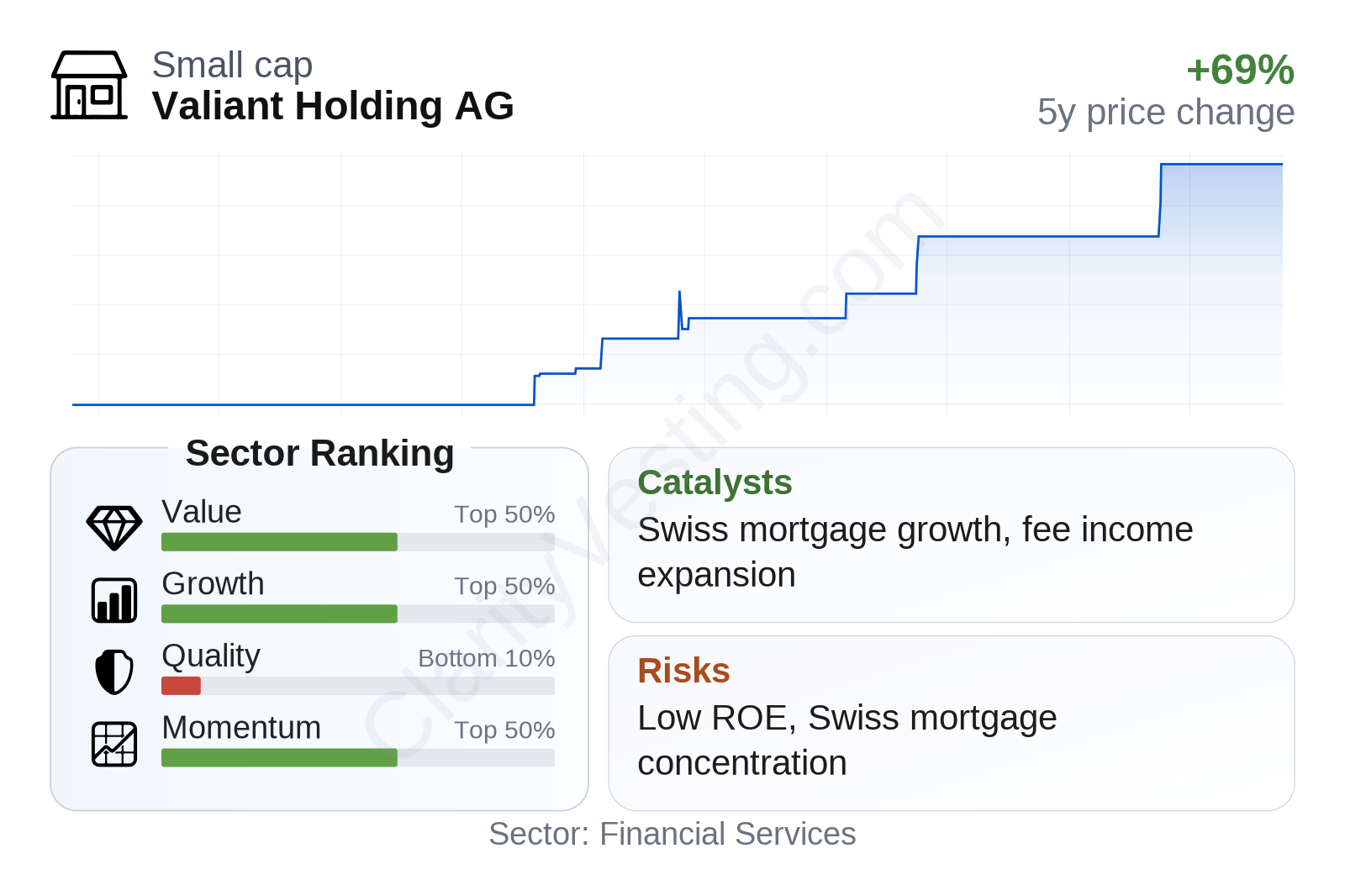
Valiant is a mid-sized bank by market value, and its share price behavior has been unusually calm, with a very low beta. That suggests the stock has moved much less than the broader equity market, which is common for domestically focused banks with stable earnings and limited investor speculation. On valuation, the earnings multiple sits modestly below the sector median, while the trailing dividend yield is clearly above the median. Growth metrics are mixed: recent revenue growth has been subdued, but five-year earnings per share growth has stayed positive. The weakest area is quality, where returns on equity and assets remain well below typical regional bank levels, even though profit margin itself is respectable.
Growth
Valiant operates in a mature sector rather than a fast-growing one. Swiss regional banking is not a high-expansion market, but it benefits from durable demand for mortgages, savings products, payments, and advisory services. That tends to favor resilience over rapid growth. For long-term analysis, the key question is less about whether the market is booming and more about whether the bank can steadily deepen client relationships, improve efficiency, and expand profitably in the areas where it already has local strength.
The company’s strategy is broadly logical for that setting. Valiant emphasizes core banking, a disciplined branch network, digital access, and selective expansion in attractive Swiss regions rather than large-scale international ambitions. That can work well in a market where trust, proximity, and underwriting discipline matter. A regional bank does not need explosive balance-sheet growth to create value over time; modest loan growth, stable credit quality, and careful cost control can be enough.
Earnings per share have shown a generally rising pattern over the past several years, moving from a little above CHF 10 to above CHF 14 before a lower trailing figure in 2026. That softer recent reading does not necessarily mean the long-term direction has changed, but it does show that progress is not perfectly linear. Compared with many banks, Valiant’s earnings profile looks steady rather than cyclical, which fits its business model.
Book value per share has continued to increase year after year, reaching roughly CHF 210 by the latest full-year point shown. For a bank, that is an important sign because book value reflects the gradual accumulation of capital and retained earnings. The pace of growth is not especially fast, but it supports the idea of a franchise that is compounding gradually rather than stretching for aggressive expansion.
Recent company communication has also pointed to continued investment in client acquisition, advisory capabilities, and digital tools. None of these are dramatic catalysts on their own, but together they support a realistic growth path: protect the core mortgage and deposit franchise, increase fee-generating business, and improve customer retention. If Swiss interest rates stabilize at levels that still allow reasonable lending spreads, that could remain a supportive backdrop. A further catalyst is simply consistency: in regional banking, a long stretch of steady profit and capital build-up can matter more than headline expansion.
Risks
This article is for informational purposes only and does not constitute financial advice. Some content is AI-generated. See Disclaimer