Stock Analysis · Vale SA (VALE)
Overview
Vale is one of the world’s largest mining companies. Based in Brazil, it is best known for producing iron ore, the main raw material used to make steel. The company also produces iron ore pellets, nickel, copper, and smaller volumes of manganese ore, ferroalloys, precious metals, and other mineral by-products. In addition to mining, Vale operates railroads, ports, and logistics assets that help move large volumes of material from mines to customers, especially in Asia.
For a long-term view, the business is easiest to understand in two layers. The first is Vale’s core cash engine: iron ore and pellets. The second is its energy transition exposure: mainly nickel and copper, which are used in electric vehicles, power grids, batteries, and industrial electrification. This mix gives Vale both mature cash-generating operations and some exposure to future-oriented metals, although the company still depends heavily on the steel cycle.
Based on the company’s recent annual reporting, revenue is dominated by ferrous minerals, with base metals contributing a much smaller share.
- Iron ore fines and related ferrous products: approximately 75% to 80% of revenue. This includes iron ore fines sold to steelmakers, plus some contribution from pellets and other ferrous materials.
- Iron ore pellets: approximately 10% to 15%. Pellets are processed iron ore products used by steel plants that value higher efficiency and lower emissions intensity.
- Nickel: approximately 5% to 8%. Nickel is used in stainless steel and, depending on chemistry, in battery applications.
- Copper: approximately 3% to 6%. Copper demand is tied to power networks, construction, industrial equipment, and electrification.
- Other products and services: generally below 5%. This includes manganese, ferroalloys, precious metal by-products, and logistics-related activity.
Geographically, sales are concentrated in international markets, especially Asia, because China remains the largest end-market for seaborne iron ore. That makes Vale less dependent on Brazil for demand than for operations.
The financial flow over recent years shows a business that can generate very large profits when iron ore prices are favorable, but also one whose revenue and earnings can compress meaningfully when pricing weakens. Cost discipline has held up better than revenue, yet net income has fallen much more sharply than sales since the 2021 peak, highlighting how cyclical the business is.
Key Figures
| Metric | Value | Sector ⓘ |
|---|---|---|
| Date | Oct 31, 2026 | |
| Context | ||
| Sector | Basic Materials | |
| Industry | Other Industrial Metals & Mining | |
| Market Cap ⓘ | $48.81B | |
| Beta ⓘ | 0.70 | |
Value (Cheapness) | ||
| P/E Ratio ⓘ | 22.94 | 16.71 |
| P/B Ratio ⓘ | 1.32 | 1.72 |
| FCF Yield ⓘ | 7.91% | 5.78% |
| Dividend Yield ⓘ | 46.26% | 2.17% |
| EBIT / EV ⓘ | 17.28% | 7.05% |
| PEG ⓘ | 0.28 | |
Growth (Business expansion) | ||
| Revenue Growth ⓘ | 6.40% | 10.85% |
| RPS Growth (5Y CAGR) ⓘ | -4.77% | 4.49% |
| EPS Growth (5Y CAGR) ⓘ | -33.20% | -12.99% |
| BVPS Growth (5Y CAGR) ⓘ | 2.77% | 5.51% |
| Margin Growth (5Y Trend) ⓘ | -40.48% | -1.42% |
| FCF Growth (5Y CAGR) ⓘ | -37.95% | 0.52% |
| DPS Growth (5Y CAGR) ⓘ | -25.33% | 6.02% |
Quality (Business durability) | ||
| ROIC (Latest) ⓘ | 16.64% | 9.28% |
| ROA (Latest) ⓘ | 2.25% | 4.90% |
| ROIC (5Y Median) ⓘ | 17.11% | 7.76% |
| ROA (5Y Median) ⓘ | 8.83% | 3.88% |
| Net Debt / EBIT (Latest) ⓘ | 1.17 | 1.35 |
| Net Debt / EBIT (5Y Median) ⓘ | 1.06 | 1.70 |
| Net Debt / EBITDA (Latest) ⓘ | 0.91 | 0.93 |
| Net Debt / Assets ⓘ | 14.97% | 12.93% |
| EBITDA / Interest ⓘ | 9.29 | 12.36 |
| Operating Margin (Latest) ⓘ | 27.72% | 12.74% |
| Operating Margin (5Y Median) ⓘ | 29.89% | 11.87% |
| Debt to Equity (Latest) ⓘ | 49.86% | 40.30% |
| Profit Margin (Latest) ⓘ | 4.76% | 6.58% |
| Free Cash Flow (Latest) ⓘ | $3.86B | |
Momentum (Price trend) | ||
| 3Y Return ⓘ | +11.60% | +75.47% |
| 12M Return (excl. last month) ⓘ | +37.66% | +22.27% |
| 6M Return ⓘ | -30.23% | -3.22% |
| Price vs. 200-Day MA ⓘ | -23.38% | -2.47% |
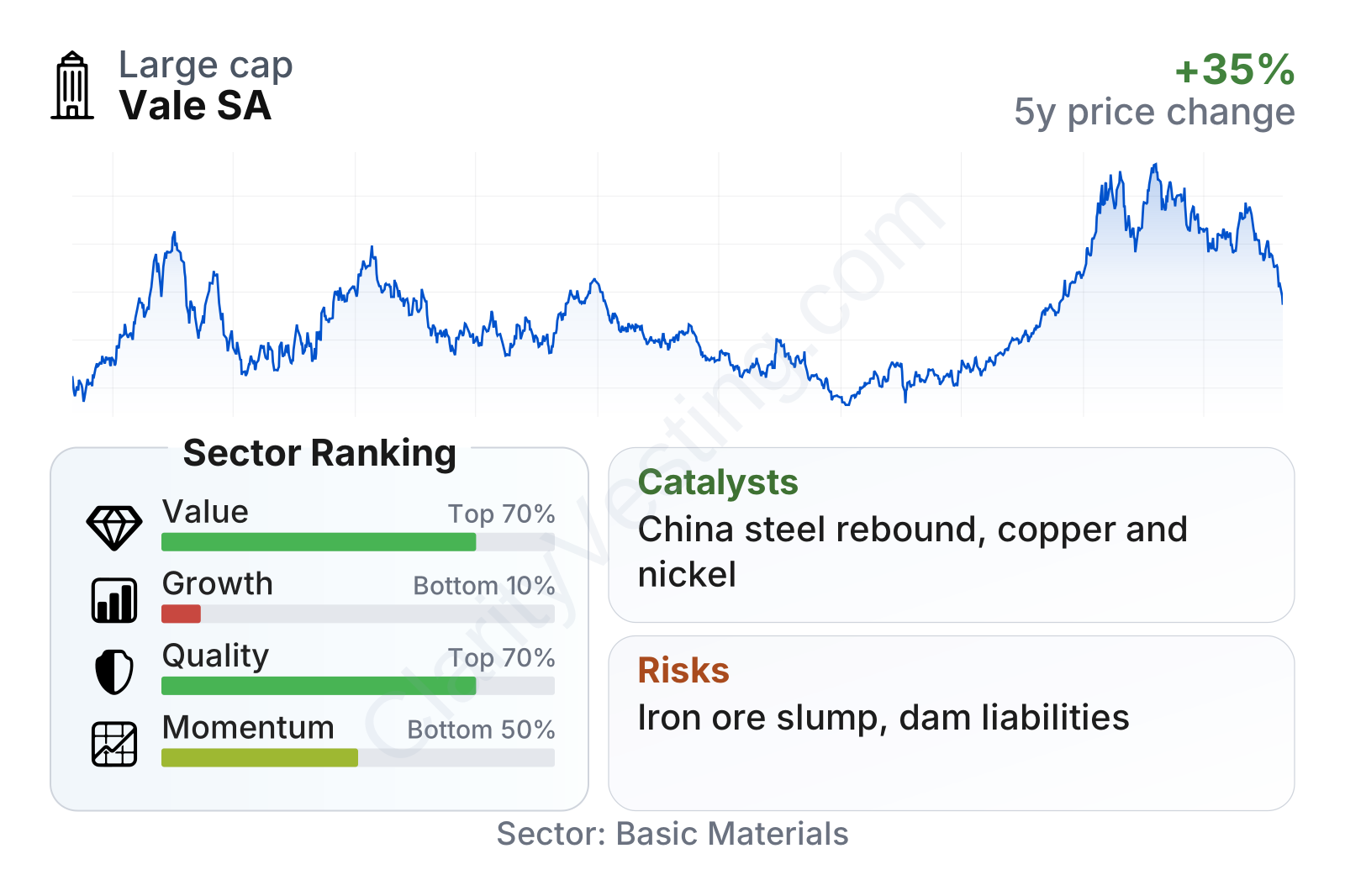
Vale remains a very large global mining company, and the stock has shown wide swings over the last several years, which is typical for a commodity producer. In the latest factor snapshot, valuation looks mixed but generally undemanding on cash-generation measures: free cash flow yield and EBIT relative to enterprise value stand above the sector median, while the P/E ratio is higher than the sector median and book value is lower than many peers. Quality is respectable, with returns on invested capital and operating margins stronger than the industry midpoint, but growth ranks weakly against the sector, reflecting a difficult five-year comparison and the normal volatility of mining earnings.
Growth
Vale operates in a sector that is mature in its core product but still strategically important. Iron ore is not a high-growth industry in the way software or digital services can be, yet it remains essential because steel is foundational to construction, infrastructure, machinery, and transportation. As long as large economies continue to build housing, rail, power systems, factories, and industrial equipment, demand for high-volume iron ore should remain structurally relevant. The stronger long-term growth angle is in base metals, especially copper and nickel, where electrification can support demand over many years.
Vale’s strategy broadly makes sense for this setup. The company is reinforcing its position in high-quality iron ore, where better ore grades can help steelmakers improve blast furnace efficiency and lower emissions per ton of steel. At the same time, Vale has been developing and optimizing its base metals operations, which adds exposure to copper and nickel without changing the company’s core identity as a major iron ore producer.
Recent revenue momentum has improved compared with the weaker periods seen in 2024 and early 2025. Year-over-year growth turned positive again and accelerated into 2026, which suggests the business is benefiting from a better operating and pricing backdrop. Even so, the longer record remains uneven, reminding readers that Vale’s top line tends to move with commodity prices and shipment volumes rather than following a smooth upward path.
Cash generation has also recovered from a very weak point, though it remains well below the exceptional levels reached a few years ago. That matters because free cash flow is one of the clearest indicators of how much flexibility a mining company has for dividends, buybacks, debt management, mine development, and resilience during downturns. Vale still produces positive cash flow on a meaningful scale, but not at the same strength as during the peak iron ore environment.
A notable catalyst is the long-term push toward electrification and grid expansion. Copper is central to transmission, motors, and electrical equipment, while nickel can benefit from selected battery technologies and stainless steel demand. Another catalyst is any improvement in Chinese steel demand or policy support for construction and infrastructure, since that can quickly lift the earnings power of Vale’s main business. In addition, Vale’s premium ore quality and logistics network can support competitiveness if customers increasingly value productivity and lower-emission steel inputs.
Recent company updates have also pointed to continued work on asset optimization, operational reliability, and portfolio simplification. Those are not headline-grabbing growth drivers on their own, but for a miner they can be important because stable volumes, controlled costs, and fewer operational surprises often create more value than aggressive expansion.
Risks
This article is for informational purposes only and does not constitute financial advice. Some content is AI-generated. See Disclaimer


