Stock Analysis · Valaris Ltd (VAL)
Overview
Valaris Ltd is an offshore drilling contractor serving oil and gas producers around the world. In simple terms, the company owns and operates large drilling rigs that energy companies rent when they want to drill wells offshore. Valaris mainly works in three rig categories: drillships for deepwater projects, semisubmersibles for harsh or complex offshore environments, and jackups for shallower-water fields. Its customers are typically major international oil companies, national oil companies, and large independent producers.
The business is built around contract drilling revenue. Customers generally pay a daily rate for the use of a rig and also reimburse certain operating items depending on the contract structure. Based on the company’s recent annual reporting, revenue is mainly split by fleet type, with deepwater rigs representing the largest share because they command much higher dayrates, followed by jackups, then other smaller sources such as managed services and reimbursable items.
- Floaters / deepwater rigs: approximately 55% to 65% of revenue. This includes drillships and semisubmersibles used in deepwater and harsh-environment offshore drilling, where dayrates are usually the highest.
- Jackups: approximately 30% to 40% of revenue. These rigs operate in shallower waters and are widely used in regions such as the Middle East and other established offshore basins.
- Other revenue: generally less than 10%. This can include reimbursable revenue, management services, and smaller ancillary items tied to contracts and fleet operations.
Over the last several years, Valaris has moved from a distressed industry backdrop to a much healthier operating environment. Revenue climbed from about $1.2 billion in 2021 to roughly $2.4 billion in 2025, while operating profitability improved sharply as older low-priced contracts rolled off and newer contracts reflected stronger market conditions. The business remains cyclical, but the company is now participating in a much tighter offshore rig market than it did earlier in the decade.
The long-term financial picture shows a clear turnaround: revenue expanded materially, gross profit widened, and operating income shifted from losses in 2021 to strong profitability by 2024 and 2025. That said, reported net income has also been helped at times by tax effects, so operating performance is a better guide than headline earnings alone.
Key Figures
| Metric | Value | Sector ⓘ |
|---|---|---|
| Date | Oct 17, 2026 | |
| Context | ||
| Sector | Energy | |
| Industry | Oil & Gas Drilling | |
| Market Cap ⓘ | $5.94B | |
| Beta ⓘ | 1.05 | |
Value (Cheapness) | ||
| P/E Ratio ⓘ | 6.45 | 15.44 |
| P/B Ratio ⓘ | 1.85 | 1.73 |
| FCF Yield ⓘ | -0.48% | 8.20% |
| Dividend Yield ⓘ | N/A | 3.59% |
| EBIT / EV ⓘ | 6.94% | 7.46% |
| PEG ⓘ | N/A | |
Growth (Business expansion) | ||
| Revenue Growth ⓘ | -12.40% | 26.90% |
| RPS Growth (5Y CAGR) ⓘ | 19.41% | 6.90% |
| EPS Growth (5Y CAGR) ⓘ | -37.17% | -15.73% |
| BVPS Growth (5Y CAGR) ⓘ | 33.31% | 6.07% |
| Margin Growth (5Y Trend) ⓘ | 38.52% | 0.58% |
| FCF Growth (5Y CAGR) ⓘ | N/A | 1.86% |
| DPS Growth (5Y CAGR) ⓘ | N/A | 16.79% |
Quality (Business durability) | ||
| ROIC (Latest) ⓘ | 34.63% | 11.40% |
| ROA (Latest) ⓘ | 18.63% | 6.06% |
| ROIC (5Y Median) ⓘ | 11.44% | 10.30% |
| ROA (5Y Median) ⓘ | 8.54% | 5.42% |
| Net Debt / EBIT (Latest) ⓘ | 1.41 | 1.64 |
| Net Debt / EBIT (5Y Median) ⓘ | 1.55 | 1.83 |
| Net Debt / EBITDA (Latest) ⓘ | 1.03 | 1.08 |
| Net Debt / Assets ⓘ | 11.46% | 17.29% |
| EBITDA / Interest ⓘ | 6.19 | 9.64 |
| Operating Margin (Latest) ⓘ | 20.64% | 16.27% |
| Operating Margin (5Y Median) ⓘ | 3.97% | 20.39% |
| Debt to Equity (Latest) ⓘ | 36.22% | 54.76% |
| Profit Margin (Latest) ⓘ | 43.95% | 8.82% |
| Free Cash Flow (Latest) ⓘ | -$28.52M | |
Momentum (Price trend) | ||
| 3Y Return ⓘ | +15.15% | +67.38% |
| 12M Return (excl. last month) ⓘ | +56.20% | +49.19% |
| 6M Return ⓘ | -7.91% | +7.07% |
| Price vs. 200-Day MA ⓘ | +1.36% | +9.56% |
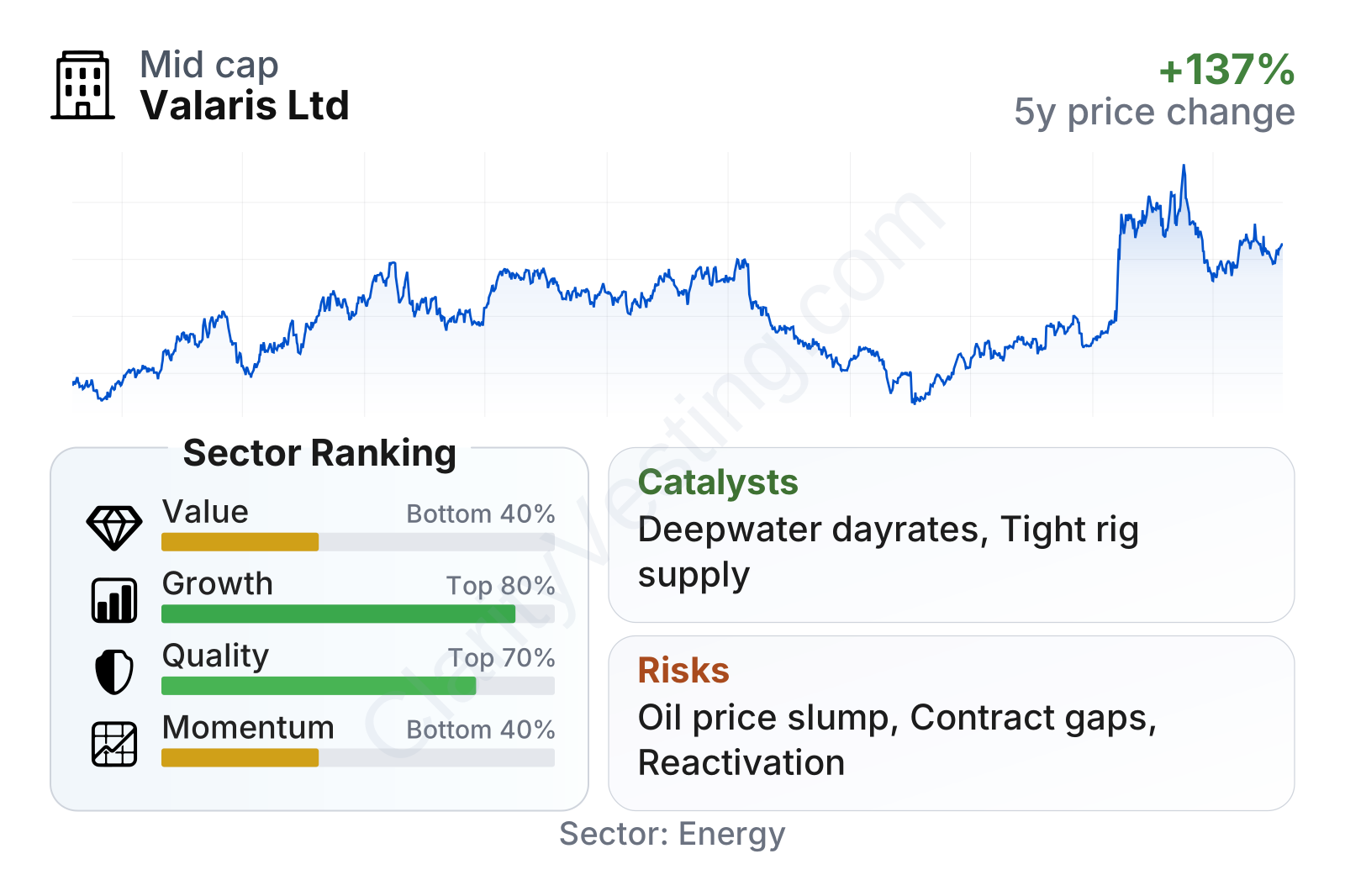
Valaris is a mid-sized energy company with a stock that has been volatile but not unusually extreme compared with many offshore peers. The metrics point to a mixed but interesting profile: valuation ratios such as earnings are low versus the sector, quality measures are solid, and long-term operating improvement has been meaningful. At the same time, recent revenue growth has turned negative, free cash flow remains uneven, and share-price momentum is weaker over six months even after a strong rebound over the prior year.
The table also highlights an unusual combination. Return on capital and return on assets are well above sector medians, debt levels are lower than many peers, and current operating margins are healthy. However, value metrics are not uniformly cheap because free cash flow is still near break-even to negative on a trailing basis, and the stock no longer looks depressed in the same way it did earlier in the recovery.
Growth
Valaris operates in a sector that has returned to growth after a long downturn. Offshore drilling is benefiting from a multi-year recovery in global upstream spending, especially in deepwater projects that can deliver large volumes over long production lives. For oil companies, offshore developments have become more attractive again because many projects can remain competitive at moderate oil prices, and several producing regions need ongoing investment to offset natural decline in existing fields.
The company’s strategy appears aligned with that recovery. Valaris has focused on high-specification rigs, contract repricing, disciplined fleet management, and selective reactivations where expected returns justify the capital required. This matters because offshore drilling is not simply about owning rigs; it is about having the right rigs in the right basins at the right point in the cycle. Stronger dayrates and improving utilization can lift earnings significantly once fixed costs are covered.
Recent growth has become less smooth than the broader five-year trend. After a strong run through 2024 and into 2025, year-over-year revenue turned negative in late 2025 and remained under pressure in the first half of 2026. That suggests the recovery is still lumpy and tied to contract timing, rig mobilizations, and fleet downtime rather than a straight-line expansion. Even so, the longer-term picture remains much stronger than it was earlier in the cycle, with revenue per share and operating margin trends still notably ahead of many sector peers.
Cash generation has also improved compared with the downturn years, but it remains uneven. Free cash flow has swung between negative and positive because offshore contractors often face heavy spending on reactivations, upgrades, surveys, and equipment before stronger contract cash flows fully arrive. For a long-term view, this means growth should be judged more by backlog quality, dayrates, utilization, and margin expansion than by any single quarter’s free cash flow number.
A notable catalyst is the company’s exposure to deepwater and harsh-environment markets, where supply of modern rigs is relatively constrained. If offshore demand remains firm, contract renewals at higher rates can still support earnings even when revenue fluctuates from quarter to quarter. Another positive element is industry consolidation and capital discipline across the offshore drilling space, which has reduced excess capacity versus the prior cycle.
Risks
This article is for informational purposes only and does not constitute financial advice. Some content is AI-generated. See Disclaimer


