Stock Analysis · VAT Group AG (VACNY)
Overview
VAT Group AG is a Swiss industrial technology company best known for making high-performance vacuum valves. These components are used in machines that need extremely clean and controlled environments, especially in semiconductor manufacturing. In simple terms, when chipmakers build advanced processors or memory chips, they use tools that move gases and materials through vacuum chambers, and VAT’s valves help control those processes with very high precision.
The business is specialized rather than broad. That matters because VAT is not trying to serve every type of factory equipment; it focuses on a narrow but technically demanding part of the production chain where reliability, contamination control, and uptime are critical. This has helped the company build a strong position in advanced manufacturing markets.
Revenue is mainly generated from three end markets described by the company:
- Valves for semiconductor manufacturing: about 70% of sales in recent years. This includes vacuum valves used in wafer fabrication equipment for deposition, etch, and related chipmaking steps.
- Global service: about 20% of sales. This covers spare parts, repairs, and maintenance tied to the installed base of VAT equipment.
- Advanced industrial applications: about 10% of sales. This includes valves and motion components for areas such as coatings, displays, solar, research, and other industrial vacuum uses.
The revenue mix shows why the company often trades with semiconductor sentiment even though it sits in the industrials sector. Its largest profit engine is tied to chip equipment spending, while service adds recurring support revenue and industrial applications provide some diversification.
Over the last several years, the business has also shown an attractive economic model: high gross margins, strong operating profitability, and solid cash generation. Revenue has been cyclical, but the company has historically converted a meaningful share of sales into earnings and free cash flow, which is unusual for many machinery businesses.
The long-term pattern is clear even with normal swings: revenue moved up sharply in the semiconductor boom, fell during the industry downturn, and then recovered. Profitability remained strong throughout, showing that VAT’s niche has pricing power and operational discipline, although year-to-year results can still be volatile.
Key Figures
| Metric | Value | Sector ⓘ |
|---|---|---|
| Date | Oct 03, 2026 | |
| Context | ||
| Sector | Industrials | |
| Industry | Specialty Industrial Machinery | |
| Market Cap ⓘ | $24.34B | |
| Beta ⓘ | 1.54 | |
Value (Cheapness) | ||
| P/E Ratio ⓘ | 97.84 | 22.45 |
| P/B Ratio ⓘ | 35.84 | 1.98 |
| FCF Yield ⓘ | 1.84% | 6.31% |
| Dividend Yield ⓘ | 1.13% | 1.96% |
| EBIT / EV ⓘ | N/A | 4.81% |
| PEG ⓘ | 1.23 | |
Growth (Business expansion) | ||
| Revenue Growth ⓘ | -8.30% | 9.10% |
| RPS Growth (5Y CAGR) ⓘ | 3.30% | 7.75% |
| EPS Growth (5Y CAGR) ⓘ | -24.34% | -13.59% |
| BVPS Growth (5Y CAGR) ⓘ | 5.80% | 6.22% |
| Margin Growth (5Y Trend) ⓘ | -4.32% | 0.72% |
| FCF Growth (5Y CAGR) ⓘ | 3.52% | 10.98% |
| DPS Growth (5Y CAGR) ⓘ | 7.33% | 9.48% |
Quality (Business durability) | ||
| ROIC (Latest) ⓘ | N/A | 10.92% |
| ROA (Latest) ⓘ | 32.47% | 5.41% |
| ROIC (5Y Median) ⓘ | 32.86% | 9.21% |
| ROA (5Y Median) ⓘ | 17.20% | 4.94% |
| Net Debt / EBIT (Latest) ⓘ | 0.53 | 2.07 |
| Net Debt / EBIT (5Y Median) ⓘ | 0.20 | 2.28 |
| Net Debt / EBITDA (Latest) ⓘ | 0.45 | 1.43 |
| Net Debt / Assets ⓘ | 20.53% | 19.27% |
| EBITDA / Interest ⓘ | 24.44 | 9.53 |
| Operating Margin (Latest) ⓘ | 25.32% | 10.50% |
| Operating Margin (5Y Median) ⓘ | 27.42% | 10.27% |
| Debt to Equity (Latest) ⓘ | 57.94% | 65.48% |
| Profit Margin (Latest) ⓘ | 20.20% | 6.62% |
| Free Cash Flow (Latest) ⓘ | $447.22M | |
Momentum (Price trend) | ||
| 3Y Return ⓘ | +139.49% | +58.56% |
| 12M Return (excl. last month) ⓘ | +128.64% | +15.63% |
| 6M Return ⓘ | +32.94% | +4.19% |
| Price vs. 200-Day MA ⓘ | +14.85% | +0.93% |
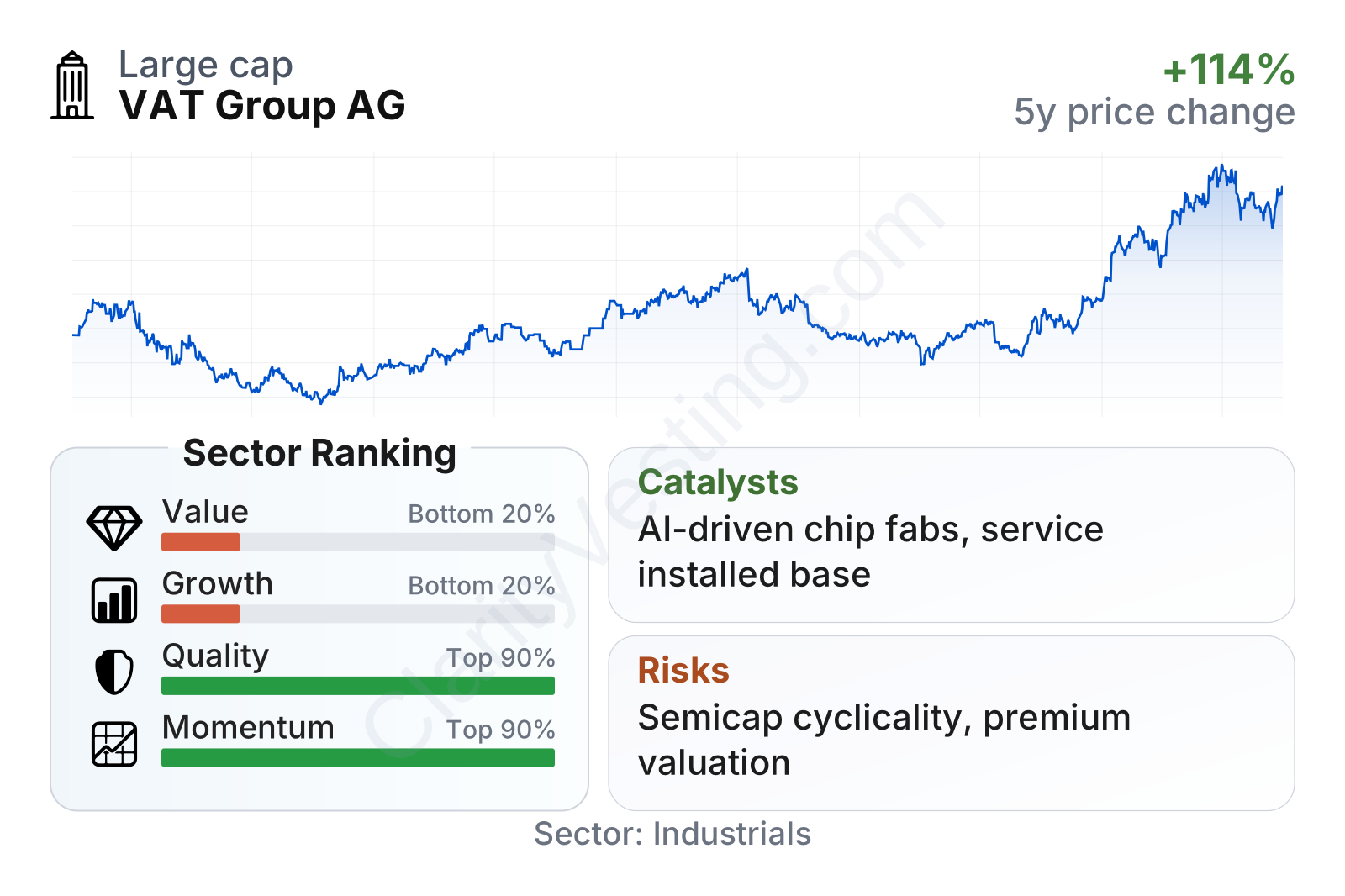
VAT stands out for business quality and recent share-price momentum, while looking weak on traditional value measures and less impressive on recent growth metrics. Profitability is far above the sector median, debt remains manageable, and interest coverage is strong. At the same time, the stock trades at a much richer earnings and book-value multiple than most industrial peers, which means the market is already pricing in a meaningful recovery and continued leadership in its niche.
The stock chart also highlights how cyclical the name can be. After a sharp decline in 2022, the shares rebounded strongly, then went through another correction before accelerating again into 2026. That pattern fits a company exposed to semiconductor equipment cycles: operational quality is high, but the market’s expectations can swing quickly as chip-capex outlooks change.
Growth
VAT operates in a market with a favorable long-term backdrop. Semiconductor demand continues to expand through AI infrastructure, high-performance computing, automotive electronics, industrial automation, and data center buildouts. More chips, more process complexity, and more advanced production steps generally mean more demanding vacuum control requirements. That supports the broader case for companies supplying critical components into wafer-fab equipment.
VAT’s strategy also makes sense for future growth because it is focused on the most technically difficult part of its market rather than chasing volume at lower margins. In advanced semiconductors, tool performance and contamination control matter enormously. If a valve failure disrupts production, the cost to the customer can be far greater than the component price itself. That dynamic supports customer stickiness and helps explain why VAT has maintained unusually strong margins for an industrial supplier.
The company also benefits from an installed base that feeds its service business. Once valves are designed into complex equipment and deployed in fabs, replacement parts and servicing can produce recurring revenue with less volatility than new system orders. This does not remove cyclicality, but it adds resilience compared with a pure one-time equipment model.
Near-term growth metrics still reflect a choppy period. Recent year-over-year revenue declined while many industrial peers grew, and the five-year growth record is positive but not exceptional. In context, that weakness looks more tied to the semiconductor downcycle than to a broken business model. The key question for long-term analysis is whether VAT can translate the next upcycle into faster order conversion and margin recovery, as it has done in past industry rebounds.
A meaningful catalyst is the continued push toward more advanced chip architectures. As semiconductor manufacturing moves to smaller nodes and more complex process flows, the performance requirements for vacuum systems become more demanding. That increases the importance of highly specialized suppliers. New fab investments in regions such as the United States, Europe, and Asia can also support demand over multiple years, although the timing can be uneven.
Another favorable element is the company’s position in a bottleneck-like component category. Compared with the total cost of a semiconductor fabrication tool, valves are a small part of the bill, but their reliability matters greatly. In industries like this, customers often prioritize proven performance over switching to a cheaper alternative, especially at leading-edge nodes.
Risks
This article is for informational purposes only and does not constitute financial advice. Some content is AI-generated. See Disclaimer


