Stock Analysis · Flughafen Zürich AG (UZAPF)
Overview
Flughafen Zürich AG is the operator of Zurich Airport, Switzerland’s largest airport, and it also develops and manages airport-related infrastructure in other countries. In simple terms, the company earns money from aircraft using the airport, passengers moving through it, retail and restaurant spending inside the terminals, parking and real estate, and selected international airport projects.
Its business model is stronger than that of a pure airline-dependent transport company because it combines regulated airport operations with commercial activities and property income. That creates several revenue streams tied to the same physical asset: a major airport with high traffic, premium location, and limited direct local competition.
Based on the company’s reporting structure, the main sources of revenue are approximately the following:
- Aviation: roughly 35% to 40% of revenue. This includes passenger charges, landing fees, aircraft handling-related airport income, and security-related airport services.
- Commercial: roughly 20% to 25% of revenue. This mainly comes from retail concessions, duty-free participation, food and beverage, advertising, and other passenger spending inside the airport.
- Real estate: roughly 15% to 20% of revenue. This includes rental income from shops, offices, logistics, and airport-linked properties.
- International activities: roughly 10% to 15% of revenue. This covers airport management and development interests outside Switzerland, including projects where Flughafen Zürich provides operating know-how.
- Parking and access-related services: roughly 5% to 10% of revenue. This includes parking, road access, and certain mobility-related services around the airport site.
- Other services: a smaller residual share, generally below 5%, from additional operational and service activities.
The financial profile has improved sharply since the pandemic period. Revenue has risen from about CHF 680 million in 2021 to about CHF 1.36 billion in 2025, while net income moved from a small loss in 2021 to roughly CHF 347 million in 2025. This shows how strongly the company benefits when air traffic normalizes and commercial spending returns.
The long recovery arc is clear: sales and operating profit rebounded strongly after 2021, and profitability has remained high even as costs moved up again. That suggests the airport’s mix of aviation, retail, and property income has regained scale and pricing power.
Key Figures
| Metric | Value | Sector ⓘ |
|---|---|---|
| Date | Oct 31, 2026 | |
| Context | ||
| Sector | Industrials | |
| Industry | Airports & Air Services | |
| Market Cap ⓘ | $7.27B | |
| Beta ⓘ | 0.58 | |
Value (Cheapness) | ||
| P/E Ratio ⓘ | 16.54 | 21.91 |
| P/B Ratio ⓘ | 2.40 | 1.97 |
| FCF Yield ⓘ | 3.13% | 6.34% |
| Dividend Yield ⓘ | 3.59% | 1.88% |
| EBIT / EV ⓘ | N/A | 4.83% |
| PEG ⓘ | 7.75 | |
Growth (Business expansion) | ||
| Revenue Growth ⓘ | 5.10% | 9.50% |
| RPS Growth (5Y CAGR) ⓘ | 18.96% | 7.67% |
| EPS Growth (5Y CAGR) ⓘ | N/A | -11.63% |
| BVPS Growth (5Y CAGR) ⓘ | 6.91% | 6.14% |
| Margin Growth (5Y Trend) ⓘ | 33.93% | 0.71% |
| FCF Growth (5Y CAGR) ⓘ | 23.08% | 11.01% |
| DPS Growth (5Y CAGR) ⓘ | -3.13% | 9.31% |
Quality (Business durability) | ||
| ROIC (Latest) ⓘ | N/A | 10.70% |
| ROA (Latest) ⓘ | 10.85% | 5.45% |
| ROIC (5Y Median) ⓘ | 6.66% | 9.33% |
| ROA (5Y Median) ⓘ | 5.89% | 4.94% |
| Net Debt / EBIT (Latest) ⓘ | 1.98 | 2.03 |
| Net Debt / EBIT (5Y Median) ⓘ | 4.69 | 2.28 |
| Net Debt / EBITDA (Latest) ⓘ | 1.20 | 1.37 |
| Net Debt / Assets ⓘ | 28.51% | 19.16% |
| EBITDA / Interest ⓘ | N/A | 9.73 |
| Operating Margin (Latest) ⓘ | 34.14% | 10.49% |
| Operating Margin (5Y Median) ⓘ | 31.76% | 10.30% |
| Debt to Equity (Latest) ⓘ | 58.99% | 65.91% |
| Profit Margin (Latest) ⓘ | 25.03% | 6.61% |
| Free Cash Flow (Latest) ⓘ | $227.43M | |
Momentum (Price trend) | ||
| 3Y Return ⓘ | +49.27% | +69.18% |
| 12M Return (excl. last month) ⓘ | -20.20% | +12.04% |
| 6M Return ⓘ | -20.57% | +0.22% |
| Price vs. 200-Day MA ⓘ | -16.90% | +0.19% |
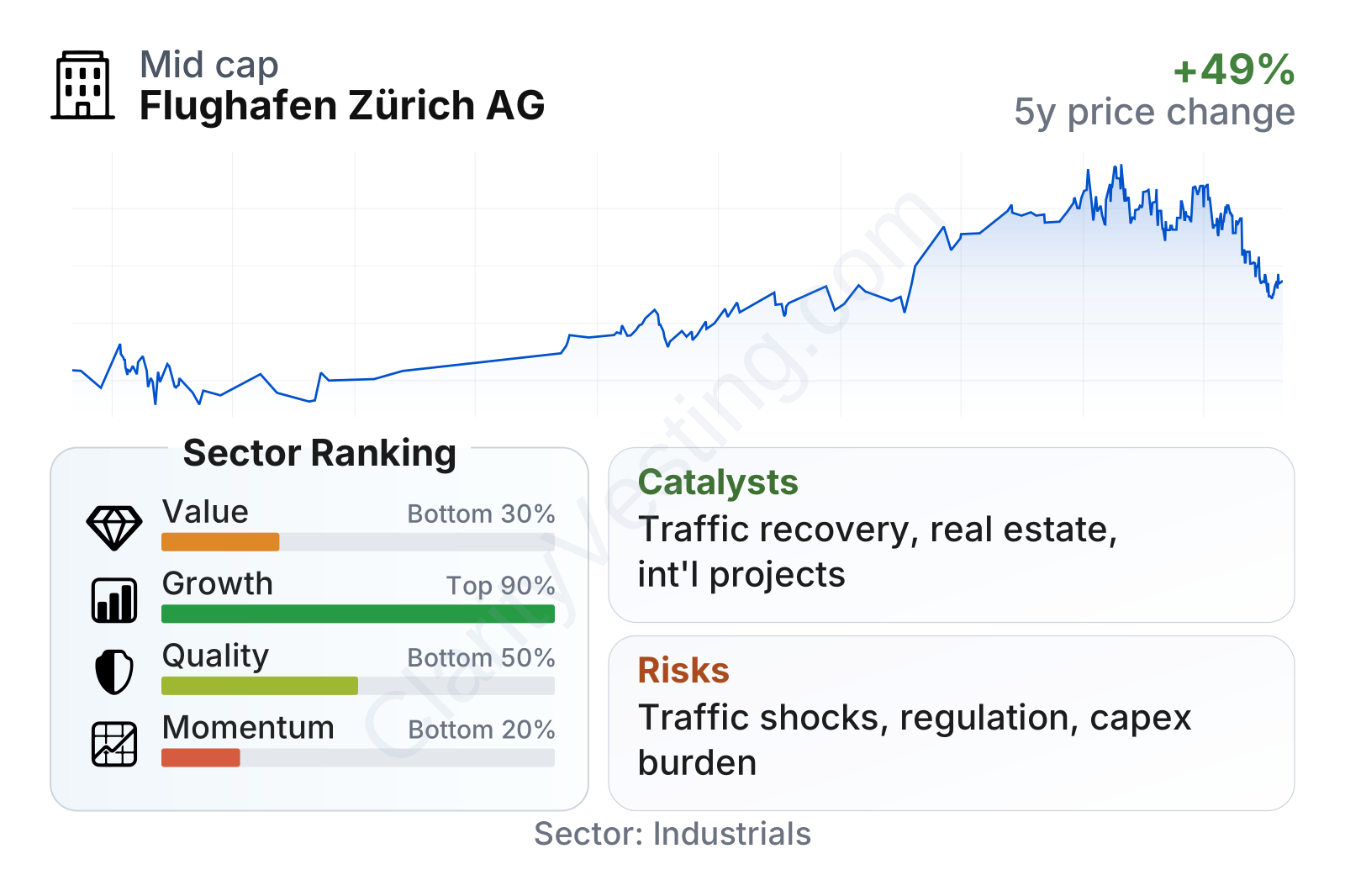
Flughafen Zürich stands out for growth and margins more than for classic cheapness. Over five years, revenue per share and free cash flow have grown much faster than the sector median, and operating margins are far above typical industrial transport infrastructure levels. Profitability is also strong, with return on assets and net margin well ahead of many peers. On the other hand, the value profile is less compelling because free cash flow yield is modest and the price-to-book ratio is above the sector median. Share-price momentum has also been weak recently, with the stock trading below its longer-term trend despite a strong multiyear advance.
The stock’s beta is low, which fits the nature of an airport infrastructure operator: traffic can be cyclical, but the underlying asset is strategic and hard to replicate. Balance-sheet leverage looks manageable at present, with net debt to EBITDA near the lower end of the sector range, although longer historical debt ratios show that this business can become more leveraged when traffic drops suddenly.
Growth
Airports remain part of a sector with durable long-term demand drivers. Global passenger traffic growth is usually supported by rising mobility, tourism, business travel, and airline network expansion. For Flughafen Zürich, this is especially relevant because Zurich is a key gateway for Switzerland and serves a wealthy catchment area with strong business and leisure demand.
The company’s strategy makes sense for future growth because it is not relying only on aircraft movements. Management has continued to build the non-aviation side of the business, especially real estate and commercial activities, which can raise earnings per passenger and reduce dependence on pure traffic volume. That matters because airport operators with a strong mix of retail, parking, and property income often produce more stable returns than those relying mostly on regulated airport fees.
Its international business adds a second layer of expansion. While Zurich Airport remains the core asset, overseas airport projects can extend the company’s operating expertise into faster-growing markets without requiring the domestic airport to handle all future growth alone. This is not yet the largest earnings driver, but it can become more meaningful over time if projects mature successfully.
A visible catalyst is the continued normalization and gradual expansion of passenger traffic combined with pricing and mix benefits inside the airport. More travelers usually support not just landing and passenger charges, but also duty-free sales, food and beverage, parking, and tenant rents. Another favorable point is that the company has already restored high operating profitability, so incremental traffic growth can still translate into attractive earnings progression.
Recent company updates have also highlighted continued traffic resilience and ongoing infrastructure development around the airport. For a business like this, expansion of terminal capacity, commercial space, and adjacent property can matter almost as much as passenger numbers, because they raise monetization of each traveler and each square meter of airport land.
Risks
This article is for informational purposes only and does not constitute financial advice. Some content is AI-generated. See Disclaimer


