Stock Analysis · UWM Holdings Corp (UWMC)
Overview
UWM Holdings Corp is the parent company of United Wholesale Mortgage, a large U.S. mortgage lender focused on the wholesale channel. In simple terms, it does not mainly lend directly to homebuyers through branch offices. Instead, it works with independent mortgage brokers, who bring borrowers to UWM. The company underwrites, funds, and services residential mortgage loans, with a strong emphasis on speed, technology, and broker relationships.
Its business is tied closely to the U.S. housing and mortgage market, especially refinancing activity, home purchases, and the direction of interest rates. When mortgage demand is healthy and the company can gain share from other lenders, revenue can rise quickly. When rates stay high or loan volumes fall, results can weaken just as quickly.
The company’s revenue mix is concentrated in mortgage banking and related activities. Based on company filings, the main economic sources are:
- Loan production and origination-related income: the largest source, typically the clear majority of revenue. This includes gains generated when UWM originates mortgage loans through broker partners and sells or transfers them into the secondary market.
- Loan servicing income: an important secondary source. UWM earns revenue from servicing mortgage loans, including fees tied to collecting payments and managing escrow accounts, as well as changes in the value of mortgage servicing rights.
- Interest income and other investment-related items: a smaller source, coming from warehouse and cash management activities, mortgage-related assets, and other balance-sheet items.
Because mortgage companies report revenue differently from many industrial businesses, exact percentages can swing sharply from year to year as market values move. In broad terms, origination-related activity has generally represented well above 70% of the company’s economic revenue base, servicing has often been in the roughly 10% to 25% range, and other sources have usually remained smaller.
Over the last several years, the business has shown how cyclical it is. Revenue fell sharply from 2021 to 2023 as the mortgage market weakened, then recovered in 2024 and rose further in 2025. Even so, net income remained thin relative to revenue because interest expense and the cost of running the platform absorbed much of the rebound. That pattern matters for long-term analysis: UWM’s scale is real, but the path from volume to durable profitability is uneven.
The operating picture improved after the 2023 trough, with revenue and operating income recovering into 2024 and 2025. Still, the conversion from revenue into bottom-line profit remained modest, showing that higher volume alone does not fully solve margin pressure in a volatile rate environment.
Key Figures
| Metric | Value | Sector ⓘ |
|---|---|---|
| Date | Oct 17, 2026 | |
| Context | ||
| Sector | Financial Services | |
| Industry | Mortgage Finance | |
| Market Cap ⓘ | $1.62B | |
| Beta ⓘ | 1.87 | |
Value (Cheapness) | ||
| P/E Ratio ⓘ | N/A | 12.26 |
| P/B Ratio ⓘ | 1.93 | 1.23 |
| FCF Yield ⓘ | -303.26% | 10.40% |
| Dividend Yield ⓘ | 38.83% | 3.02% |
| EBIT / EV ⓘ | 4.11% | 8.14% |
| PEG ⓘ | N/A | |
Growth (Business expansion) | ||
| Revenue Growth ⓘ | -70.60% | 9.35% |
| RPS Growth (5Y CAGR) ⓘ | -16.62% | 12.19% |
| EPS Growth (5Y CAGR) ⓘ | N/A | -9.53% |
| BVPS Growth (5Y CAGR) ⓘ | -11.83% | 4.99% |
| Margin Growth (5Y Trend) ⓘ | -30.96% | -3.86% |
| FCF Growth (5Y CAGR) ⓘ | N/A | 4.81% |
| DPS Growth (5Y CAGR) ⓘ | -20.77% | 8.79% |
Quality (Business durability) | ||
| ROIC (Latest) ⓘ | 13.01% | 9.49% |
| ROE (Latest) ⓘ | -23.86% | 13.90% |
| ROA (Latest) ⓘ | -0.21% | 1.55% |
| ROIC (5Y Median) ⓘ | 10.16% | 7.86% |
| ROE (5Y Median) ⓘ | 10.51% | 12.17% |
| ROA (5Y Median) ⓘ | 0.17% | 1.30% |
| Net Debt / EBIT (Latest) ⓘ | 20.81 | 0.96 |
| Net Debt / EBIT (5Y Median) ⓘ | 13.77 | 0.73 |
| Net Debt / EBITDA (Latest) ⓘ | 19.13 | 0.92 |
| Operating Margin (Latest) ⓘ | 21.21% | 22.30% |
| Operating Margin (5Y Median) ⓘ | 24.73% | 24.63% |
| Debt to Equity (Latest) ⓘ | 10953.09% | 58.56% |
| Profit Margin (Latest) ⓘ | -1.27% | 26.57% |
| Free Cash Flow (Latest) ⓘ | -$4.92B | |
Momentum (Price trend) | ||
| 3Y Return ⓘ | -72.42% | +88.33% |
| 12M Return (excl. last month) ⓘ | -78.87% | +19.38% |
| 6M Return ⓘ | -68.43% | +4.75% |
| Price vs. 200-Day MA ⓘ | -59.68% | +3.50% |
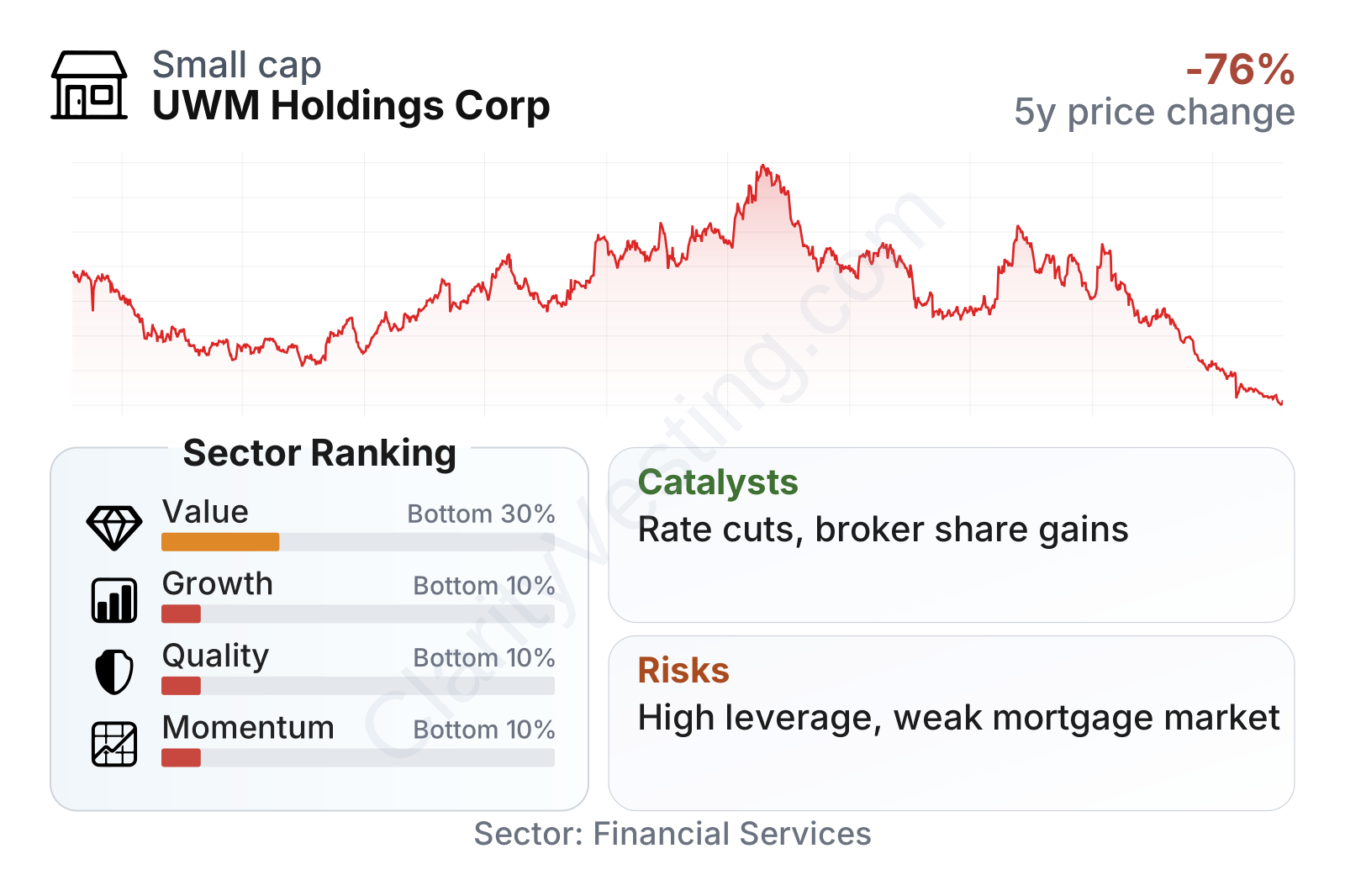
UWM is a small-cap financial company with a stock that has been notably volatile, reflected in a beta well above 1. The factor profile looks weak overall versus the broader financial sector: value ranks in the lower part of the group, while growth, quality, and momentum sit near the bottom. The standout metric is the dividend yield, which is unusually high, but that is offset by negative free cash flow, weak recent growth, and a sharp share-price decline over multiple time frames.
The stock history shows a business that has repeatedly moved with mortgage-cycle expectations. After recovering during parts of 2023 and 2024, the shares gave back much of that progress into 2026. That suggests the market is still questioning how durable earnings and book value will be through the next part of the cycle.
Growth
UWM operates in a sector with long-term structural relevance but short-term cyclicality. Mortgage finance is not a fading industry: people will continue to buy homes, refinance debt, and use mortgage brokers. The more important question is whether UWM can capture a larger share of that activity when volumes recover. On that point, the company has a credible strategy. It has built itself around the wholesale broker channel, where it has claimed leadership, and it continues to invest in technology, pricing tools, and fast loan processing to make itself more attractive to brokers.
That strategy makes sense because scale matters in mortgage lending. A lender that can spread technology, compliance, underwriting, and servicing costs across a larger base can be more competitive on price and speed. UWM’s business model is designed to reinforce that advantage: more broker partners can bring more volume, and more volume can improve operating leverage when the market normalizes.
A major catalyst for the whole sector remains interest rates. If mortgage rates fall meaningfully over time, refinancing activity could recover and affordability pressure could ease somewhat for purchase mortgages. That would likely support industry volume. For UWM specifically, any broad rebound in mortgage originations could have an outsized effect because its earnings have historically been highly sensitive to volume changes.
Earnings per share show that sensitivity clearly. Results were strong in 2021, weakened sharply through 2023, improved in 2024 and 2025, and then turned negative again on a trailing basis in 2026. That pattern does not show steady compounding; it shows a business whose earning power depends heavily on market conditions and gain-on-sale economics.
Book value per share has also been under pressure over the longer period. That is an important signal for a financial company because book value often acts as a rough anchor for long-run value creation. A declining trend suggests that even when revenue rebounds, it has not yet translated into consistently stronger balance-sheet value per share.
Recent company communications have continued to emphasize market share gains, broker channel leadership, and platform efficiency. If those share gains persist while the mortgage market eventually improves, that combination could create a meaningful operating tailwind. The most significant opportunity is not a new business line; it is the possibility that UWM emerges from a difficult mortgage cycle with a larger industry position than before.
Risks
This article is for informational purposes only and does not constitute financial advice. Some content is AI-generated. See Disclaimer


