Stock Analysis · Universal Corporation (UVV)
Overview
Universal Corporation is a global agricultural supply-chain company best known for sourcing, processing, financing, and supplying leaf tobacco to cigarette and other nicotine-product manufacturers. It operates between farmers and major tobacco producers, handling activities such as crop contracting, processing, quality control, storage, and logistics. In recent years, the company has also expanded into plant-based ingredients through acquisitions in fruit, vegetable, and flavor-related businesses, which slightly broadens it beyond tobacco.
The business is still heavily centered on tobacco. Based on the latest annual reporting for fiscal 2026, revenue is primarily generated from two operating segments.
- Tobacco Operations: approximately 90% to 92% of total revenue. This includes sourcing and processing flue-cured, burley, dark air-cured, and oriental tobacco, along with related services such as crop financing, blending support, and delivery to large manufacturers.
- Ingredients Operations: approximately 8% to 10% of total revenue. This segment includes dehydrated vegetables, fruit-based ingredients, flavors, and specialty food ingredients used by food and beverage customers.
That mix matters because it shows Universal is not a consumer tobacco brand owner like Philip Morris or British American Tobacco. It is mainly a business-to-business supplier, which gives it a different risk profile: less direct exposure to cigarette branding, but meaningful exposure to crop conditions, customer concentration, and global tobacco volumes.
Over the last several years, revenue expanded from a little above $2.1 billion to roughly $2.9 billion, but the flow from sales to final profit has become tighter. Gross profit remained relatively stable in the low-to-mid hundreds of millions, while interest expense moved up materially and net income fell sharply in the latest fiscal year. That pattern suggests scale alone has not translated into stronger earnings quality.
Key Figures
| Metric | Value | Sector ⓘ |
|---|---|---|
| Date | Oct 17, 2026 | |
| Context | ||
| Sector | Consumer Defensive | |
| Industry | Tobacco | |
| Market Cap ⓘ | $1.04B | |
| Beta ⓘ | 0.57 | |
Value (Cheapness) | ||
| P/E Ratio ⓘ | 55.14 | 17.88 |
| P/B Ratio ⓘ | 0.77 | 1.29 |
| FCF Yield ⓘ | 15.75% | 12.39% |
| Dividend Yield ⓘ | 7.83% | 2.85% |
| EBIT / EV ⓘ | 6.75% | 6.43% |
| PEG ⓘ | 11.98 | |
Growth (Business expansion) | ||
| Revenue Growth ⓘ | -11.80% | 4.10% |
| RPS Growth (5Y CAGR) ⓘ | 8.30% | 6.18% |
| EPS Growth (5Y CAGR) ⓘ | N/A | -13.59% |
| BVPS Growth (5Y CAGR) ⓘ | 1.12% | 3.20% |
| Margin Growth (5Y Trend) ⓘ | -2.04% | -0.15% |
| FCF Growth (5Y CAGR) ⓘ | N/A | 4.10% |
| DPS Growth (5Y CAGR) ⓘ | 1.28% | 6.79% |
Quality (Business durability) | ||
| ROIC (Latest) ⓘ | 3.84% | 12.34% |
| ROA (Latest) ⓘ | 0.63% | 6.30% |
| ROIC (5Y Median) ⓘ | 7.08% | 10.49% |
| ROA (5Y Median) ⓘ | 3.51% | 5.44% |
| Net Debt / EBIT (Latest) ⓘ | 7.28 | 1.96 |
| Net Debt / EBIT (5Y Median) ⓘ | 4.10 | 2.35 |
| Net Debt / EBITDA (Latest) ⓘ | 5.32 | 1.38 |
| Net Debt / Assets ⓘ | 34.38% | 21.51% |
| EBITDA / Interest ⓘ | 2.60 | 9.46 |
| Operating Margin (Latest) ⓘ | 5.03% | 8.87% |
| Operating Margin (5Y Median) ⓘ | 8.08% | 9.53% |
| Debt to Equity (Latest) ⓘ | 87.64% | 72.35% |
| Profit Margin (Latest) ⓘ | 0.67% | 5.40% |
| Free Cash Flow (Latest) ⓘ | $164.38M | |
Momentum (Price trend) | ||
| 3Y Return ⓘ | +9.79% | +20.92% |
| 12M Return (excl. last month) ⓘ | -13.26% | +2.13% |
| 6M Return ⓘ | -18.10% | +1.26% |
| Price vs. 200-Day MA ⓘ | -15.90% | +1.39% |
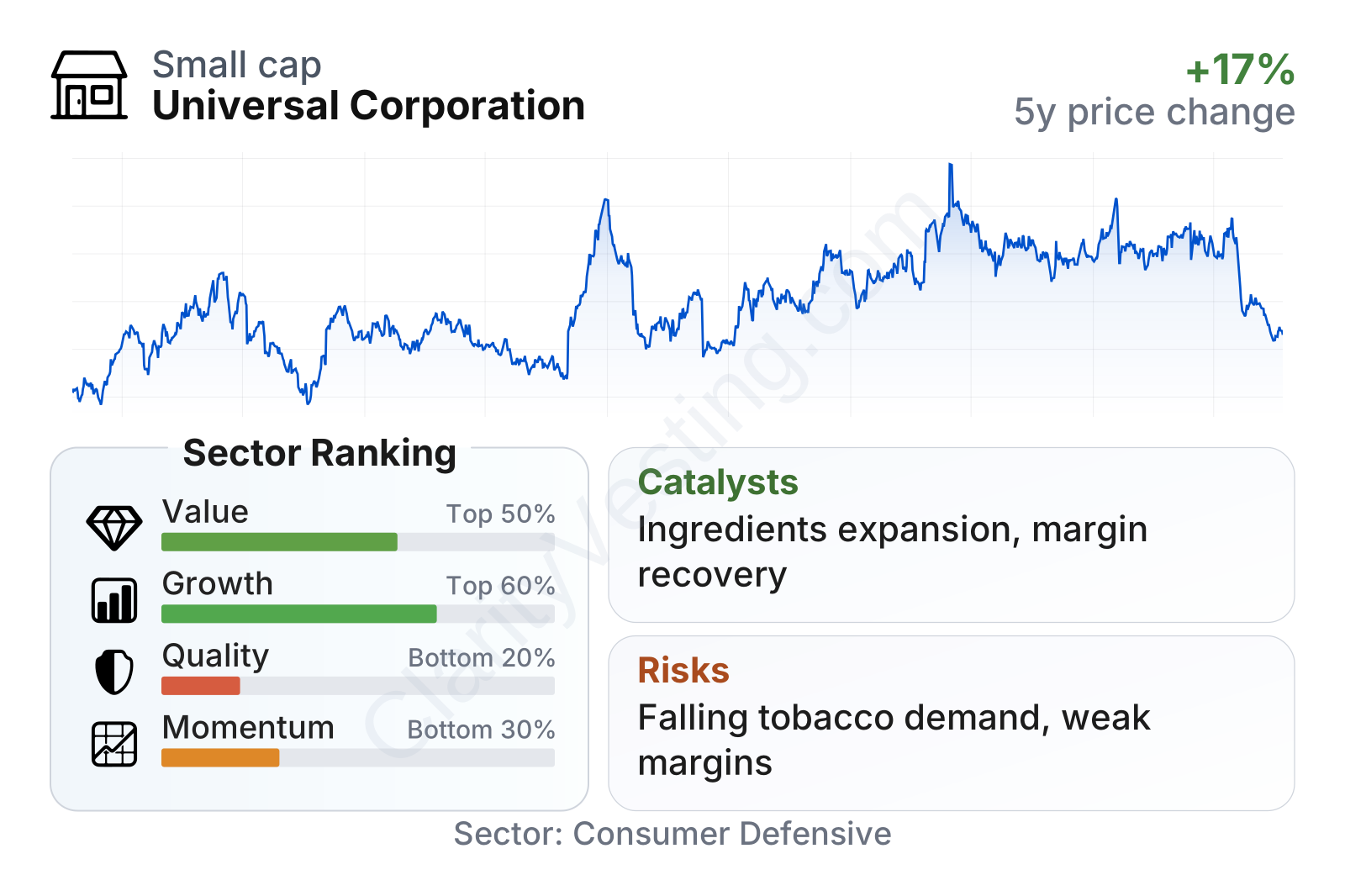
Universal is a small-cap company with a low beta, meaning its share price has historically moved less dramatically than the broader market. The profile is mixed, however. On valuation-oriented measures, the stock still shows some supportive features such as a low price-to-book ratio, a strong free-cash-flow yield, and a dividend yield well above the sector median. At the same time, quality measures are weak versus peers: profitability, returns on capital, and interest coverage all rank near the lower end of the consumer defensive group. Growth metrics also look uneven, with decent long-term revenue-per-share expansion but weak recent sales momentum and soft margin trends.
Growth
Universal operates in a sector with limited structural growth. Global cigarette consumption is under long-term pressure in many developed markets, even though tobacco leaf demand can remain more stable than consumer volumes for periods because of inventory shifts, geographic mix, and demand in emerging markets. This makes Universal more of a cash-generation and supply-chain execution business than a straightforward secular growth company.
The company’s strategy for future expansion has two parts. First, it aims to protect its core tobacco franchise by relying on long-standing grower and customer relationships, broad geographic sourcing, and logistical expertise. Second, it is trying to build a second leg through ingredients, a market with better long-term demand drivers than tobacco because it is tied to food manufacturing and value-added formulations rather than nicotine consumption.
Revenue growth has been volatile. Universal posted strong gains during parts of 2022 through 2024, then moved into a weaker phase with negative year-over-year comparisons in several recent quarters. The latest reading is below the sector median, which indicates that current momentum is not especially strong even if the longer multi-year picture is better.
Cash generation has also been uneven. Free cash flow was negative for several years, then rebounded sharply in fiscal 2025 before cooling again. Even so, trailing free cash flow remains positive, which is important for a company that emphasizes dividends and operates in a working-capital-heavy business. For long-term analysis, the main question is not whether Universal can produce cash in a good year, but whether it can do so consistently through crop cycles, customer inventory swings, and higher financing costs.
A practical catalyst is the ingredients segment. If management can keep growing that business at a healthy pace and improve its margins, Universal could become less dependent on a mature tobacco market. Another possible support is its entrenched role in the leaf tobacco supply chain, where scale, compliance capability, and global sourcing networks are hard to replicate quickly.
Recent company communications in 2026 also point to ongoing portfolio management, dividend continuity, and continued emphasis on both tobacco execution and ingredients expansion. None of that changes the low-growth nature of the legacy business, but it does suggest management is trying to build a more balanced revenue base over time.
Risks
This article is for informational purposes only and does not constitute financial advice. Some content is AI-generated. See Disclaimer


