Stock Analysis · Univest Corporation Pennsylvania (UVSP)
Overview
Univest Corporation of Pennsylvania is a regional financial services company built around banking, but it also operates in wealth management and insurance. Its main subsidiary, Univest Bank and Trust Co., serves consumers, small and mid-sized businesses, municipalities, and nonprofit organizations, mainly in Pennsylvania and nearby markets. For long-term analysis, this matters because the company is not a single-product bank: it combines traditional lending and deposit gathering with fee-based businesses that can help soften pressure when interest rates move against banks.
The largest source of revenue is typically net interest income, which is the spread between what the bank earns on loans and securities and what it pays on deposits and borrowings. Based on recent annual results, a practical breakdown is:
- Net interest income: about 70% to 75% of total revenue. This includes income from commercial loans, residential mortgages, consumer lending, and investment securities, minus funding costs.
- Wealth management fees: about 10% to 15%. This includes advisory, trust, and investment management services.
- Insurance commissions and fees: about 8% to 12%. This comes from property and casualty, employee benefits, and related brokerage activity.
- Service charges, mortgage banking, and other noninterest income: about 5% to 10%. This includes deposit account fees, card-related income, and smaller operating lines.
That revenue mix is one of Univest’s more useful features. Many smaller regional banks depend overwhelmingly on lending spreads, while Univest has meaningful fee businesses alongside the bank. Over the past several years, total revenue has expanded materially, but higher funding costs also absorbed a larger share of that revenue before easing somewhat in the most recent year. Operating expenses have been relatively controlled compared with revenue growth, helping net income recover after the more difficult rate shock period for the banking sector.
The business has become larger on the revenue line since 2021, with a notable jump during the period of higher rates. At the same time, interest expense rose sharply in 2023 and 2024 before moderating, which shows how much profitability for a regional bank can depend on deposit pricing and funding discipline.
Key Figures
| Metric | Value | Sector ⓘ |
|---|---|---|
| Date | Oct 17, 2026 | |
| Context | ||
| Sector | Financial Services | |
| Industry | Banks - Regional | |
| Market Cap ⓘ | $1.11B | |
| Beta ⓘ | 0.66 | |
Value (Cheapness) | ||
| P/E Ratio ⓘ | 11.67 | 12.26 |
| P/B Ratio ⓘ | 1.20 | 1.23 |
| FCF Yield ⓘ | 9.24% | 10.40% |
| Dividend Yield ⓘ | 2.22% | 3.02% |
| EBIT / EV ⓘ | 10.34% | 8.14% |
| PEG ⓘ | 1.30 | |
Growth (Business expansion) | ||
| Revenue Growth ⓘ | 8.40% | 9.35% |
| RPS Growth (5Y CAGR) ⓘ | 16.15% | 12.19% |
| EPS Growth (5Y CAGR) ⓘ | -9.62% | -9.53% |
| BVPS Growth (5Y CAGR) ⓘ | 5.82% | 4.99% |
| Margin Growth (5Y Trend) ⓘ | -17.16% | -3.86% |
| FCF Growth (5Y CAGR) ⓘ | 0.12% | 4.81% |
| DPS Growth (5Y CAGR) ⓘ | 2.53% | 8.79% |
Quality (Business durability) | ||
| ROIC (Latest) ⓘ | 8.02% | 9.49% |
| ROE (Latest) ⓘ | 10.43% | 13.90% |
| ROA (Latest) ⓘ | 1.17% | 1.55% |
| ROIC (5Y Median) ⓘ | 7.15% | 7.86% |
| ROE (5Y Median) ⓘ | 9.92% | 12.17% |
| ROA (5Y Median) ⓘ | 1.09% | 1.30% |
| Net Debt / EBIT (Latest) ⓘ | 2.49 | 0.96 |
| Net Debt / EBIT (5Y Median) ⓘ | 0.92 | 0.73 |
| Net Debt / EBITDA (Latest) ⓘ | 2.38 | 0.92 |
| Operating Margin (Latest) ⓘ | 23.57% | 22.30% |
| Operating Margin (5Y Median) ⓘ | 21.87% | 24.63% |
| Debt to Equity (Latest) ⓘ | 28.26% | 58.56% |
| Profit Margin (Latest) ⓘ | 29.84% | 26.57% |
| Free Cash Flow (Latest) ⓘ | $102.89M | |
Momentum (Price trend) | ||
| 3Y Return ⓘ | +166.91% | +88.33% |
| 12M Return (excl. last month) ⓘ | +42.64% | +19.38% |
| 6M Return ⓘ | +13.10% | +4.75% |
| Price vs. 200-Day MA ⓘ | +6.55% | +3.50% |
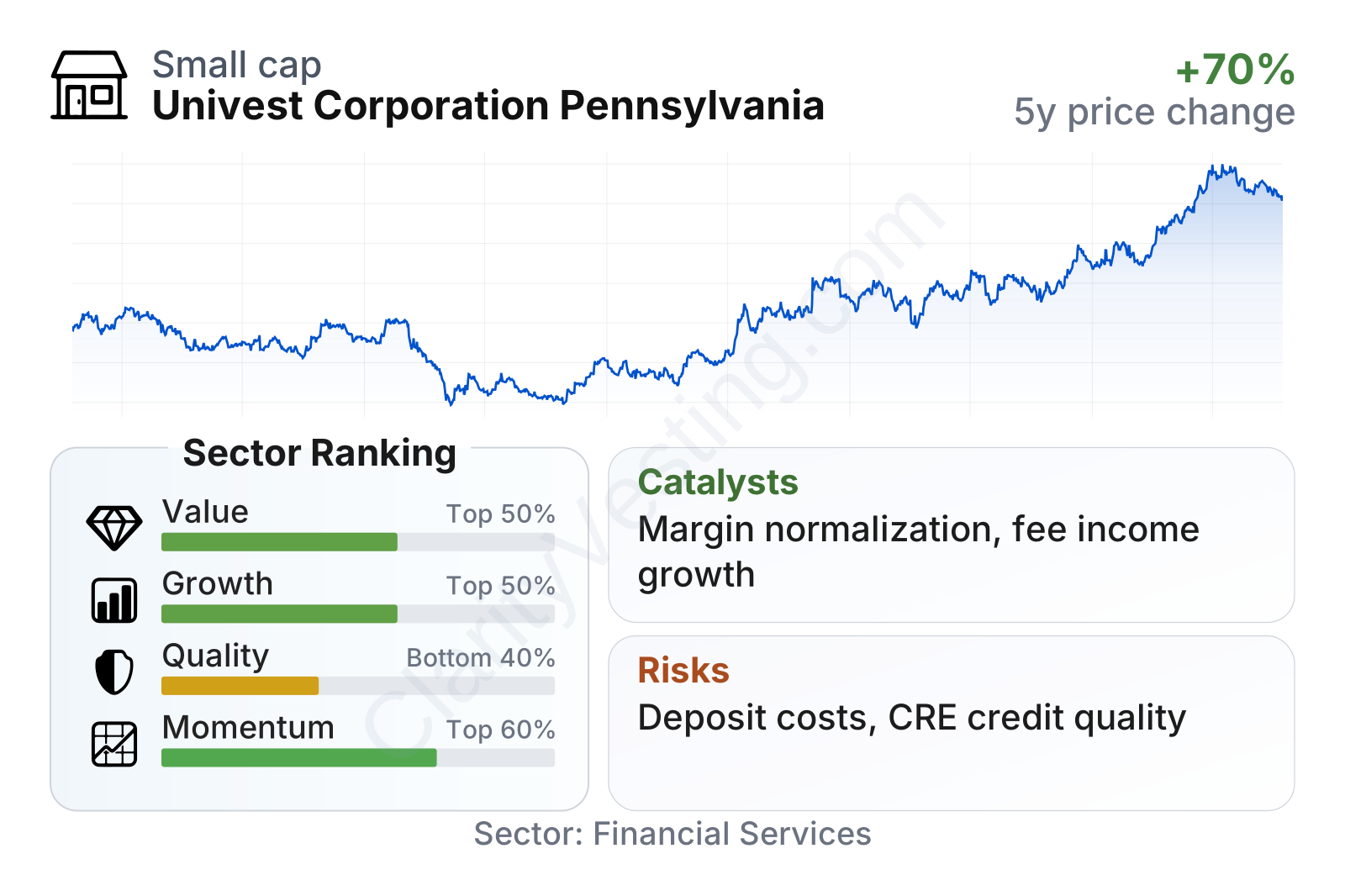
Univest sits in the middle of the pack on valuation and growth measures, while quality metrics are weaker than the regional bank median. The market is not assigning an extreme multiple: earnings and book-based valuation are close to sector norms. Growth has been respectable on a multiyear revenue-per-share basis, but profitability metrics such as return on equity and return on assets still trail many peers. Recent share-price performance has been stronger than the sector median, suggesting sentiment improved as earnings recovered and balance-sheet pressure became more manageable.
In size terms, Univest is a smaller public bank, with a market value a little above $1 billion. Its beta is below 1, which means the stock has historically moved less than the broad market on average, although bank-specific moves can still be sharp when rates, credit concerns, or deposit flows shift.
Growth
Regional banking is not a fast-growing industry in the way software or semiconductors can be, but it remains essential and can produce steady long-term expansion when a bank gains customers, deepens commercial relationships, and expands fee income. Univest operates in economically active parts of Pennsylvania and surrounding areas where small business banking, real estate lending, wealth management, and insurance can reinforce one another. That makes the sector mature rather than high-growth, but still capable of compounding if execution remains steady.
Univest’s strategy is sensible for that kind of market. It focuses on local relationship banking while keeping complementary businesses that do not depend entirely on interest spreads. Wealth and insurance are especially important because they diversify revenue and can improve customer retention. In a banking model, that is a practical advantage: a business client that also uses treasury services, insurance brokerage, and advisory support is harder to lose than a simple loan customer.
Earnings per share fell from the 2021 level through 2023, then recovered in 2024 and returned close to prior peak levels in 2025. That pattern fits the broader regional banking cycle: rapidly rising deposit costs hurt profitability, then banks that managed pricing and balance-sheet mix more effectively began to recover. The rebound is encouraging because it shows the earlier earnings decline was not purely structural, although it also shows how exposed the business remains to interest-rate conditions.
Book value per share has moved upward consistently over the last several years, rising at a moderate pace. For a bank, that is an important signal because book value reflects retained capital and balance-sheet growth over time. Even when earnings were pressured, Univest still added to shareholder equity on a per-share basis, which supports the idea of steady underlying franchise development rather than a stagnant institution.
A meaningful catalyst is the normalization of the funding environment. If deposit costs stabilize more fully while loan yields remain relatively healthy, net interest margin can improve further. Another catalyst is continued expansion in fee-based businesses, especially insurance and wealth management, which could make overall results less cyclical than those of a pure-play lender. Public company updates in 2026 have also pointed to continued profitability and capital strength rather than balance-sheet stress, which is important after the sector disruptions of recent years.
Risks
This article is for informational purposes only and does not constitute financial advice. Some content is AI-generated. See Disclaimer


