Stock Analysis · Universal Robina Corporation (UVRBF)
Overview
Universal Robina Corporation is a Philippine food and beverage company best known for branded packaged snacks, instant drinks, candies, biscuits, noodles, and ready-to-drink products sold across the Philippines and other Asian markets. It also has a meaningful presence in fresh dairy and drinks through its joint venture with Danone in the Philippines. For long-term analysis, the business is easiest to understand as a consumer staples company: it sells everyday affordable food products that tend to see repeat purchases even when economic conditions are uneven.
The company’s revenue base is fairly diversified by business line, although branded consumer foods remain the core engine. Based on recent annual disclosures, the largest sources of sales are approximately:
- Branded Consumer Foods – Philippines: about 50% to 55%
Packaged snacks, candies, chocolates, biscuits, instant noodles, bakery items, and beverages sold mainly through traditional stores and modern retail. - Branded Consumer Foods – International: about 20% to 25%
Many of the same categories sold in markets such as Vietnam, Thailand, Indonesia, Malaysia, Myanmar, and other parts of Asia. - Agro-Industrial and Commodities / Feed-related businesses: about 10% to 15%
Animal nutrition and related products, with earnings that can be more cyclical than packaged foods. - Refreshment beverages and dairy-related operations, including the Danone-related business: about 10% to 15%
Includes ready-to-drink products and dairy categories exposed to changing consumer preferences and distribution expansion.
This mix matters because it gives Universal Robina exposure to both resilient staple demand and faster-growing categories in Southeast Asia. It also means the company is not dependent on a single product line. Over the last several years, sales have continued to rise, but profits have not expanded at the same pace, suggesting that growth has come with margin pressure from costs, competition, or mix changes.
The business has clearly expanded its top line since 2021, while operating income and net income have been less consistent. In simple terms, more products are being sold, but a smaller share of each sales dollar is reaching the bottom line than a few years ago.
Key Figures
| Metric | Value | Sector ⓘ |
|---|---|---|
| Date | Nov 21, 2026 | |
| Context | ||
| Sector | Consumer Defensive | |
| Industry | Packaged Foods | |
| Market Cap ⓘ | $1.92B | |
| Beta ⓘ | 0.50 | |
Value (Cheapness) | ||
| P/E Ratio ⓘ | 10.11 | 18.64 |
| P/B Ratio ⓘ | N/A | 2.51 |
| FCF Yield ⓘ | 13.72% | 7.02% |
| Dividend Yield ⓘ | 3.79% | 2.67% |
| EBIT / EV ⓘ | 10.51% | 7.77% |
| PEG ⓘ | 1.24 | |
Growth (Business expansion) | ||
| Revenue Growth ⓘ | 6.80% | 3.80% |
| RPS Growth (5Y CAGR) ⓘ | 10.55% | 6.10% |
| EPS Growth (5Y CAGR) ⓘ | -66.34% | -10.36% |
| BVPS Growth (5Y CAGR) ⓘ | 3.73% | 3.04% |
| Margin Growth (5Y Trend) ⓘ | -2.07% | -0.21% |
| FCF Growth (5Y CAGR) ⓘ | 106.14% | 5.25% |
| DPS Growth (5Y CAGR) ⓘ | 4.65% | 5.88% |
Quality (Business durability) | ||
| ROIC (Latest) ⓘ | 8.23% | 11.80% |
| ROA (Latest) ⓘ | 5.94% | 6.20% |
| ROIC (5Y Median) ⓘ | 9.31% | 10.51% |
| ROA (5Y Median) ⓘ | 6.93% | 5.41% |
| Net Debt / EBIT (Latest) ⓘ | 0.98 | 1.88 |
| Net Debt / EBIT (5Y Median) ⓘ | 0.79 | 2.32 |
| Net Debt / EBITDA (Latest) ⓘ | 0.68 | 1.29 |
| Net Debt / Assets ⓘ | 7.88% | 20.02% |
| EBITDA / Interest ⓘ | 17.58 | 9.62 |
| Operating Margin (Latest) ⓘ | 8.76% | 9.06% |
| Operating Margin (5Y Median) ⓘ | 10.30% | 9.57% |
| Debt to Equity (Latest) ⓘ | 22.69% | 67.45% |
| Profit Margin (Latest) ⓘ | 6.42% | 5.43% |
| Free Cash Flow (Latest) ⓘ | $263.76M | |
Momentum (Price trend) | ||
| 3Y Return ⓘ | -50.73% | +17.50% |
| 12M Return (excl. last month) ⓘ | -18.93% | +3.34% |
| 6M Return ⓘ | -5.50% | +2.78% |
| Price vs. 200-Day MA ⓘ | -23.17% | +3.79% |
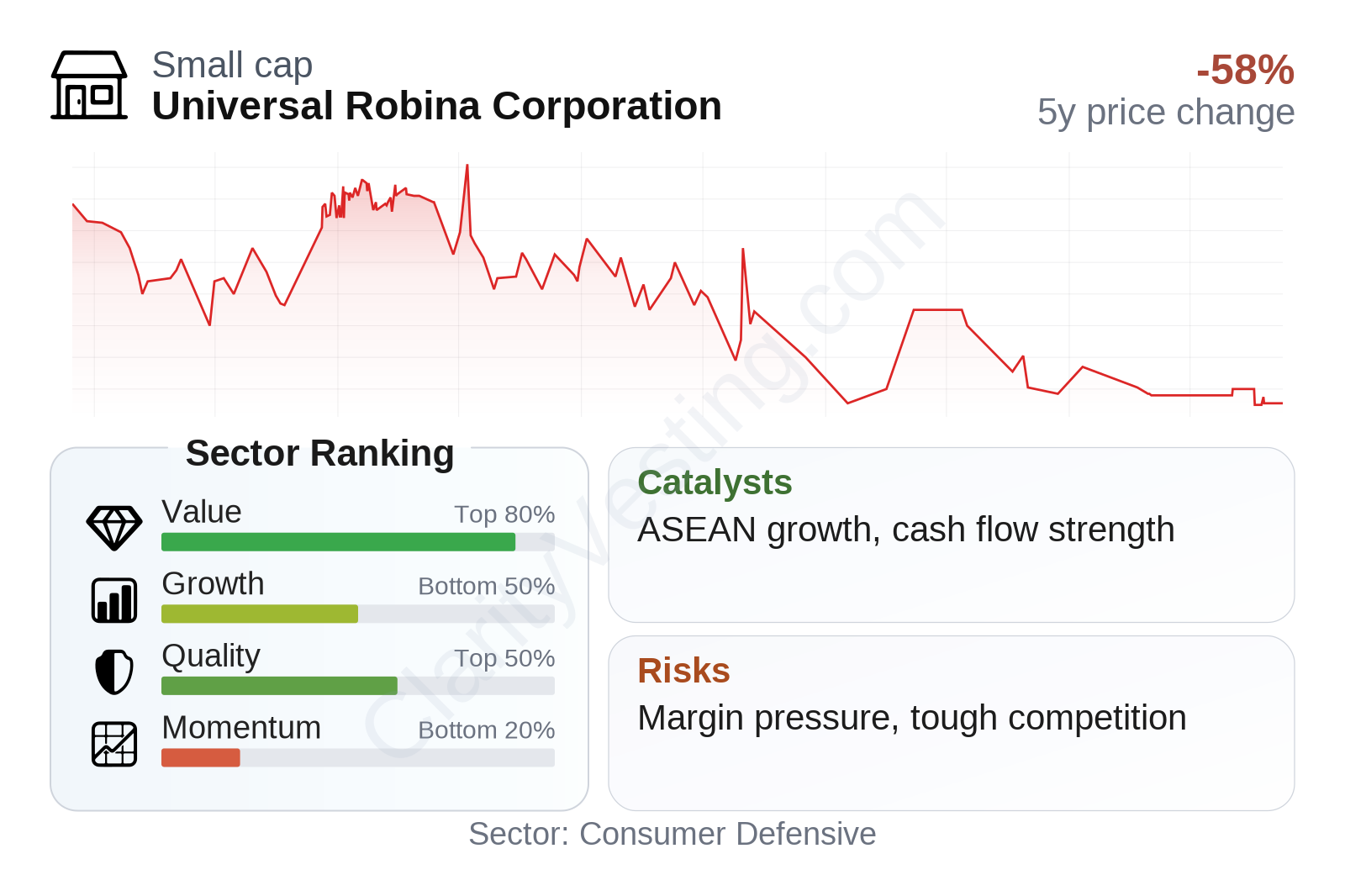
Universal Robina is a mid-sized consumer staples company with a relatively low share-price volatility profile, shown by a beta close to 0.5. On valuation measures, it screens cheaper than many peers in packaged foods: the earnings multiple is well below the sector median, free cash flow yield is notably stronger than average, and the dividend yield is also above the sector median. At the same time, its growth and momentum profile is weaker than the broader group, which helps explain why the market is assigning a lower multiple. Quality looks solid rather than exceptional, supported by conservative leverage and healthy cash generation, even though returns on capital are not among the best in the sector.
Growth
Universal Robina operates in a sector that is generally attractive for long-term demand: affordable branded food and beverages in Southeast Asia. Population growth, urbanization, rising convenience-oriented consumption, and the gradual shift from unbranded to branded packaged foods all support the category over time. These are not usually explosive growth markets, but they can be durable ones.
The company’s strategy also makes sense on paper. It combines a strong home-market position in the Philippines with expansion across neighboring countries, while keeping a product portfolio centered on mass-market price points. That approach can work well in emerging consumer markets because lower-ticket branded products often travel better across income segments than premium categories do.
Revenue growth has cooled from the very strong post-pandemic rebound, but the pattern still points to a business that is expanding rather than shrinking. Recent year-over-year growth has mostly stayed positive, though at a more moderate pace. That suggests the main question is not demand collapse, but whether the company can turn steady sales growth into better earnings growth.
One of the most encouraging signals is cash generation. Free cash flow has improved sharply, reaching a level far above where it stood several years ago. Stronger cash conversion gives the company more room to fund capital spending, maintain dividends, reduce debt, or support selective expansion without depending heavily on outside financing.
A useful catalyst is the company’s exposure to categories that can benefit from brand strength and distribution scale, especially snacks, beverages, and convenience food. Another is operating discipline: if management can stabilize input costs and improve mix toward better-margin products, earnings could improve faster than revenue. The company’s regional footprint also creates opportunities if consumer demand in Southeast Asia remains healthy and if newer products gain traction in modern retail channels.
Recent company communications have also emphasized continued brand investment, product innovation, and expansion in key categories. None of these alone transforms the business overnight, but together they support the view that Universal Robina still has room to compound through everyday consumption rather than through a single breakthrough event.
Risks
This article is for informational purposes only and does not constitute financial advice. Some content is AI-generated. See Disclaimer