Stock Analysis · Universal Insurance Holdings Inc (UVE)
Overview
Universal Insurance Holdings is a property and casualty insurance company focused mainly on homeowners coverage. Through its insurance subsidiaries, the group underwrites policies for homes and related personal residential risks, with a particularly strong presence in Florida and a growing footprint in other U.S. states. The business is relatively easy to understand: it collects premiums from policyholders, invests part of that float, pays claims when covered losses occur, and keeps the difference after operating expenses and reinsurance costs.
The company’s revenue is driven first by insurance activity and second by investment-related income. Based on recent annual filings, the mix is heavily concentrated in premiums, while other revenue streams are much smaller.
- Direct premiums earned and other underwriting revenue: approximately 90% to 95% of total revenue. This includes homeowners insurance and other personal residential lines, net of changes tied to earned premium recognition over the life of policies.
- Net investment income: approximately 3% to 6%. This comes from the company’s investment portfolio, which is important for insurers because premium cash is invested before claims are paid.
- Other revenue and service-related items: generally less than 5%. This can include commission-related items, fee income, or other smaller insurance-related sources depending on the period.
Geographically, Universal remains most exposed to Florida, even though management has spent several years expanding into other states to reduce concentration. That matters because in property insurance, where a company operates can be just as important as how much it sells.
The profit flow over the last several years shows a sharp recovery. After a difficult 2022 with underwriting pressure and losses, revenue kept rising while profitability improved materially in 2023, stayed solid in 2024, and then strengthened sharply in 2025 as claims experience and underwriting economics improved.
Key Figures
| Metric | Value | Sector ⓘ |
|---|---|---|
| Date | Oct 17, 2026 | |
| Context | ||
| Sector | Financial Services | |
| Industry | Insurance - Property & Casualty | |
| Market Cap ⓘ | $1.30B | |
| Beta ⓘ | 0.70 | |
Value (Cheapness) | ||
| P/E Ratio ⓘ | 6.14 | 12.26 |
| P/B Ratio ⓘ | 2.12 | 1.23 |
| FCF Yield ⓘ | 26.14% | 10.40% |
| Dividend Yield ⓘ | 1.36% | 3.02% |
| EBIT / EV ⓘ | 39.93% | 8.14% |
| PEG ⓘ | N/A | |
Growth (Business expansion) | ||
| Revenue Growth ⓘ | 6.70% | 9.35% |
| RPS Growth (5Y CAGR) ⓘ | 11.50% | 12.19% |
| EPS Growth (5Y CAGR) ⓘ | N/A | -9.53% |
| BVPS Growth (5Y CAGR) ⓘ | 8.65% | 4.99% |
| Margin Growth (5Y Trend) ⓘ | 13.05% | -3.86% |
| FCF Growth (5Y CAGR) ⓘ | 13.51% | 4.81% |
| DPS Growth (5Y CAGR) ⓘ | -0.11% | 8.79% |
Quality (Business durability) | ||
| ROIC (Latest) ⓘ | 33.65% | 9.49% |
| ROE (Latest) ⓘ | 38.84% | 13.90% |
| ROA (Latest) ⓘ | 6.88% | 1.55% |
| ROIC (5Y Median) ⓘ | 13.50% | 7.86% |
| ROE (5Y Median) ⓘ | 16.49% | 12.17% |
| ROA (5Y Median) ⓘ | 2.28% | 1.30% |
| Net Debt / EBIT (Latest) ⓘ | -1.45 | 0.96 |
| Net Debt / EBIT (5Y Median) ⓘ | -2.37 | 0.73 |
| Net Debt / EBITDA (Latest) ⓘ | -1.42 | 0.92 |
| Operating Margin (Latest) ⓘ | 18.39% | 22.30% |
| Operating Margin (5Y Median) ⓘ | 5.94% | 24.63% |
| Debt to Equity (Latest) ⓘ | 15.36% | 58.56% |
| Profit Margin (Latest) ⓘ | 13.50% | 26.57% |
| Free Cash Flow (Latest) ⓘ | $339.68M | |
Momentum (Price trend) | ||
| 3Y Return ⓘ | +264.49% | +88.33% |
| 12M Return (excl. last month) ⓘ | +79.58% | +19.38% |
| 6M Return ⓘ | +37.12% | +4.75% |
| Price vs. 200-Day MA ⓘ | +23.87% | +3.50% |
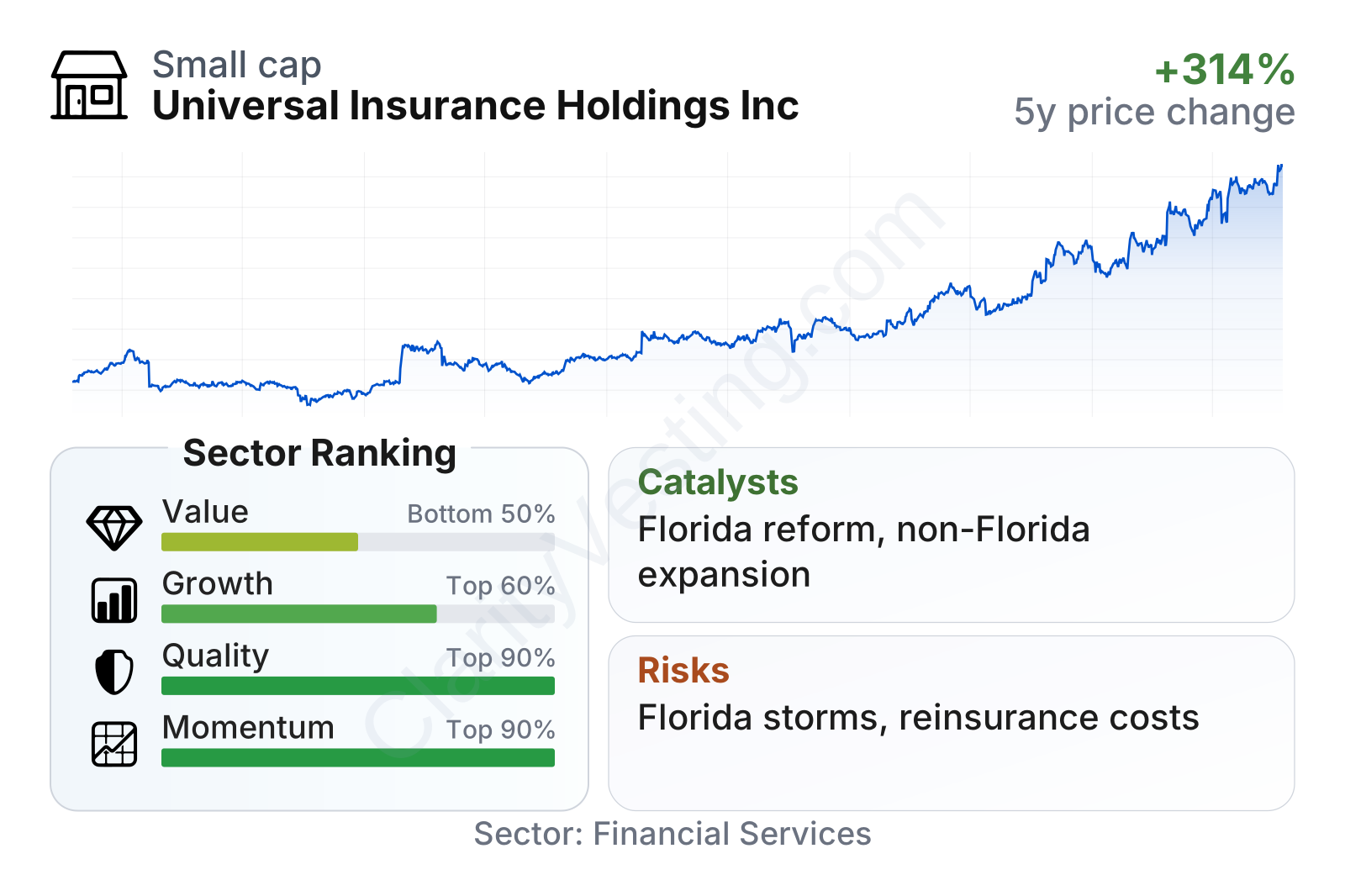
Universal sits in the small-cap range, with a share-price record that has been very strong over the last three years. The factor profile is unusual in a good way: quality ranks near the top of the sector, momentum is also strong, and free cash generation stands out. Growth is respectable rather than exceptional, while the value picture is mixed because the earnings multiple is very low but the price-to-book ratio is above the sector median. That combination usually signals that the market is recognizing a real operational turnaround, but not valuing the company as cheaply on balance-sheet terms as it did in the past.
Growth
The property and casualty insurance sector is not a classic high-growth industry, but it can deliver attractive long-term expansion when pricing improves and insurers gain share in underserved markets. Universal operates in a segment where demand is persistent: homeowners need coverage, mortgage lenders usually require it, and in catastrophe-prone regions insurance availability often tightens after weaker players pull back. That creates room for disciplined carriers to grow.
Universal’s strategy makes sense in that context. Management has been pushing rate adequacy, reinsurance discipline, and geographic diversification outside Florida. For a company with roots in one of the most difficult homeowners markets in the country, that diversification effort is important because it can reduce dependence on one regulatory and catastrophe environment. Growth does not have to come only from writing many more policies; it can also come from better pricing, a healthier mix of risks, and improved retention where returns are attractive.
Earnings progression highlights how powerful that recovery has been. Results moved from a loss period in 2022 to a meaningful rebound in 2023 and 2024, followed by a major jump in 2025. That pattern suggests the company benefited from stronger underwriting conditions rather than simple top-line expansion alone, which is often more valuable in insurance.
Book value per share has also recovered well after the earlier drawdown. For insurers, book value is a useful long-term anchor because it reflects how capital is being rebuilt over time. Universal’s multi-year increase has outpaced the sector median, which supports the view that recent earnings are translating into stronger shareholder equity, not just temporary accounting gains.
A meaningful catalyst is the ongoing reshaping of the Florida insurance market. In recent years, the state has gone through heavy disruption, insurer failures, litigation reform efforts, and changes in pricing conditions. For companies that remain adequately capitalized and operationally disciplined, that can create a better competitive environment than in the past. Another catalyst is reinsurance execution: if Universal continues to secure sufficient protection at manageable cost, earnings stability can improve materially. Recent company updates have also pointed to continued premium growth outside Florida, which matters because even moderate success there can broaden the earnings base over time.
Risks
This article is for informational purposes only and does not constitute financial advice. Some content is AI-generated. See Disclaimer


