Stock Analysis · Energy Fuels Inc (UUUU)
Overview
Energy Fuels Inc. is a U.S.-based critical minerals company best known for uranium, but its business has expanded beyond nuclear fuel materials. The company owns and operates uranium mining assets in the United States, conventional and in-situ recovery projects, and the White Mesa Mill in Utah, which is widely described by the company as the only operating conventional uranium mill in the U.S. In recent years, Energy Fuels has also built positions in rare earth elements, heavy mineral sands, vanadium, and medical isotope-related materials. That makes it more diversified than a pure uranium miner, even though uranium remains the core economic driver.
Its revenue can shift sharply from year to year because sales depend on the timing of uranium deliveries, inventory sales, market prices, and newer businesses that are still scaling. Based on the company’s latest public filings and disclosures, the revenue mix is best understood as follows:
- Uranium: approximately 70% to 85% of revenue in the most recent period. This includes sales of U3O8 produced from company assets or sold from inventory under long-term and spot arrangements.
- Heavy mineral sands and rare earth-related materials: approximately 10% to 25%. This reflects the company’s developing critical minerals platform, including monazite processing and feedstock-related activity.
- Vanadium and other materials/services: generally 0% to 10%. This can include vanadium sales when market conditions are favorable, tolling or processing-related activity, and smaller by-product streams.
The bigger strategic point is that Energy Fuels is trying to become a domestic supplier of several materials that the U.S. considers strategically important: uranium for nuclear power, rare earth materials for magnets and advanced manufacturing, and selected isotopes or feedstocks tied to medical and industrial uses. That ambition is larger than the company’s current income statement, which still shows a business in transition rather than a fully mature multi-product producer.
The longer-term pattern has been uneven: revenue has grown substantially from very low levels a few years ago, but operating costs and corporate spending have also risen, which has kept profitability volatile and recently negative.
Key Figures
| Metric | Value | Sector ⓘ |
|---|---|---|
| Date | Oct 17, 2026 | |
| Context | ||
| Sector | Energy | |
| Industry | Uranium | |
| Market Cap ⓘ | $2.45B | |
| Beta ⓘ | 1.87 | |
Value (Cheapness) | ||
| P/E Ratio ⓘ | N/A | 15.44 |
| P/B Ratio ⓘ | 2.46 | 1.73 |
| FCF Yield ⓘ | -4.52% | 8.20% |
| Dividend Yield ⓘ | N/A | 3.59% |
| EBIT / EV ⓘ | -2.92% | 7.46% |
| PEG ⓘ | N/A | |
Growth (Business expansion) | ||
| Revenue Growth ⓘ | 496.10% | 26.90% |
| RPS Growth (5Y CAGR) ⓘ | 91.04% | 6.90% |
| EPS Growth (5Y CAGR) ⓘ | -12.46% | -15.73% |
| BVPS Growth (5Y CAGR) ⓘ | 10.82% | 6.07% |
| Margin Growth (5Y Trend) ⓘ | N/A | 0.58% |
| FCF Growth (5Y CAGR) ⓘ | N/A | 1.86% |
| DPS Growth (5Y CAGR) ⓘ | N/A | 16.79% |
Quality (Business durability) | ||
| ROIC (Latest) ⓘ | -5.21% | 11.40% |
| ROA (Latest) ⓘ | -7.13% | 6.06% |
| ROIC (5Y Median) ⓘ | -7.22% | 10.30% |
| ROA (5Y Median) ⓘ | -8.46% | 5.42% |
| Net Debt / EBIT (Latest) ⓘ | N/A | 1.64 |
| Net Debt / EBIT (5Y Median) ⓘ | N/A | 1.83 |
| Net Debt / EBITDA (Latest) ⓘ | N/A | 1.08 |
| Net Debt / Assets ⓘ | 40.67% | 17.29% |
| EBITDA / Interest ⓘ | N/A | 9.64 |
| Operating Margin (Latest) ⓘ | -77.80% | 16.27% |
| Operating Margin (5Y Median) ⓘ | -61.72% | 20.39% |
| Debt to Equity (Latest) ⓘ | 86.04% | 54.76% |
| Profit Margin (Latest) ⓘ | -77.30% | 8.82% |
| Free Cash Flow (Latest) ⓘ | -$111.06M | |
Momentum (Price trend) | ||
| 3Y Return ⓘ | +10.61% | +67.38% |
| 12M Return (excl. last month) ⓘ | +3.44% | +49.19% |
| 6M Return ⓘ | -57.32% | +7.07% |
| Price vs. 200-Day MA ⓘ | -50.77% | +9.56% |
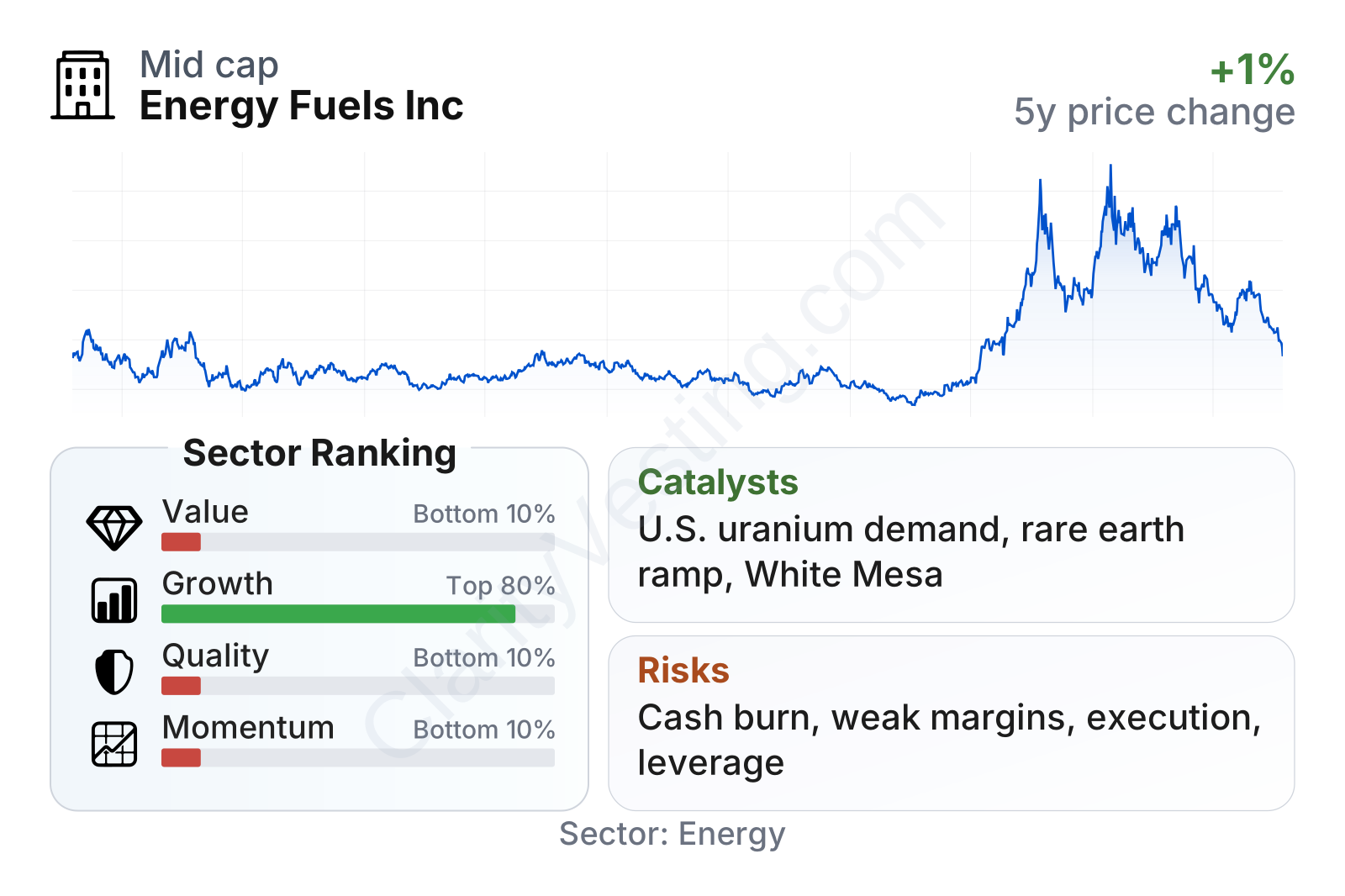
Energy Fuels is a mid-cap uranium and critical minerals company with above-average share price volatility, reflected in a beta around 1.6. The overall factor picture is mixed. Growth metrics look strong relative to much of the energy sector, helped by low historical revenue bases and large swings in product sales, but value, quality, and momentum rank poorly. The company trades at a premium to book value, has negative free cash flow yield, and current profitability measures remain well below sector norms. In simple terms, the market is still valuing future optionality more than present earnings power.
Growth
Energy Fuels operates in a part of the market with clear long-term structural support. Uranium demand is linked to nuclear power, and nuclear power has regained importance because it offers low-carbon baseload electricity. Governments in the U.S. and allied countries are also trying to reduce dependence on foreign supply chains for uranium, conversion, enrichment, and rare earth materials. That broad policy backdrop is favorable for companies with domestic assets and processing infrastructure.
The company’s strategy broadly makes sense in that context. White Mesa gives Energy Fuels a rare U.S. processing asset, and the company has been using that footprint to expand into monazite and rare earth separation. If this effort scales successfully, Energy Fuels could become more than a uranium price vehicle. It could become one of the few publicly traded U.S. companies with meaningful exposure to both nuclear fuel materials and domestic rare earth processing.
Revenue growth has been extremely volatile rather than steady. The latest year-over-year figure is very strong, and five-year revenue per share growth has far exceeded the sector median. However, the history shows large swings tied to contract timing, inventory movements, and project ramp-up rather than a smooth operating trend. That means growth exists, but it is lumpy.
Cash generation remains an important reality check. Free cash flow has stayed negative and has worsened as the company has invested in inventory, project development, acquisitions, and processing capacity. For a developing materials platform, that is not unusual, but it does mean the growth plan is still absorbing cash instead of producing it.
Recent company updates have pointed to several potential catalysts. These include progress on rare earth separation capabilities at White Mesa, heavy mineral sands development in countries such as Australia, ongoing uranium contracting activity, and continued U.S. interest in building domestic nuclear fuel and critical minerals supply chains. Another meaningful opportunity is the longer-term shift toward small modular reactors and broader nuclear fleet support, which could strengthen demand for domestically sourced uranium products over time.
Risks
This article is for informational purposes only and does not constitute financial advice. Some content is AI-generated. See Disclaimer


