Stock Analysis · United Utilities Group PLC (UUGRY)
Overview
United Utilities Group PLC is a regulated water and wastewater utility serving North West England. In simple terms, it owns and operates the networks that bring drinking water to homes and businesses, then collects and treats wastewater. That makes it part of an essential public service industry where demand is usually steady because water is a basic need.
The business model is relatively straightforward. The company invests heavily in pipes, treatment works, reservoirs, and environmental upgrades, then earns returns within a regulatory framework set by Ofwat, the water regulator in England and Wales. This regulation matters a lot because it largely determines what the company can charge customers and how much return it can earn on its infrastructure base.
Revenue is mainly concentrated in two operating activities, with very little contribution from anything outside the core network business.
- Water services: approximately 35% to 45% of revenue. This includes supplying clean water to households and commercial customers, maintaining water networks, and associated regulated charges.
- Wastewater services: approximately 55% to 65% of revenue. This includes sewerage, drainage, wastewater transport, treatment, and related regulated services.
- Other activities: a small residual share. This can include developer services, renewable energy-related items, and miscellaneous non-core or support income.
For a long-term view, the important point is that United Utilities is not trying to win customers in the way a normal consumer brand would. Its economic profile depends far more on regulation, operational performance, environmental compliance, financing costs, and disciplined capital spending than on marketing or market share gains.
The business mix remains heavily centered on regulated utility income, and the broad direction has been toward higher revenue and stronger operating profit over time. That said, financing costs are still meaningful, which is typical for a capital-intensive water utility.
Key Figures
| Metric | Value | Sector ⓘ |
|---|---|---|
| Date | Nov 21, 2026 | |
| Context | ||
| Sector | Utilities | |
| Industry | Utilities - Regulated Water | |
| Market Cap ⓘ | $15.13B | |
| Beta ⓘ | 0.58 | |
Value (Cheapness) | ||
| P/E Ratio ⓘ | 14.44 | 17.21 |
| P/B Ratio ⓘ | N/A | 1.97 |
| FCF Yield ⓘ | -4.48% | -0.81% |
| Dividend Yield ⓘ | 3.54% | 3.67% |
| EBIT / EV ⓘ | 9.68% | 5.78% |
| PEG ⓘ | 1.25 | |
Growth (Business expansion) | ||
| Revenue Growth ⓘ | 11.70% | 8.30% |
| RPS Growth (5Y CAGR) ⓘ | 9.24% | 3.61% |
| EPS Growth (5Y CAGR) ⓘ | N/A | -2.03% |
| BVPS Growth (5Y CAGR) ⓘ | -6.75% | 4.29% |
| Margin Growth (5Y Trend) ⓘ | 7.25% | 3.68% |
| FCF Growth (5Y CAGR) ⓘ | N/A | -8.99% |
| DPS Growth (5Y CAGR) ⓘ | 5.24% | 4.70% |
Quality (Business durability) | ||
| ROIC (Latest) ⓘ | 11.21% | 6.37% |
| ROA (Latest) ⓘ | 6.36% | 3.14% |
| ROIC (5Y Median) ⓘ | 4.39% | 5.97% |
| ROA (5Y Median) ⓘ | 1.41% | 2.74% |
| Net Debt / EBIT (Latest) ⓘ | 4.63 | 7.15 |
| Net Debt / EBIT (5Y Median) ⓘ | 12.06 | 7.25 |
| Net Debt / EBITDA (Latest) ⓘ | 3.10 | 4.42 |
| Net Debt / Assets ⓘ | 48.09% | 38.03% |
| EBITDA / Interest ⓘ | 4.06 | 4.57 |
| Operating Margin (Latest) ⓘ | 39.33% | 20.06% |
| Operating Margin (5Y Median) ⓘ | 34.44% | 19.99% |
| Debt to Equity (Latest) ⓘ | 364.43% | 137.61% |
| Profit Margin (Latest) ⓘ | 26.98% | 10.90% |
| Free Cash Flow (Latest) ⓘ | -$677.99M | |
Momentum (Price trend) | ||
| 3Y Return ⓘ | +73.48% | +47.60% |
| 12M Return (excl. last month) ⓘ | +27.00% | +6.07% |
| 6M Return ⓘ | +17.48% | 0.00% |
| Price vs. 200-Day MA ⓘ | +11.31% | +1.40% |
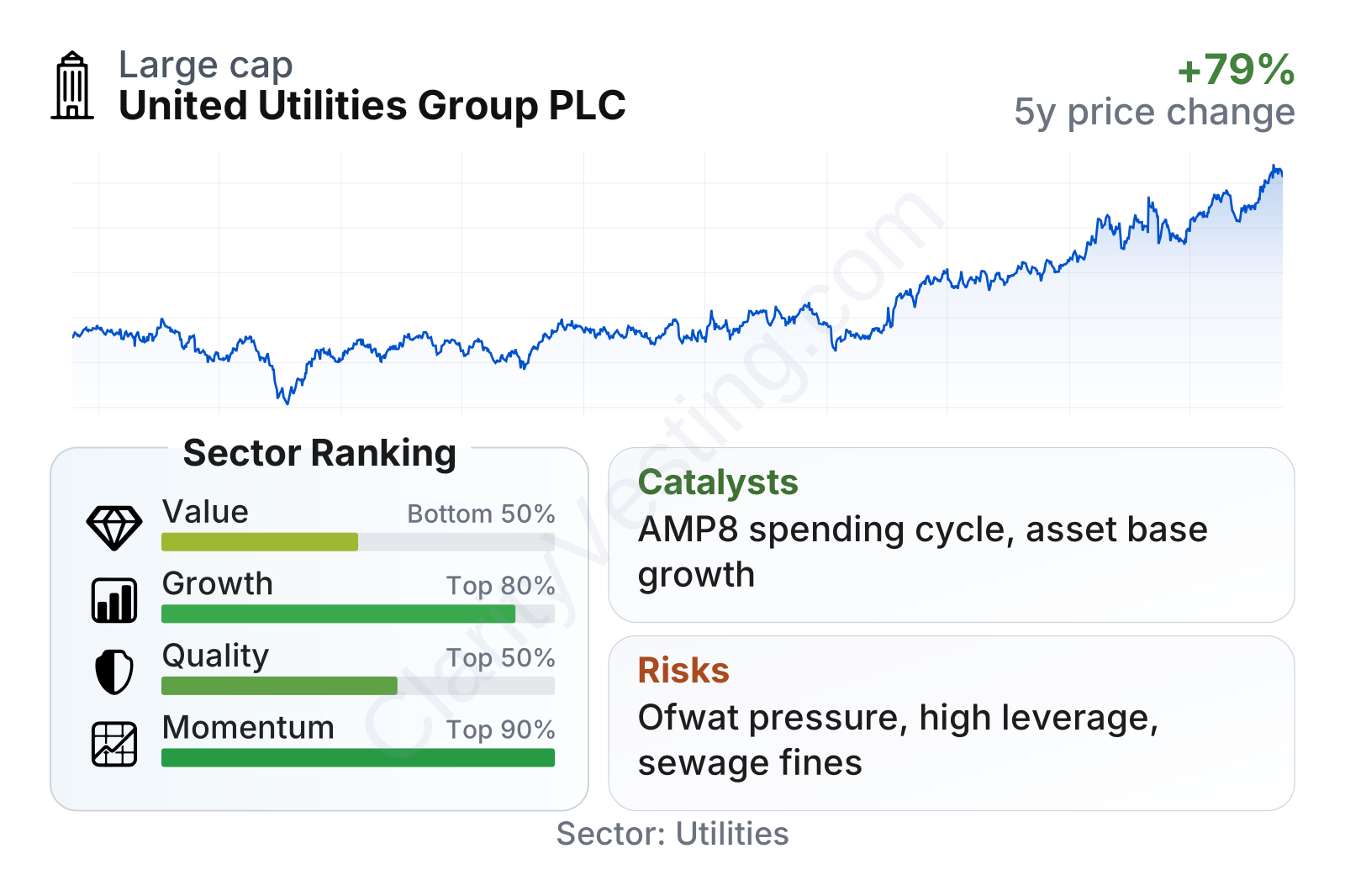
United Utilities stands out as a large, lower-volatility utility, with a beta well below 1. Its growth and share-price momentum rank well against many utility peers, while quality is solid rather than exceptional. On valuation, the picture is mixed: earnings multiples are not stretched relative to the sector, but cash generation is currently under pressure, which weakens the value profile. The overall setup is consistent with a defensive infrastructure business that has recently improved its earnings profile but still carries balance-sheet and cash-flow constraints common in the water sector.
Growth
The regulated water sector is not a fast-moving growth industry in the usual sense, but it is supported by durable long-term demand. Population needs, aging infrastructure, climate resilience spending, leakage reduction, and tighter environmental standards all require large and ongoing investment. That gives companies like United Utilities a visible runway for asset growth, even if customer demand itself grows slowly.
United Utilities’ strategy broadly fits that environment. The company is focused on expanding and upgrading its regulated asset base, improving network resilience, reducing pollution incidents and leakage, and aligning with the next regulatory period in the UK water market. In a regulated utility, future growth often comes less from selling more units and more from earning returns on a larger infrastructure base and meeting performance targets efficiently.
Revenue per share has moved upward at a healthy pace over the last five years, and that is notable for a utility. The trend suggests that tariff changes, regulatory mechanisms, and the underlying asset program have translated into stronger top-line output on a per-share basis.
One practical catalyst is the start of the new AMP8 investment cycle in the UK water sector, which is set to require very large network and environmental spending across the industry. For a company with an established regional franchise and a deep pipeline of projects, that can support a larger regulated asset base over time. Another catalyst is operational delivery: if United Utilities meets service, leakage, and environmental targets efficiently, returns can be stronger and penalties lower.
Recent company reporting also points to stronger reported revenue and profit than in prior years, which supports the case that the business is entering this new investment period from a position of improving earnings strength. The stock’s strong medium-term momentum also indicates that the market has already recognized some of that improvement.
Free cash flow needs more caution. Utilities often swing into negative free cash flow during heavy investment phases because they are building long-lived infrastructure. That does not automatically signal operational weakness, but it does mean growth is dependent on regulation, access to funding, and the company’s ability to convert capital spending into future allowed returns.
Risks
This article is for informational purposes only and does not constitute financial advice. Some content is AI-generated. See Disclaimer


