Stock Analysis · Utz Brands Inc (UTZ)
Overview
Utz Brands is a U.S. salty snacks company best known for potato chips, tortilla chips, pretzels, cheese snacks, pork skins, popcorn, and party mixes. Its portfolio includes the flagship Utz brand as well as On The Border, Zapp’s, Boulder Canyon, Golden Flake, Hawaiian Brand, Tortiyahs!, Dirty Potato Chips, Good Health, and several regional labels. The business is focused mainly on selling branded snack foods through grocery stores, mass retailers, club stores, convenience channels, and foodservice.
The company reports its business primarily as one operating platform rather than many separate segments, so revenue detail is more visible by product family and customer channel than by formal reporting segment. Based on recent annual disclosures, the largest revenue sources are broadly the following:
- Potato chips and other salty snacks: approximately 45% to 55% of revenue. This includes core potato chips, kettle chips, ridged chips, cheese snacks, party mixes, and similar packaged savory products sold under Utz and acquired brands.
- Pretzels: approximately 15% to 25% of revenue. This includes traditional pretzels, twists, rods, and filled or flavored pretzel products.
- Tortilla chips, salsa, and Mexican-inspired snacks: approximately 10% to 20% of revenue. This is largely tied to brands such as On The Border and related tortilla-based products.
- Pork skins, popcorn, pub/party mixes, and other snacks: approximately 10% to 15% of revenue. These are smaller but still meaningful categories that help diversify the shelf offering.
- Private label and other revenues: a smaller share. This includes products made for other labels and certain non-core sales.
Geographically, Utz is still overwhelmingly a U.S.-focused business. That concentration makes the company easier to understand: it is essentially a domestic branded snacks manufacturer trying to expand distribution, improve shelf presence, and raise margins through scale and better mix.
One important operating pattern stands out over the last several years: revenue has been fairly stable around the low-$1.4 billion range, but profitability has been much less stable. Gross profit improved in 2024, then weakened sharply in 2025, showing that the main debate around Utz is not demand alone, but whether it can consistently convert sales into attractive earnings and cash generation.
Key Figures
| Metric | Value | Sector ⓘ |
|---|---|---|
| Date | Oct 17, 2026 | |
| Context | ||
| Sector | Consumer Defensive | |
| Industry | Packaged Foods | |
| Market Cap ⓘ | $2.06B | |
| Beta ⓘ | 0.73 | |
Value (Cheapness) | ||
| P/E Ratio ⓘ | N/A | 17.88 |
| P/B Ratio ⓘ | 16.21 | 1.29 |
| FCF Yield ⓘ | 2.48% | 12.39% |
| Dividend Yield ⓘ | 2.60% | 2.85% |
| EBIT / EV ⓘ | 0.47% | 6.43% |
| PEG ⓘ | N/A | |
Growth (Business expansion) | ||
| Revenue Growth ⓘ | 1.40% | 4.10% |
| RPS Growth (5Y CAGR) ⓘ | 3.01% | 6.18% |
| EPS Growth (5Y CAGR) ⓘ | -12.04% | -13.59% |
| BVPS Growth (5Y CAGR) ⓘ | N/A | 3.20% |
| Margin Growth (5Y Trend) ⓘ | -1.02% | -0.15% |
| FCF Growth (5Y CAGR) ⓘ | -10.86% | 4.10% |
| DPS Growth (5Y CAGR) ⓘ | 14.69% | 6.79% |
Quality (Business durability) | ||
| ROIC (Latest) ⓘ | 0.51% | 12.34% |
| ROA (Latest) ⓘ | -1.04% | 6.30% |
| ROIC (5Y Median) ⓘ | 1.57% | 10.49% |
| ROA (5Y Median) ⓘ | 0.03% | 5.44% |
| Net Debt / EBIT (Latest) ⓘ | 93.45 | 1.96 |
| Net Debt / EBIT (5Y Median) ⓘ | 24.63 | 2.35 |
| Net Debt / EBITDA (Latest) ⓘ | 9.90 | 1.38 |
| Net Debt / Assets ⓘ | 35.02% | 21.51% |
| EBITDA / Interest ⓘ | 1.30 | 9.46 |
| Operating Margin (Latest) ⓘ | 0.72% | 8.87% |
| Operating Margin (5Y Median) ⓘ | 2.95% | 9.53% |
| Debt to Equity (Latest) ⓘ | 148.08% | 72.35% |
| Profit Margin (Latest) ⓘ | -2.00% | 5.40% |
| Free Cash Flow (Latest) ⓘ | $51.10M | |
Momentum (Price trend) | ||
| 3Y Return ⓘ | +27.64% | +20.92% |
| 12M Return (excl. last month) ⓘ | +13.46% | +2.13% |
| 6M Return ⓘ | +92.01% | +1.26% |
| Price vs. 200-Day MA ⓘ | +42.96% | +1.39% |
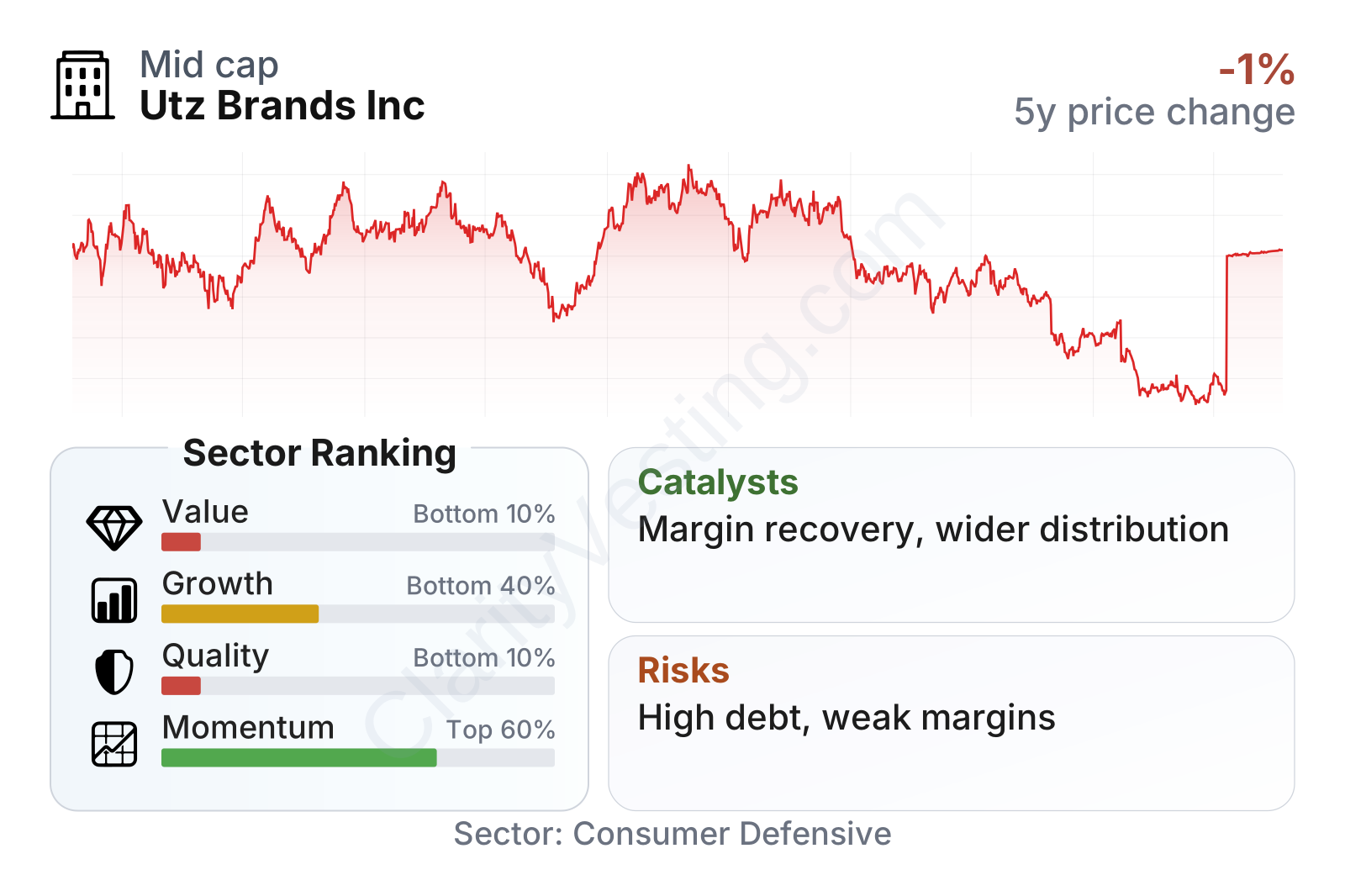
Utz is a small-cap consumer staples company with below-average share price volatility, but the operating profile is mixed. Recent market momentum has improved sharply, yet the underlying fundamentals still look weak versus most packaged food peers. Value, quality, and growth metrics rank in the lower end of the sector, mainly because returns on capital are very low, leverage is elevated, and cash flow yield is thin. The stock’s recent strength therefore appears more connected to changing expectations than to already-established business quality.
Growth
The snack category is generally considered an attractive part of the consumer staples market. People keep buying affordable indulgences even in slower economic periods, and salty snacks have shown long-term resilience because they are inexpensive, habitual purchases with frequent repeat demand. That gives Utz exposure to a sector with steady baseline demand rather than a highly cyclical one.
Utz’s strategy also makes sense on paper. Management has spent several years building a broader national platform out of what was historically a regional snack business. The growth play has centered on expanding distribution, strengthening productivity, focusing on owned brands, and using acquisitions to gain new categories and shelf space. If executed well, that can create a better mix of scale and brand density, especially in convenience stores and national retail chains where shelf access matters a lot.
The top-line picture, however, is modest rather than explosive. After very strong growth earlier in the decade, year-over-year revenue gains slowed materially, turned negative during parts of 2024, and then moved back to low-single-digit growth in 2025 and the first half of 2026. That suggests the company is no longer in a rapid expansion phase and now needs better execution, pricing discipline, and volume improvement to produce more durable progress.
Cash generation is another area to watch closely. Free cash flow has swung between negative and positive territory over the last few years, which shows the business can produce cash but has not yet done so with the consistency usually associated with stronger consumer staples operators. The latest trailing figure is positive, which is encouraging, but long-term confidence depends on whether that improvement becomes durable rather than temporary.
A meaningful catalyst is the company’s margin recovery potential. In branded snacks, small changes in manufacturing efficiency, freight, plant utilization, and promotional intensity can have an outsized effect on earnings. If Utz can keep improving distribution density and reduce costs across its supply chain, earnings can move faster than revenue. Another possible tailwind is category premiumization through brands such as Boulder Canyon and Zapp’s, where differentiated flavors and positioning may support better pricing.
Recent company communications have also emphasized productivity initiatives and portfolio focus. That matters because Utz does not need dramatic category growth to improve its financial profile; it mainly needs steadier execution inside a category that is already large and habitual.
Risks
This article is for informational purposes only and does not constitute financial advice. Some content is AI-generated. See Disclaimer


