Stock Analysis · Universal Technical Institute Inc (UTI)
Overview
Universal Technical Institute, Inc. operates post-secondary schools focused on career training for skilled trades. Its campuses prepare students for jobs in automotive, diesel, collision repair, motorcycle, marine, HVACR, welding, CNC machining, robotics, and healthcare. The company runs two main education platforms: the legacy Universal Technical Institute schools centered on transportation and technical trades, and Concorde Career Colleges, which focuses on allied health programs such as nursing and dental hygiene. In simple terms, UTI sells career-oriented education tied to industries where employers need trained workers.
Revenue mainly comes from student tuition and fees, with most of the cash ultimately supported by a mix of federal financial aid, student payments, and other financing sources disclosed in regulatory filings. Following the Concorde acquisition, the business became more diversified, with healthcare now representing a major second engine of growth alongside transportation and skilled trades.
Based on recent company filings, the main revenue sources can be described approximately as follows:
- Healthcare education: about 45% to 50% of revenue. This includes Concorde’s nursing, dental, diagnostic, and other allied health training programs.
- Transportation and skilled trades education: about 50% to 55% of revenue. This includes automotive, diesel, welding, HVACR, marine, motorcycle, and related technician training delivered through UTI, NASCAR Technical Institute, and MIAT.
- Other revenue: a small share, mainly from fees, tools, educational materials, and other student-related items.
The business mix has shifted materially in the last few years. Revenue has expanded strongly, while operating income has improved faster than sales, showing that scale and integration have mattered. At the same time, selling and administrative costs still absorb a meaningful portion of gross profit, which is important when judging how much of each tuition dollar turns into profit.
The company’s financial flow shows a business that has grown rapidly since 2022, with revenue roughly doubling by 2025 while operating income and net income improved even faster. That said, overhead remains substantial, so long-term performance still depends on maintaining enrollment growth without letting support costs rise too quickly.
Key Figures
| Metric | Value | Sector ⓘ |
|---|---|---|
| Date | Oct 17, 2026 | |
| Context | ||
| Sector | Consumer Defensive | |
| Industry | Education & Training Services | |
| Market Cap ⓘ | $1.15B | |
| Beta ⓘ | 1.19 | |
Value (Cheapness) | ||
| P/E Ratio ⓘ | 34.77 | 17.88 |
| P/B Ratio ⓘ | 3.36 | 1.29 |
| FCF Yield ⓘ | -1.99% | 12.39% |
| Dividend Yield ⓘ | N/A | 2.85% |
| EBIT / EV ⓘ | 3.66% | 6.43% |
| PEG ⓘ | 1.81 | |
Growth (Business expansion) | ||
| Revenue Growth ⓘ | 7.20% | 4.10% |
| RPS Growth (5Y CAGR) ⓘ | 10.39% | 6.18% |
| EPS Growth (5Y CAGR) ⓘ | -22.09% | -13.59% |
| BVPS Growth (5Y CAGR) ⓘ | 0.90% | 3.20% |
| Margin Growth (5Y Trend) ⓘ | 6.14% | -0.15% |
| FCF Growth (5Y CAGR) ⓘ | N/A | 4.10% |
| DPS Growth (5Y CAGR) ⓘ | N/A | 6.79% |
Quality (Business durability) | ||
| ROIC (Latest) ⓘ | 7.97% | 12.34% |
| ROA (Latest) ⓘ | 3.98% | 6.30% |
| ROIC (5Y Median) ⓘ | 11.21% | 10.49% |
| ROA (5Y Median) ⓘ | 4.85% | 5.44% |
| Net Debt / EBIT (Latest) ⓘ | 4.77 | 1.96 |
| Net Debt / EBIT (5Y Median) ⓘ | 4.16 | 2.35 |
| Net Debt / EBITDA (Latest) ⓘ | 2.20 | 1.38 |
| Net Debt / Assets ⓘ | 25.55% | 21.51% |
| EBITDA / Interest ⓘ | 26.03 | 9.46 |
| Operating Margin (Latest) ⓘ | 5.44% | 8.87% |
| Operating Margin (5Y Median) ⓘ | 5.31% | 9.53% |
| Debt to Equity (Latest) ⓘ | 104.40% | 72.35% |
| Profit Margin (Latest) ⓘ | 3.88% | 5.40% |
| Free Cash Flow (Latest) ⓘ | -$22.87M | |
Momentum (Price trend) | ||
| 3Y Return ⓘ | +146.54% | +20.92% |
| 12M Return (excl. last month) ⓘ | -25.30% | +2.13% |
| 6M Return ⓘ | -41.49% | +1.26% |
| Price vs. 200-Day MA ⓘ | -36.76% | +1.39% |
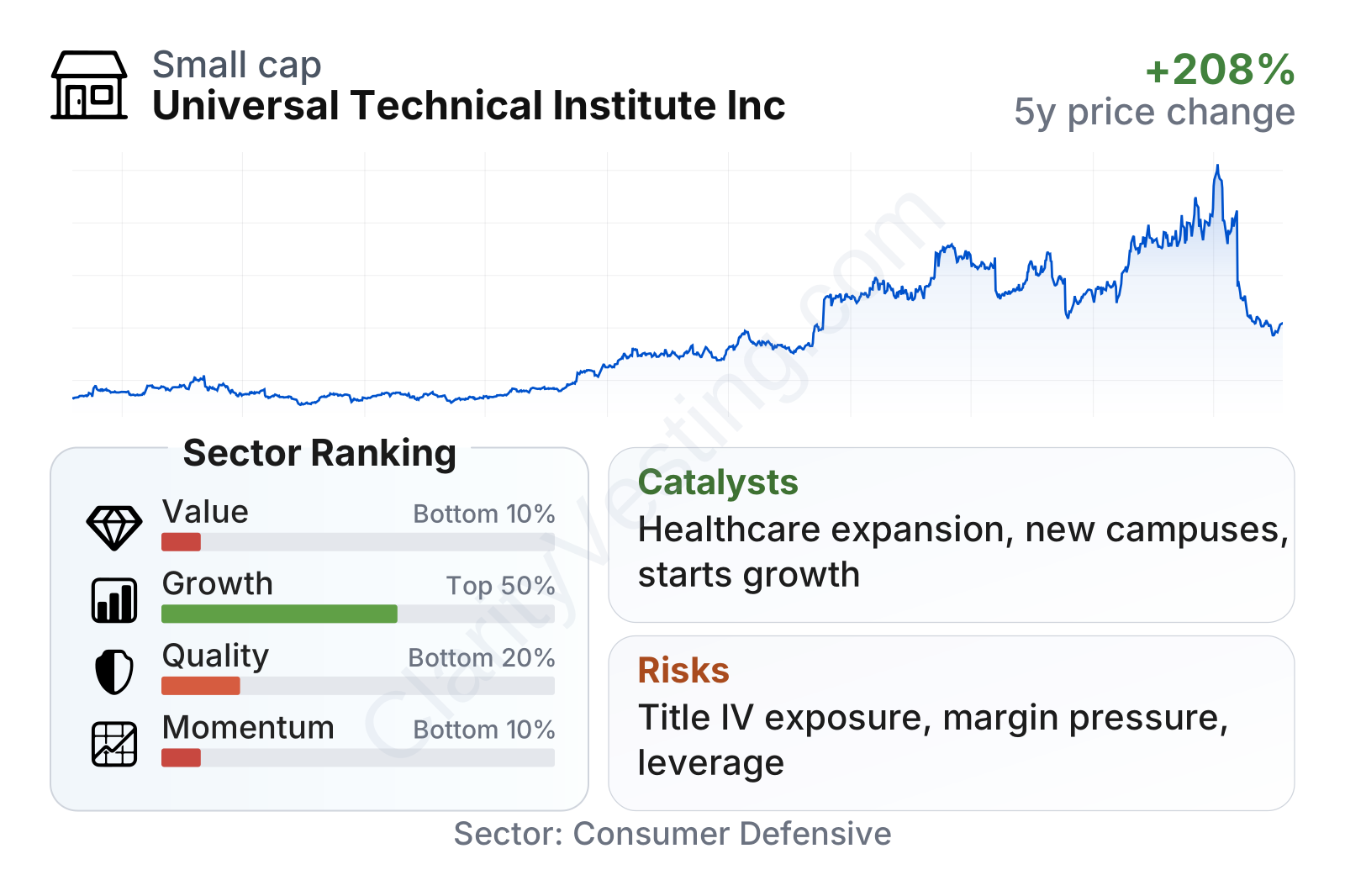
UTI is now a mid-sized public education company with a market value around the $1 billion range and a share price that has risen sharply over the past several years. The stock’s long-term performance has been strong, but recent momentum measures are weaker after that run. In the factor view, growth looks better than much of the sector, while value, quality, and momentum rank less favorably. That combination usually points to a company the market is pricing for continued business improvement rather than current cheapness.
Growth
UTI operates in areas with favorable long-term demand. The U.S. continues to face shortages of skilled trade workers and healthcare staff, and both of those gaps support demand for practical, job-focused training. This is one reason the company’s strategy makes sense: it is not trying to compete broadly across traditional higher education, but instead concentrates on programs tied to labor shortages and employer demand.
The company’s recent strategy has several clear growth pillars. First, the Concorde acquisition gave UTI a large presence in healthcare training, which broadened the addressable market and reduced dependence on the transportation technician cycle. Second, management has been expanding program offerings and opening or planning new campuses and program starts in markets where employer demand appears strong. Third, employer partnerships with brands and industry participants help keep programs relevant and support graduate placement, which is critical for attracting future students.
Revenue growth has cooled from the unusually high post-acquisition and post-expansion surge, but it remains positive and still above the sector median. That matters because it suggests the business is not merely digesting a past acquisition; it is still adding students and capacity at a healthy pace. Five-year revenue-per-share growth also stands above the sector median, reinforcing the broader expansion trend.
Cash generation has been less steady than revenue growth. Free cash flow improved dramatically through 2024 and 2025, then weakened sharply over the trailing twelve months and slipped slightly negative. For a school operator that is opening sites, integrating acquisitions, and investing in growth, swings like this can happen, but they are still worth watching closely because sustained expansion eventually needs to translate into durable cash production, not just accounting profits.
A meaningful near-term catalyst is the company’s continued campus and program rollout, especially in healthcare and skilled trades categories where labor shortages are well documented. Recent corporate updates have also emphasized start growth, student population growth, and the development of additional program capacity. If those trends continue, UTI could keep compounding revenue even as the base gets larger.
Risks
This article is for informational purposes only and does not constitute financial advice. Some content is AI-generated. See Disclaimer


