Stock Analysis · United Therapeutics Corporation (UTHR)
Overview
United Therapeutics Corporation is a biotechnology company focused mainly on treatments for pulmonary arterial hypertension, or PAH, a serious disease that raises blood pressure in the lungs and strains the heart. The company also has programs in organ manufacturing and transplantation technologies, but today the business is still driven primarily by approved PAH medicines. In simple terms, United Therapeutics is a profitable specialty-drug company that uses its cash flow from established therapies to fund newer products and longer-range research.
Its revenue base is concentrated, with most sales coming from PAH drugs sold in the United States and selected international markets. Based on the company’s latest annual filing and product disclosures, the main sources of revenue are approximately:
- Tyvaso and Tyvaso DPI: about 60% to 65% — inhaled treprostinil products used in PAH and pulmonary hypertension associated with interstitial lung disease. This is the company’s largest franchise and the biggest engine of recent growth.
- Remodulin: about 15% to 20% — an older continuous-infusion treprostinil therapy for PAH. It remains meaningful but is mature and faces generic pressure.
- Orenitram: about 10% to 15% — an oral treprostinil treatment for PAH.
- Unituxin and other revenue: about 5% to 10% — Unituxin is an oncology product for high-risk neuroblastoma, while the rest includes royalty and collaboration-related items and other smaller activities.
- Adcirca and legacy products: low single-digit contribution — a smaller part of the business relative to the treprostinil portfolio.
The business model is attractive on the surface: a specialized drug portfolio, very high margins, and strong cash generation. The tradeoff is that the company depends heavily on one therapeutic area and, increasingly, one leading franchise.
The operating picture has improved materially over the last several years. Revenue, operating income, and net income have all moved higher, while research spending has also risen, showing that the company has been able to expand profits without stepping away from pipeline investment. Cost of revenue remains relatively small compared with sales, which helps explain why profitability is far above the broader healthcare sector.
Key Figures
| Metric | Value | Sector ⓘ |
|---|---|---|
| Date | Nov 14, 2026 | |
| Context | ||
| Sector | Healthcare | |
| Industry | Drug Manufacturers - Specialty & Generic | |
| Market Cap ⓘ | $25.37B | |
| Beta ⓘ | 0.48 | |
Value (Cheapness) | ||
| P/E Ratio ⓘ | 22.49 | 25.84 |
| P/B Ratio ⓘ | 4.28 | 4.34 |
| FCF Yield ⓘ | 3.42% | 2.57% |
| Dividend Yield ⓘ | N/A | 1.62% |
| EBIT / EV ⓘ | 6.77% | 2.92% |
| PEG ⓘ | 2.22 | |
Growth (Business expansion) | ||
| Revenue Growth ⓘ | 4.10% | 7.15% |
| RPS Growth (5Y CAGR) ⓘ | 16.86% | 8.64% |
| EPS Growth (5Y CAGR) ⓘ | 4.28% | -9.67% |
| BVPS Growth (5Y CAGR) ⓘ | 15.34% | 3.71% |
| Margin Growth (5Y Trend) ⓘ | 13.71% | -0.63% |
| FCF Growth (5Y CAGR) ⓘ | 21.51% | 1.59% |
| DPS Growth (5Y CAGR) ⓘ | N/A | 6.69% |
Quality (Business durability) | ||
| ROIC (Latest) ⓘ | 18.96% | 5.79% |
| ROA (Latest) ⓘ | 16.51% | 2.88% |
| ROIC (5Y Median) ⓘ | 16.78% | 4.60% |
| ROA (5Y Median) ⓘ | 14.91% | 1.82% |
| Net Debt / EBIT (Latest) ⓘ | -0.80 | 1.33 |
| Net Debt / EBIT (5Y Median) ⓘ | -0.38 | 1.92 |
| Net Debt / EBITDA (Latest) ⓘ | -0.75 | 0.91 |
| Net Debt / Assets ⓘ | -16.90% | 5.89% |
| EBITDA / Interest ⓘ | 132.94 | 9.68 |
| Operating Margin (Latest) ⓘ | 46.62% | 9.24% |
| Operating Margin (5Y Median) ⓘ | 54.46% | 7.30% |
| Debt to Equity (Latest) ⓘ | N/A | 28.47% |
| Profit Margin (Latest) ⓘ | 38.61% | 3.33% |
| Free Cash Flow (Latest) ⓘ | $867.20M | |
Momentum (Price trend) | ||
| 3Y Return ⓘ | +162.35% | +48.98% |
| 12M Return (excl. last month) ⓘ | +24.54% | +13.65% |
| 6M Return ⓘ | +2.67% | +14.05% |
| Price vs. 200-Day MA ⓘ | +9.99% | +8.64% |
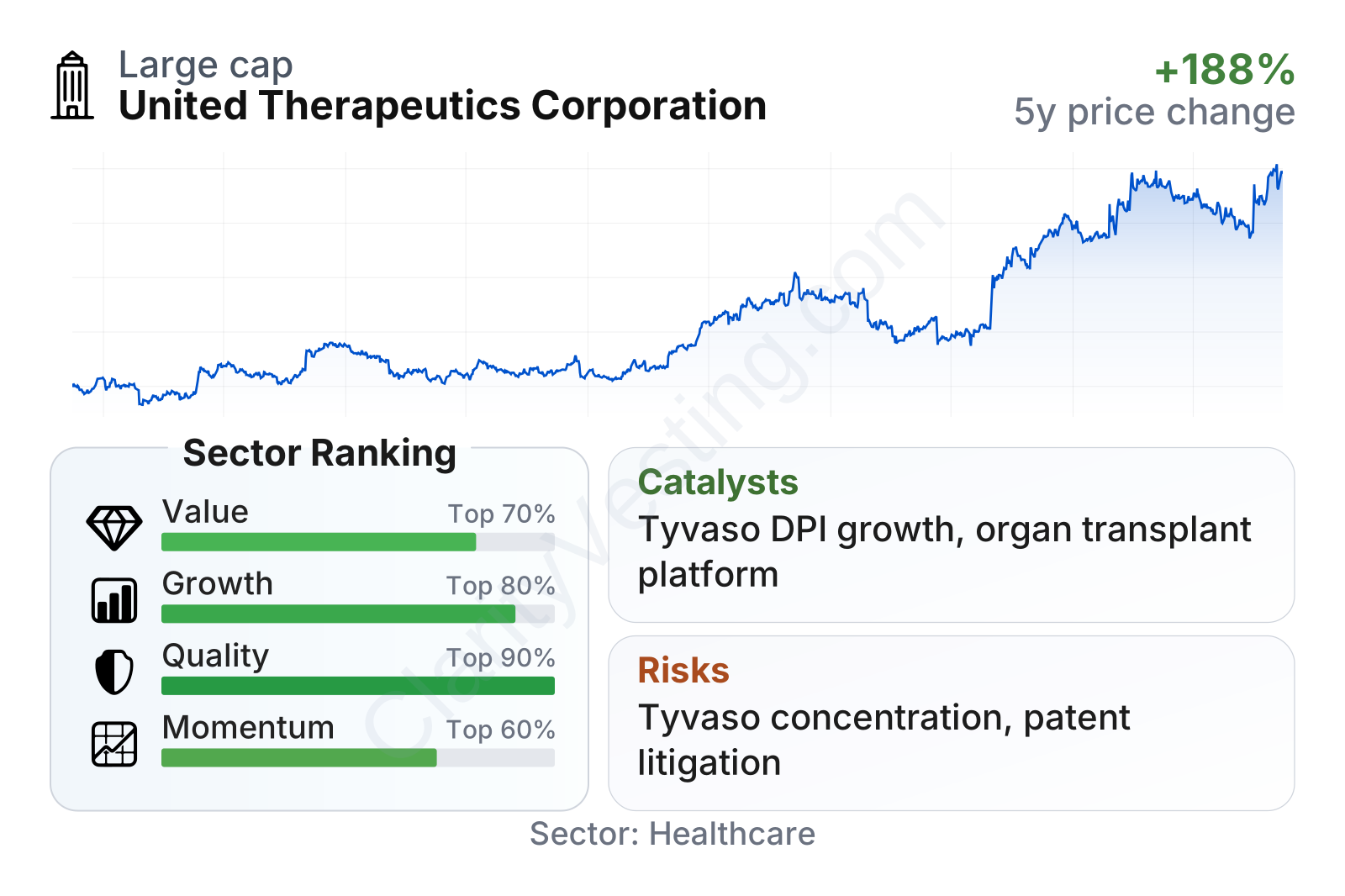
United Therapeutics stands out as a large specialty-biopharma company with unusually strong quality measures. Profitability and returns on capital are well above sector norms, and the balance sheet is especially solid, with net cash rather than meaningful net debt. Growth metrics are also favorable over a multi-year period, even if the most recent year-over-year revenue pace has cooled from earlier peaks. On valuation, the shares are not stretched relative to much of healthcare, but they are no longer at the cheaper levels seen in prior years. Price momentum has been positive over longer periods, though more mixed in the shorter term.
Growth
United Therapeutics operates in a healthcare niche that can still grow because PAH remains a serious chronic condition requiring long-term treatment, and physicians continue to shift toward products that improve convenience and broaden use. That backdrop supports the company’s strategy of expanding the treprostinil franchise across delivery methods such as inhaled, dry-powder, oral, and infused options. This approach makes strategic sense because it allows the company to serve different patient needs while building on the same core drug expertise.
The growth trend has been strong over the last several years, with especially impressive gains through 2023 to 2025, before moderating in 2026. That slowdown matters, but it needs context: the company is now lapping a much larger revenue base after a period of exceptional expansion, driven largely by Tyvaso. Multi-year growth still looks robust, especially compared with much of the healthcare sector.
Cash generation remains one of the clearest positives. Free cash flow has stayed high even after funding research and development, giving the company room to support clinical programs, manufacturing capacity, business development, and share repurchases without leaning heavily on debt. For a long-term view, that matters because internally funded growth is usually more durable than growth that depends on constant financing.
The most important catalyst is continued expansion of the Tyvaso franchise, especially Tyvaso DPI. This product benefits from physician familiarity, a simpler administration format than nebulized delivery for many patients, and a market that still appears to have room for broader adoption. Another meaningful catalyst is the company’s pipeline in pulmonary hypertension and related areas, including efforts to extend the life and reach of its treprostinil platform.
There is also a more speculative, but potentially significant, long-range opportunity in organ manufacturing and transplantation technologies, including xenotransplantation and bioengineered organs. These projects are not the reason the company earns its current profits, but they do create a layer of optional upside that is unusual for a company of this size and profitability. Recent company communications have continued to emphasize progress in these programs, keeping them relevant as future value drivers even if commercial impact is still uncertain.
Risks
This article is for informational purposes only and does not constitute financial advice. Some content is AI-generated. See Disclaimer