Stock Analysis · US Foods Holding Corp (USFD)
Overview
US Foods Holding Corp is one of the largest foodservice distributors in the United States. Its role is straightforward: it buys food and related products from manufacturers and farmers, stores them in its distribution network, and delivers them to professional kitchens and foodservice operators. Its customers include independent restaurants, regional restaurant groups, healthcare facilities, hospitality businesses, government and educational institutions, and retail locations with prepared-food needs.
The business is mainly a scale-and-logistics model. Customers rely on US Foods not only for ingredients, but also for menu items, kitchen supplies, cleaning products, technology tools, and support services that help manage ordering and operations. This makes the company more than a truck-based wholesaler; it is a broad supplier to commercial foodservice.
Revenue comes overwhelmingly from product sales rather than fees or subscriptions. Based on company disclosures, the clearest way to think about sales is by customer channel rather than by product line.
- Independent restaurants and other local foodservice operators: approximately 45% to 50% of sales. This is a core focus area and includes many small and medium-sized restaurant customers.
- Healthcare, hospitality, and other multi-unit foodservice customers: approximately 25% to 30%. This includes hospitals, hotels, travel-related foodservice, and similar institutional accounts.
- National chain restaurants: approximately 15% to 20%. These are larger organized restaurant accounts with broader purchasing scale.
- Education, government, and retail-related foodservice: approximately 10% to 15%. This includes schools, public institutions, and some prepared-food retail channels.
At the product level, food is the dominant category, while non-food items such as disposables, cleaning supplies, and restaurant operating products make up a smaller but still meaningful share. The model runs on high volume and very thin margins, which is typical for food distribution.
Over the last several years, the company has expanded revenue steadily while lifting operating income and net income faster than sales. That points to a business that is not only growing, but also extracting better efficiency from its network.
The multi-year financial flow shows a consistent rise in sales and gross profit, while earnings have generally improved faster than revenue since 2021. That is encouraging in a distribution business where small margin gains can have a noticeable effect on profit.
Key Figures
| Metric | Value | Sector ⓘ |
|---|---|---|
| Date | Oct 10, 2026 | |
| Context | ||
| Sector | Consumer Defensive | |
| Industry | Food Distribution | |
| Market Cap ⓘ | $20.47B | |
| Beta ⓘ | 0.86 | |
Value (Cheapness) | ||
| P/E Ratio ⓘ | 29.12 | 17.64 |
| P/B Ratio ⓘ | 4.97 | 1.27 |
| FCF Yield ⓘ | 4.62% | 12.68% |
| Dividend Yield ⓘ | N/A | 2.85% |
| EBIT / EV ⓘ | 4.94% | 6.32% |
| PEG ⓘ | 0.91 | |
Growth (Business expansion) | ||
| Revenue Growth ⓘ | 4.50% | 3.85% |
| RPS Growth (5Y CAGR) ⓘ | 6.94% | 6.20% |
| EPS Growth (5Y CAGR) ⓘ | -0.87% | -14.31% |
| BVPS Growth (5Y CAGR) ⓘ | 3.06% | 3.33% |
| Margin Growth (5Y Trend) ⓘ | 1.60% | -0.17% |
| FCF Growth (5Y CAGR) ⓘ | 60.37% | 4.37% |
| DPS Growth (5Y CAGR) ⓘ | N/A | 6.68% |
Quality (Business durability) | ||
| ROIC (Latest) ⓘ | 9.97% | 12.58% |
| ROA (Latest) ⓘ | 5.13% | 6.32% |
| ROIC (5Y Median) ⓘ | 7.62% | 10.38% |
| ROA (5Y Median) ⓘ | 3.71% | 5.44% |
| Net Debt / EBIT (Latest) ⓘ | 4.09 | 1.92 |
| Net Debt / EBIT (5Y Median) ⓘ | 5.60 | 2.32 |
| Net Debt / EBITDA (Latest) ⓘ | 2.98 | 1.36 |
| Net Debt / Assets ⓘ | 36.14% | 21.29% |
| EBITDA / Interest ⓘ | 5.68 | 9.52 |
| Operating Margin (Latest) ⓘ | 3.16% | 8.88% |
| Operating Margin (5Y Median) ⓘ | 2.53% | 9.53% |
| Debt to Equity (Latest) ⓘ | 122.39% | 71.95% |
| Profit Margin (Latest) ⓘ | 1.81% | 5.37% |
| Free Cash Flow (Latest) ⓘ | $946.00M | |
Momentum (Price trend) | ||
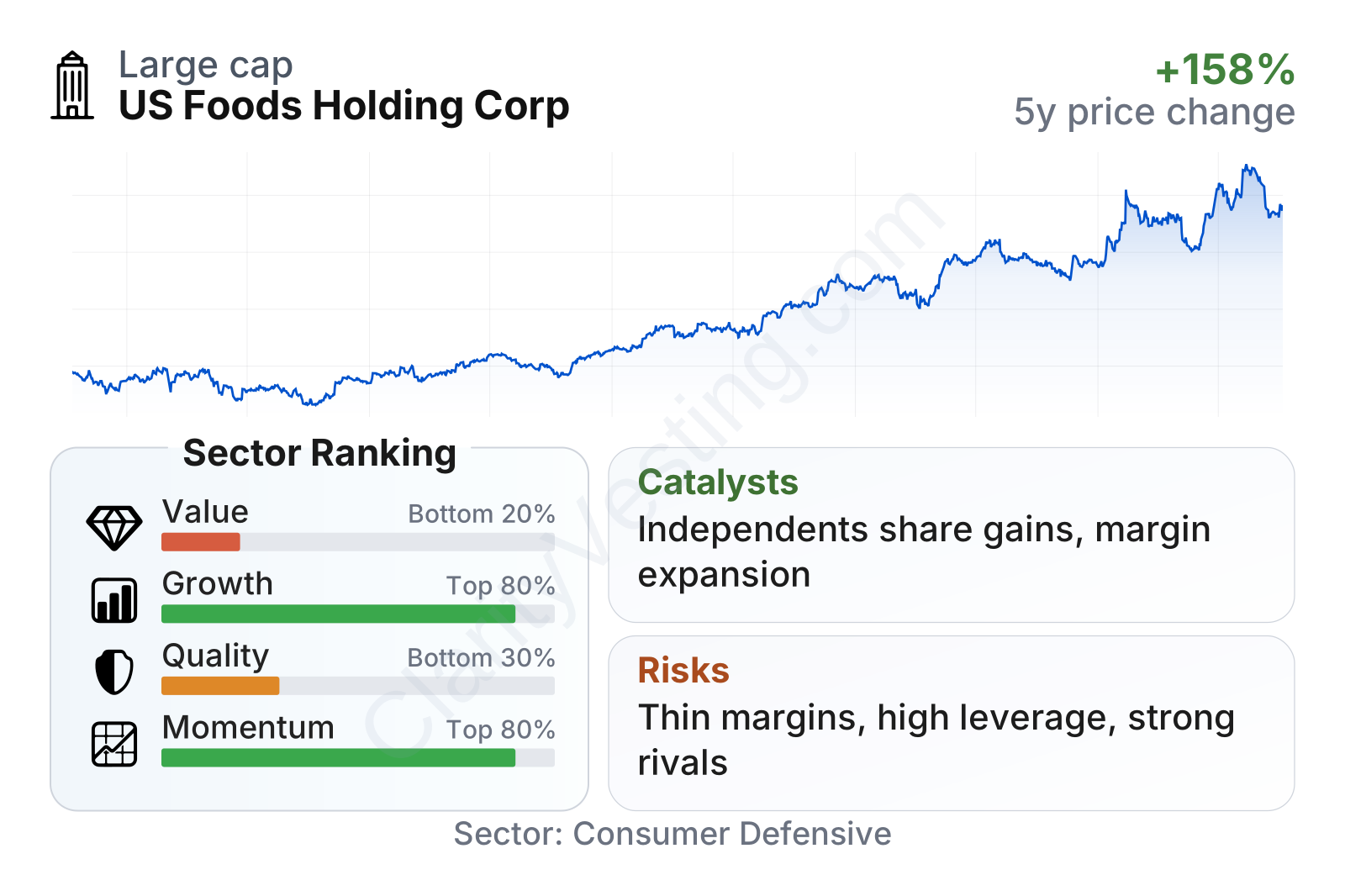
| 3Y Return ⓘ | +159.21% | +18.12% |
| 12M Return (excl. last month) ⓘ | +33.54% | +2.64% |
| 6M Return ⓘ | +6.18% | +1.32% |
| Price vs. 200-Day MA ⓘ | +4.51% | +0.17% |
US Foods is a large company in its industry, with a market value in the tens of billions of dollars and a share price record that has been strong over the last three years. The factor breakdown is more mixed. Growth and market momentum rank well versus the broader consumer defensive group, while value and quality rank weaker. In plain terms, the market has rewarded the company’s recent execution, but the stock is no longer screened as cheap, and the balance sheet and margins still look less robust than many peers.
Growth
Food distribution is not a flashy industry, but it is a durable one. Restaurants, hospitals, schools, and hospitality venues need reliable supply every day, and demand usually grows over time with population, dining-out activity, travel, and the outsourcing of food preparation. That makes the sector relatively resilient, even if it does not usually deliver rapid growth like software or semiconductors.
US Foods’ strategy for growth is logical for this kind of market. Management has emphasized three levers: winning more independent restaurant customers, increasing share of wallet with existing customers, and using technology and private-label products to improve retention and margins. The independent restaurant channel matters because it is fragmented, giving large distributors room to gain business over time.
Revenue growth has cooled from the very strong post-pandemic rebound period, but it has remained positive and generally ahead of the sector median. Recent year-over-year growth has been running in the low- to mid-single-digit range, which is respectable for a mature distributor and suggests the company is still taking share rather than simply riding food inflation.
Cash generation has improved meaningfully from the low base seen a few years ago. Free cash flow remains uneven from period to period, which is normal in distribution because inventory and working capital can swing, but the broader trend is much better than it was earlier in the cycle. That matters because cash supports debt reduction, acquisitions, and internal investment.
A notable catalyst for future expansion is the company’s effort to improve digital ordering, customer analytics, and operational efficiency across its network. US Foods has also used acquisitions in the past to extend geographic coverage and customer reach. In a fragmented market, disciplined consolidation can remain a practical source of incremental growth if integration is managed well.
Recent company updates have also pointed to continued focus on margin expansion and cost productivity. For a distributor, that can be as important as sales growth. If the business can keep lifting operating efficiency while volume rises modestly, earnings can still grow at a faster pace than revenue.
Risks
This article is for informational purposes only and does not constitute financial advice. Some content is AI-generated. See Disclaimer