Stock Analysis · USA Rare Earth Inc (USAR)
Overview
USA Rare Earth Inc is building a domestic rare earth and magnet supply chain in the United States. In simple terms, the company is trying to do two things that are strategically important: develop rare earth resources and process them into materials and magnets used in electric vehicles, defense systems, industrial motors, consumer electronics, and other advanced technologies. Its main assets have included the Round Top project in Texas, which contains rare earth elements and other critical minerals, and a magnet manufacturing effort aimed at producing sintered neodymium-iron-boron, or NdFeB, magnets in the U.S.
The business is still in a development stage, so its current revenue base is limited and not yet representative of what management appears to be targeting over the long run. Based on recent reported results, revenue has been very small relative to the company’s market value and operating spending. Public filings indicate that the company is primarily focused on developing production capacity rather than operating a mature, diversified commercial business.
For now, the revenue mix appears to be concentrated in minor and early-stage commercial activity rather than large-scale product sales.
- Other operating and early commercial revenue: approximately 100% of recent revenue. This appears to reflect limited activity while the company is still developing its mining, processing, and magnet manufacturing platform.
- Large-scale magnet sales: 0% at present on a meaningful commercial basis.
- Large-scale rare earth oxide or separated material sales: 0% at present on a meaningful commercial basis.
That makes USA Rare Earth less like an established miner or manufacturer and more like a strategic build-out project. The long-term appeal depends much more on execution over the next several years than on today’s income statement.
The longer financial picture shows why this name needs to be read carefully. Reported revenue and profit have not followed a stable operating pattern, and the latest periods look much more like a company absorbing development costs than one already benefiting from scale. That does not invalidate the strategic case, but it does mean historical earnings are not a reliable guide to the business the company is trying to become.
Key Figures
| Metric | Value | Sector ⓘ |
|---|---|---|
| Date | Oct 17, 2026 | |
| Context | ||
| Sector | Basic Materials | |
| Industry | Other Industrial Metals & Mining | |
| Market Cap ⓘ | $4.23B | |
| Beta ⓘ | 2.68 | |
Value (Cheapness) | ||
| P/E Ratio ⓘ | N/A | 16.90 |
| P/B Ratio ⓘ | 0.80 | 1.65 |
| FCF Yield ⓘ | -5.80% | 5.76% |
| Dividend Yield ⓘ | N/A | 2.13% |
| EBIT / EV ⓘ | -2.83% | 6.30% |
| PEG ⓘ | N/A | |
Growth (Business expansion) | ||
| Revenue Growth ⓘ | N/A | 11.10% |
| RPS Growth (5Y CAGR) ⓘ | -69.82% | 4.49% |
| EPS Growth (5Y CAGR) ⓘ | N/A | -13.47% |
| BVPS Growth (5Y CAGR) ⓘ | 1.25% | 5.51% |
| Margin Growth (5Y Trend) ⓘ | N/A | -1.54% |
| FCF Growth (5Y CAGR) ⓘ | N/A | 0.37% |
| DPS Growth (5Y CAGR) ⓘ | 2.50% | 6.08% |
Quality (Business durability) | ||
| ROIC (Latest) ⓘ | -8.04% | 9.26% |
| ROA (Latest) ⓘ | -17.11% | 4.91% |
| ROIC (5Y Median) ⓘ | N/A | 7.70% |
| ROA (5Y Median) ⓘ | -0.85% | 3.86% |
| Net Debt / EBIT (Latest) ⓘ | N/A | 1.40 |
| Net Debt / EBIT (5Y Median) ⓘ | N/A | 1.70 |
| Net Debt / EBITDA (Latest) ⓘ | N/A | 0.95 |
| Net Debt / Assets ⓘ | -52.71% | 13.69% |
| EBITDA / Interest ⓘ | N/A | 12.34 |
| Operating Margin (Latest) ⓘ | -38.38% | 13.20% |
| Operating Margin (5Y Median) ⓘ | -1.32% | 11.80% |
| Debt to Equity (Latest) ⓘ | 0.53% | 40.56% |
| Profit Margin (Latest) ⓘ | N/A | 6.43% |
| Free Cash Flow (Latest) ⓘ | -$245.52M | |
Momentum (Price trend) | ||
| 3Y Return ⓘ | +0.98% | +68.89% |
| 12M Return (excl. last month) ⓘ | +11.74% | +30.21% |
| 6M Return ⓘ | -39.26% | -4.16% |
| Price vs. 200-Day MA ⓘ | -46.35% | -1.27% |
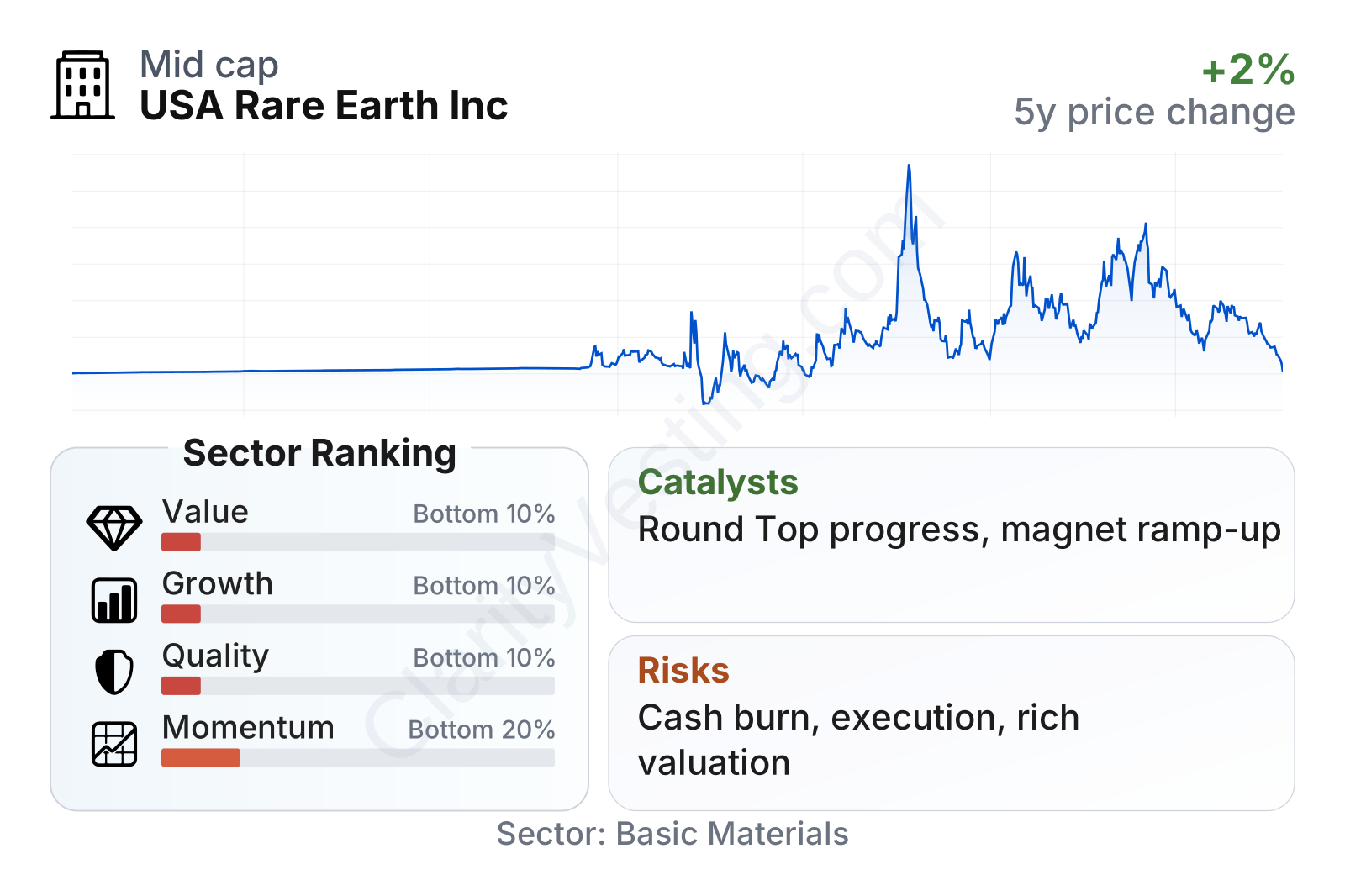
USA Rare Earth sits in the lower end of its sector on value, growth, and quality measures, which is not unusual for a company that is still pre-scale and loss-making. The balance sheet stands out in a more favorable way: debt is very low, but that strength is offset by negative cash flow, negative returns on capital, and weak profitability. The share price has also been volatile, with a sharp run-up followed by a pullback, which fits the profile of a company driven by expectations rather than established operating results.
Growth
The sector itself has strong long-term demand drivers. Rare earths and permanent magnets are important to electric vehicles, robotics, wind power, aerospace, and defense. A U.S.-based supply chain is also a major policy objective because China currently dominates several steps of the rare earth and magnet value chain. That broader industry backdrop gives the company exposure to a real structural theme rather than a short-lived trend.
USA Rare Earth’s strategy is logical on paper because it aims to connect domestic resource development with downstream magnet production. If that model works, it could move the company beyond being only a mineral developer and position it in a higher-value part of the chain. Magnet manufacturing is especially important because finished magnets often capture more strategic and commercial value than simply owning a mineral deposit.
Near-term growth, however, does not yet show up in reported revenue. Recent year-over-year comparisons indicate a steep decline from already small levels, reinforcing that the company is still in build-out mode rather than commercial ramp-up mode. For long-term analysis, this means the growth case rests more on future commissioning milestones, customer qualification, and production scaling than on current sales momentum.
Cash generation also reflects this stage. Free cash flow has become materially more negative as spending increased, which is typical when a company is funding facilities, equipment, and development work ahead of meaningful revenue. In the right context, negative free cash flow can be part of a growth plan; the key issue is whether that spending leads to usable capacity, customer adoption, and eventually margins that justify the investment.
Recent company communications have highlighted progress around domestic magnet manufacturing and the strategic value of a U.S. rare earth ecosystem. The most important potential catalysts are operational, not theoretical: commissioning of manufacturing capacity, movement toward larger commercial contracts, progress at Round Top, and any government-related support tied to critical minerals or defense-oriented supply chain security. Those are the events that could materially change how the market judges the business.
Risks
This article is for informational purposes only and does not constitute financial advice. Some content is AI-generated. See Disclaimer


