Stock Analysis · USA Compression Partners LP (USAC)
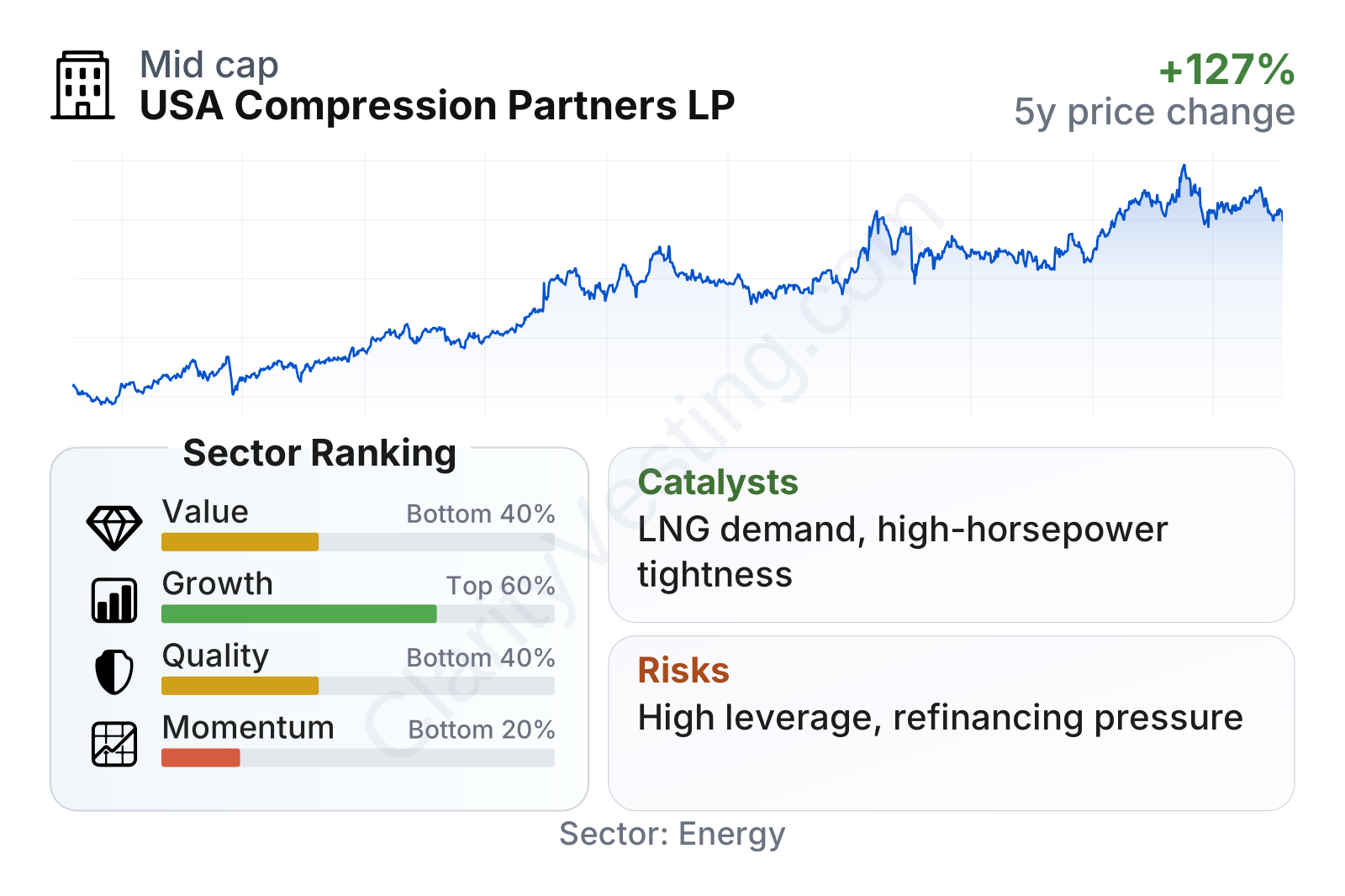
Overview
USA Compression Partners LP is a midstream energy company focused on one specialized service: providing large-horsepower compression equipment used in natural gas gathering, processing, transportation, and storage. In simple terms, compression helps move natural gas through pipelines and related infrastructure by increasing pressure. This service is essential because gas production and pipeline systems cannot operate efficiently without it.
The partnership makes money primarily by renting out compression units and providing related services under long-term, fee-based arrangements. That business model is important for long-term analysis because it is less directly tied to daily swings in oil and gas prices than a producer would be. Demand depends more on natural gas volumes moving through infrastructure and on customers’ need to keep assets running continuously.
Based on recent company filings, revenue is heavily concentrated in compression services, with only a small portion coming from parts, maintenance, and other related activities.
- Compression services and rentals: approximately 90% to 95% of revenue. This includes monthly service fees from customers using the company’s compression fleet in the field.
- Aftermarket services, parts, and other: approximately 5% to 10% of revenue. This generally includes maintenance support, parts sales, and ancillary services tied to installed equipment.
USA Compression’s customer base includes natural gas producers, gatherers, processors, transporters, and storage operators. The company’s fleet is designed mainly for large-horsepower applications, a niche that tends to require technical expertise, high upfront capital, and established customer relationships.
Over the last several years, the business has shown a clear pattern of rising revenue, expanding operating income, and improving net income. One notable feature is that gross profit and operating profit have grown faster than selling and administrative costs, which points to operating leverage. Interest expense remains material, but profitability has improved enough to offset more of that burden than in earlier years.
Key Figures
| Metric | Value | Sector ⓘ |
|---|---|---|
| Date | Oct 17, 2026 | |
| Context | ||
| Sector | Energy | |
| Industry | Oil & Gas Equipment & Services | |
| Market Cap ⓘ | $3.73B | |
| Beta ⓘ | 0.25 | |
Value (Cheapness) | ||
| P/E Ratio ⓘ | 24.30 | 15.44 |
| P/B Ratio ⓘ | 12.61 | 1.73 |
| FCF Yield ⓘ | 8.30% | 8.20% |
| Dividend Yield ⓘ | 8.18% | 3.59% |
| EBIT / EV ⓘ | 5.22% | 7.46% |
| PEG ⓘ | -68.32 | |
Growth (Business expansion) | ||
| Revenue Growth ⓘ | 36.80% | 26.90% |
| RPS Growth (5Y CAGR) ⓘ | 6.01% | 6.90% |
| EPS Growth (5Y CAGR) ⓘ | N/A | -15.73% |
| BVPS Growth (5Y CAGR) ⓘ | N/A | 6.07% |
| Margin Growth (5Y Trend) ⓘ | 7.75% | 0.58% |
| FCF Growth (5Y CAGR) ⓘ | 5.90% | 1.86% |
| DPS Growth (5Y CAGR) ⓘ | -4.34% | 16.79% |
Quality (Business durability) | ||
| ROIC (Latest) ⓘ | 11.34% | 11.40% |
| ROA (Latest) ⓘ | 4.61% | 6.06% |
| ROIC (5Y Median) ⓘ | 11.73% | 10.30% |
| ROA (5Y Median) ⓘ | 2.53% | 5.42% |
| Net Debt / EBIT (Latest) ⓘ | 8.44 | 1.64 |
| Net Debt / EBIT (5Y Median) ⓘ | 9.65 | 1.83 |
| Net Debt / EBITDA (Latest) ⓘ | 4.41 | 1.08 |
| Net Debt / Assets ⓘ | 79.99% | 17.29% |
| EBITDA / Interest ⓘ | 3.51 | 9.64 |
| Operating Margin (Latest) ⓘ | 29.70% | 16.27% |
| Operating Margin (5Y Median) ⓘ | 28.78% | 20.39% |
| Debt to Equity (Latest) ⓘ | 1030.25% | 54.76% |
| Profit Margin (Latest) ⓘ | 12.43% | 8.82% |
| Free Cash Flow (Latest) ⓘ | $309.81M | |
Momentum (Price trend) | ||
| 3Y Return ⓘ | +25.06% | +67.38% |
| 12M Return (excl. last month) ⓘ | +20.24% | +49.19% |
| 6M Return ⓘ | -4.23% | +7.07% |
| Price vs. 200-Day MA ⓘ | -4.67% | +9.56% |
USA Compression is a mid-sized energy infrastructure name with an unusually low beta of about 0.20, meaning its share price has historically moved less than the broader market. On the surface, the income profile stands out: the trailing distribution yield is around 8%, clearly above the sector median. Growth metrics are mixed but generally respectable, with recent revenue growth well ahead of the sector median and free cash flow improving over time. The weaker areas are valuation, leverage, and market momentum. Relative to peers, the units trade at richer earnings and book multiples while balance-sheet pressure remains elevated.
The share price trend over the last several years has been positive overall, though recent momentum has been softer than much of the energy sector. That combination often reflects a business that is operationally improving, but already carries a market premium because of its income characteristics and stable-fee model.
Growth
USA Compression operates in a part of the energy value chain that still has long-term relevance. Natural gas remains a major fuel for U.S. power generation, industrial use, LNG exports, and pipeline transportation. Even in a changing energy landscape, gas infrastructure is expected to remain important for reliability and export growth. Compression is not an optional add-on to this system; it is a necessary function, which gives the company a structurally useful position.
The company’s strategy also makes sense for durable expansion. It focuses on large-horsepower compression, where customers often prioritize reliability, installed expertise, and service continuity over simply choosing the lowest bidder. That can support high utilization and recurring revenue. Management has also emphasized disciplined fleet additions and pricing, which matters in a capital-intensive business where growing too aggressively can destroy returns.
Revenue growth had slowed during 2024 and 2025 after a stronger earlier expansion phase, but the latest readings show a sharp reacceleration, moving into the mid-30% range year over year. That is a meaningful signal because it suggests the business is not merely stable; it may be entering another step-up period tied to higher utilization, stronger pricing, acquisitions, or a combination of those factors.
Free cash flow has also improved materially after a weak period in 2024. The latest trailing figure is above $300 million, which is significant for a company of this size. For a compression provider, that matters because free cash flow supports debt management, distributions, and fleet investment. When a capital-intensive energy service business produces rising cash after operating and investment needs, it usually points to a healthier operating base.
A key catalyst for future demand is the broader buildout of natural gas infrastructure in the United States, including gathering systems, processing plants, pipeline expansions, and LNG-related activity. Compression demand often follows volume growth and system complexity. If U.S. natural gas production and exports continue increasing, large-horsepower compression should remain well positioned.
Recent company communications have also highlighted strong customer demand for high-horsepower units and ongoing tightness in available equipment. In practical terms, a tight market can help support better pricing and stronger fleet utilization, both of which are favorable for revenue and margins.
Risks
This article is for informational purposes only and does not constitute financial advice. Some content is AI-generated. See Disclaimer


