Stock Analysis · UroGen Pharma Ltd (URGN)
Overview
UroGen Pharma Ltd is a biotechnology company focused on specialty cancers and urologic diseases. Its core idea is relatively easy to understand: instead of only developing new drug molecules, it also works on a delivery technology designed to keep medicine in contact with the urinary tract for longer. That matters because cancers in areas such as the bladder and upper urinary tract can be difficult to treat with standard liquid drugs that are quickly washed away.
The business today is still concentrated around a small number of commercial and development assets. Revenue mainly comes from its approved product and from collaboration-related activity. Based on recent company reporting, the main revenue sources can be summarized as follows:
- JELMYTO product sales: approximately 90% to 95% of revenue in the most recent annual period. JELMYTO is approved for low-grade upper tract urothelial cancer, a rare cancer of the lining of the upper urinary tract.
- Royalty, license, and collaboration revenue: approximately 5% to 10% of revenue. This includes payments tied to partnerships and other contractual arrangements rather than direct product sales.
That concentration is important for long-term analysis. UroGen has moved beyond the pure research stage because it already sells a product, but it is not yet a broadly diversified pharmaceutical company. Its near-term business profile is still heavily linked to the trajectory of one commercial asset and to the potential expansion of its platform into additional indications.
The financial flow also shows a company with solid gross margins but very heavy spending on research, commercialization, and administration. Revenue has grown meaningfully over the last several years, yet operating losses widened as the company increased investment behind development programs and launch activity.
Over time, sales have climbed from under $50 million in 2021 to roughly $110 million in 2025, while gross profit remained strong. The weak point is spending: operating expenses increased much faster than revenue, especially selling and administrative costs, which helps explain why losses have persisted despite commercial progress.
Key Figures
| Metric | Value | Sector ⓘ |
|---|---|---|
| Date | Oct 17, 2026 | |
| Context | ||
| Sector | Healthcare | |
| Industry | Biotechnology | |
| Market Cap ⓘ | $1.79B | |
| Beta ⓘ | 1.58 | |
Value (Cheapness) | ||
| P/E Ratio ⓘ | N/A | 24.79 |
| P/B Ratio ⓘ | N/A | 3.08 |
| FCF Yield ⓘ | -8.90% | 3.15% |
| Dividend Yield ⓘ | N/A | 1.94% |
| EBIT / EV ⓘ | -3.43% | 0.57% |
| PEG ⓘ | N/A | |
Growth (Business expansion) | ||
| Revenue Growth ⓘ | 199.20% | 7.45% |
| RPS Growth (5Y CAGR) ⓘ | 1.50% | 8.61% |
| EPS Growth (5Y CAGR) ⓘ | -38.99% | -17.81% |
| BVPS Growth (5Y CAGR) ⓘ | N/A | 3.72% |
| Margin Growth (5Y Trend) ⓘ | N/A | -0.62% |
| FCF Growth (5Y CAGR) ⓘ | N/A | 1.04% |
| DPS Growth (5Y CAGR) ⓘ | N/A | 6.77% |
Quality (Business durability) | ||
| ROIC (Latest) ⓘ | -156.51% | 3.24% |
| ROA (Latest) ⓘ | -44.62% | 3.01% |
| ROIC (5Y Median) ⓘ | -166.11% | 4.60% |
| ROA (5Y Median) ⓘ | -65.14% | 1.89% |
| Net Debt / EBIT (Latest) ⓘ | N/A | 1.34 |
| Net Debt / EBIT (5Y Median) ⓘ | N/A | 1.84 |
| Net Debt / EBITDA (Latest) ⓘ | N/A | 1.00 |
| Net Debt / Assets ⓘ | 46.32% | 5.45% |
| EBITDA / Interest ⓘ | N/A | 9.64 |
| Operating Margin (Latest) ⓘ | -38.55% | 9.27% |
| Operating Margin (5Y Median) ⓘ | -121.25% | 7.38% |
| Debt to Equity (Latest) ⓘ | -148.14% | 28.58% |
| Profit Margin (Latest) ⓘ | -51.73% | 3.59% |
| Free Cash Flow (Latest) ⓘ | -$159.13M | |
Momentum (Price trend) | ||
| 3Y Return ⓘ | +180.11% | +42.80% |
| 12M Return (excl. last month) ⓘ | +131.12% | +18.50% |
| 6M Return ⓘ | +70.20% | +7.57% |
| Price vs. 200-Day MA ⓘ | +19.53% | +5.12% |
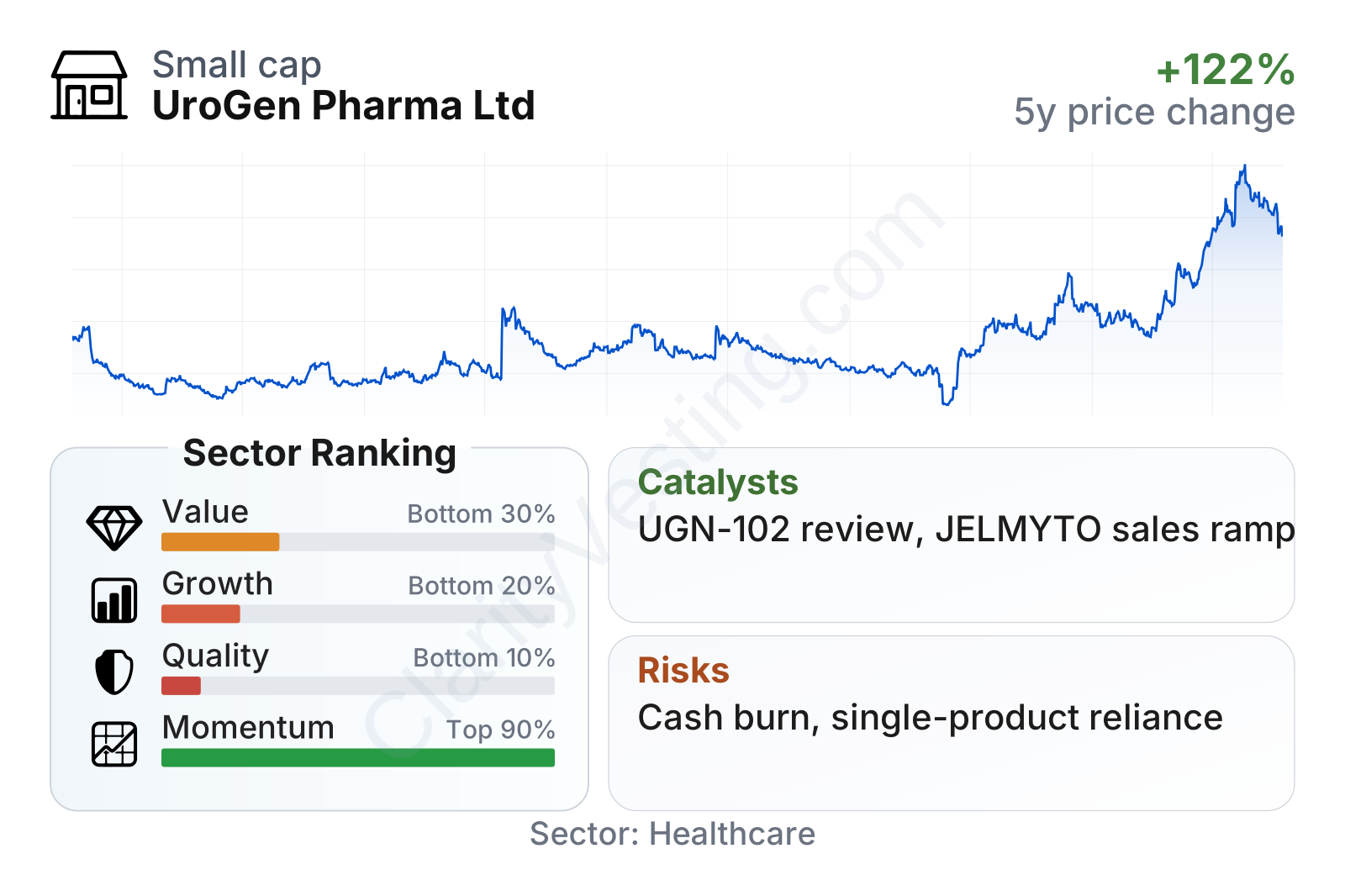
UroGen is a mid-sized biotech by market value, and the stock has been notably volatile, with a beta well above 1. The share price has been very strong recently, clearly outperforming much of the healthcare sector over the last 6 months, 12 months, and 3 years. That price strength stands in contrast to the company’s fundamentals, which still rank weakly on value, growth quality, and profitability versus the broader biotech group.
The table highlights a business in transition rather than one in a mature steady-state. Revenue growth has accelerated sharply in the latest period, but free cash flow remains deeply negative, returns on capital are far below sector norms, and profit metrics are still materially negative. In other words, market momentum has improved much faster than the underlying earnings profile.
Growth
UroGen operates in an attractive area of healthcare. Urologic cancers are serious conditions with limited treatment options in some niches, and there is clear medical interest in organ-sparing therapies that could reduce the need for invasive surgery. That puts the company in a sector where innovation can create meaningful value if clinical data and regulatory execution line up.
The company’s strategy also makes logical sense for future expansion. It already has a marketed product, a specialized delivery platform, and a commercial infrastructure aimed at urologists. If management can use that base to extend into larger indications, the economics could improve because future products would not be starting from zero. The biggest long-term opportunity is not simply selling more of JELMYTO in its current niche, but broadening the platform into new bladder cancer uses that address larger patient populations.
One of the most important growth catalysts has been the progress of UGN-102, an investigational treatment for recurrent low-grade intermediate-risk non-muscle invasive bladder cancer. This indication is much larger than the current approved JELMYTO market. In recent company communications and regulatory updates, UroGen has emphasized its filing plans and regulatory pathway for UGN-102, making it the central value driver for the business beyond the existing product base.
There is also evidence of a recent commercial acceleration. Revenue growth had slowed during parts of 2024 and 2025, but the latest year-over-year figures show a sharp reacceleration into 2026. That kind of step-up often signals either stronger demand, easier comparisons, or both. For a company of this size, that change can materially alter market expectations.
The growth pattern is uneven over the long run, but the most recent quarters stand out. After a period of mostly modest increases, year-over-year revenue growth jumped into triple digits in early 2026. That suggests the commercial business has entered a much stronger phase, although it remains to be seen how durable that pace will be.
The challenge is that growth has not yet translated into self-funding operations.
Cash generation remains a clear weak spot. Free cash flow has stayed meaningfully negative and has deteriorated further in the latest trailing period, showing that the company is still spending heavily to pursue expansion. For a development-stage biotech with a commercial product, that is not unusual, but it means future growth still depends on successful execution and access to capital.
Recent company updates also point to a meaningful opportunity if UGN-102 advances successfully through review and launch preparation. A second approved product in a larger urology market would change the company from a single-product commercial biotech into a broader franchise, which is likely the main reason the market has re-rated the shares so strongly.
Risks
This article is for informational purposes only and does not constitute financial advice. Some content is AI-generated. See Disclaimer


