Stock Analysis · Upstart Holdings Inc (UPST)
Overview
Upstart Holdings is a lending technology company that uses artificial intelligence models to help banks, credit unions, and institutional funding partners evaluate borrowers. In simple terms, it tries to improve how loans are approved by looking beyond traditional credit scores. The company is best known for unsecured personal loans, but it has also expanded into auto lending, small-dollar credit, and home-related lending products.
Its business model is a mix of software platform economics and credit marketplace activity. Upstart does not operate like a traditional bank at its core; instead, it earns fees for connecting borrowers with lending partners, processing loan applications, servicing loans, and providing access to its underwriting technology. Revenue can still be affected by credit conditions because loan volume depends on capital availability, borrower demand, and lender appetite.
Based on the company’s recent annual reporting, revenue is heavily concentrated in personal lending, while newer categories remain much smaller but are strategic for expansion.
- Personal loans: approximately 85% to 90% of revenue. This includes fees tied to loan origination, referral activity, servicing, and platform usage for unsecured consumer loans.
- Auto retail and auto refinance: approximately 5% to 10% of revenue. This business supports dealerships and auto lenders with digital loan approval tools and refinancing workflows.
- Other products, including small-dollar and home-related lending: approximately 0% to 5% of revenue. These businesses are still early and are intended to widen the addressable market over time.
The biggest takeaway is that Upstart remains primarily a personal-loan platform today, even though management is trying to build a broader AI-driven lending network across several credit categories.
The company’s financial profile has been highly cyclical over the last few years. Revenue and gross profit fell sharply during the 2022-2023 credit downturn, then improved meaningfully in 2024 and 2025. Profitability also recovered after a deep loss period, which matters because it suggests the model can rebound when funding conditions become more normal.
Key Figures
| Metric | Value | Sector ⓘ |
|---|---|---|
| Date | Oct 17, 2026 | |
| Context | ||
| Sector | Financial Services | |
| Industry | Credit Services | |
| Market Cap ⓘ | $2.21B | |
| Beta ⓘ | 2.43 | |
Value (Cheapness) | ||
| P/E Ratio ⓘ | 45.48 | 12.26 |
| P/B Ratio ⓘ | 3.41 | 1.23 |
| FCF Yield ⓘ | -13.41% | 10.40% |
| Dividend Yield ⓘ | N/A | 3.02% |
| EBIT / EV ⓘ | 1.62% | 8.14% |
| PEG ⓘ | N/A | |
Growth (Business expansion) | ||
| Revenue Growth ⓘ | 42.30% | 9.35% |
| RPS Growth (5Y CAGR) ⓘ | 2.81% | 12.19% |
| EPS Growth (5Y CAGR) ⓘ | 41.70% | -9.53% |
| BVPS Growth (5Y CAGR) ⓘ | -3.35% | 4.99% |
| Margin Growth (5Y Trend) ⓘ | N/A | -3.86% |
| FCF Growth (5Y CAGR) ⓘ | N/A | 4.81% |
| DPS Growth (5Y CAGR) ⓘ | -21.58% | 8.79% |
Quality (Business durability) | ||
| ROIC (Latest) ⓘ | 2.32% | 9.49% |
| ROE (Latest) ⓘ | 7.83% | 13.90% |
| ROA (Latest) ⓘ | 1.99% | 1.55% |
| ROIC (5Y Median) ⓘ | -5.40% | 7.86% |
| ROE (5Y Median) ⓘ | -14.69% | 12.17% |
| ROA (5Y Median) ⓘ | -5.79% | 1.30% |
| Net Debt / EBIT (Latest) ⓘ | 25.45 | 0.96 |
| Net Debt / EBIT (5Y Median) ⓘ | N/A | 0.73 |
| Net Debt / EBITDA (Latest) ⓘ | 17.99 | 0.92 |
| Operating Margin (Latest) ⓘ | 4.80% | 22.30% |
| Operating Margin (5Y Median) ⓘ | -13.52% | 24.63% |
| Debt to Equity (Latest) ⓘ | 253.98% | 58.56% |
| Profit Margin (Latest) ⓘ | 4.69% | 26.57% |
| Free Cash Flow (Latest) ⓘ | -$296.70M | |
Momentum (Price trend) | ||
| 3Y Return ⓘ | -14.57% | +88.33% |
| 12M Return (excl. last month) ⓘ | -62.26% | +19.38% |
| 6M Return ⓘ | -25.81% | +4.75% |
| Price vs. 200-Day MA ⓘ | -20.67% | +3.50% |
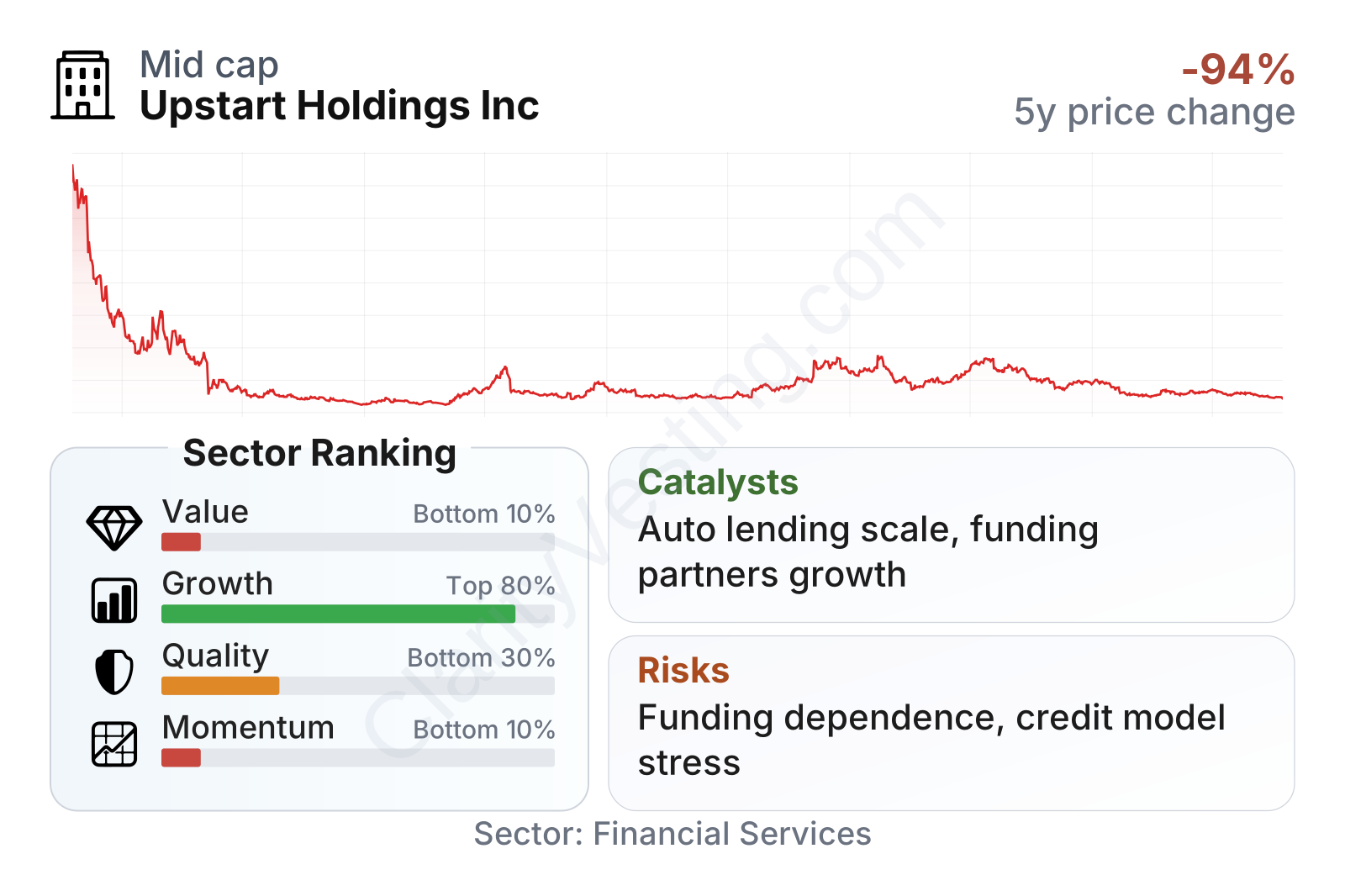
Upstart is a mid-sized company with unusually high share-price volatility, reflected in a beta above 2. Across the main factor groups, the picture is mixed. Growth is stronger than much of the sector, especially on recent year-over-year revenue expansion and multi-year EPS recovery. But value, quality, and momentum look weak relative to peers. The stock trades at a clear premium to typical financial companies on earnings and book value, while free cash flow remains negative and recent share-price performance has lagged the sector by a wide margin.
This combination usually signals a market that is still valuing future potential more than current stability. In other words, the market is treating Upstart less like a mature lender and more like a higher-risk platform business that might scale if operating conditions cooperate.
Growth
Upstart operates in a part of financial services that still has room for long-term change. Consumer lending remains a very large market, and much of the industry still relies on older underwriting methods built around traditional credit scores and manual review. If AI-based risk assessment can improve approval rates while keeping credit performance acceptable, that creates a real opening for platforms like Upstart. This is a credible growth thesis because even small share gains in consumer credit can translate into meaningful revenue.
The company’s strategy also makes sense in principle. It is trying to build a two-sided network: more borrowers attract more lenders, and more lenders can improve conversion and product breadth for borrowers. Expanding beyond personal loans is especially important because concentration has been a major limitation. Auto lending is the most notable expansion area, since vehicle financing is a much larger market than unsecured personal loans. If Upstart can make its underwriting and dealer tools more widely adopted, that could materially diversify the business.
Recent operating progress supports the idea that the company is moving out of its downturn phase. Full-year revenue rose strongly in 2025, and the business returned to positive net income after losses in 2023 and 2024. That recovery matters because it shows Upstart can regain earnings power when loan demand and funding conditions improve.
The earnings trend is still uneven, but the bigger picture is better than it was two years ago. After swinging from profitability to losses, EPS turned positive again in 2025. That does not remove cyclicality, but it does indicate that the underlying platform can produce earnings when origination volume recovers.
Book value per share has been pressured over the last several years, only stabilizing more recently. That is not ideal, but the recent leveling off is more encouraging than the prior decline. For a company still rebuilding profitability, preserving and gradually rebuilding book value is an important sign of operating repair.
A key catalyst is Upstart’s effort to secure more stable sources of loan funding. The company has spent the last few years working to broaden committed capital and reduce dependence on short-term market sentiment. Any evidence that more banks, credit unions, or institutional buyers are consistently purchasing loans through the platform would be significant, because funding availability is one of the main variables that controls revenue growth.
Another potential opportunity is product expansion. Auto, small-dollar lending, and home-related products are still too small to reshape results today, but they represent much larger lending pools than the company’s current contribution suggests. If even one of these categories gains meaningful scale, Upstart’s revenue mix could become less concentrated and more resilient.
Risks
This article is for informational purposes only and does not constitute financial advice. Some content is AI-generated. See Disclaimer


