Stock Analysis · United Parcel Service Inc (UPS)
Overview
United Parcel Service is one of the world’s largest package delivery and logistics companies. Its core business is moving parcels and freight through a large transportation network that includes trucks, aircraft, sorting hubs, last-mile delivery operations, and technology systems used by businesses and consumers. UPS serves e-commerce merchants, large enterprises, healthcare customers, and small businesses, with activities spanning domestic parcel delivery in the United States, international shipping, and supply chain services.
UPS reports revenue through three main business segments. Based on the latest annual filing, the mix is approximately:
- U.S. Domestic Package: about 67% of revenue. This includes ground, air, and residential package delivery inside the United States, including shipments tied to online shopping and business-to-business traffic.
- International Package: about 20% of revenue. This covers small-package delivery outside the U.S. and cross-border shipments, with exposure to Europe, Asia, Canada, and Latin America.
- Supply Chain Solutions: about 13% of revenue. This segment includes logistics, brokerage, forwarding, warehousing, healthcare logistics, and related transportation management services.
That structure matters because it shows that UPS is still primarily a U.S. parcel company, even though its global operations and logistics services add diversification. Over the last several years, revenue has moved down from the pandemic-era peak, while profits have fallen more sharply than sales, suggesting that volume pressure and cost inflation have weighed on operating leverage.
The business remains very large, but the recent pattern has been less about expansion and more about defending margins while adjusting the network to lower demand levels.
Key Figures
| Metric | Value | Sector ⓘ |
|---|---|---|
| Date | Oct 03, 2026 | |
| Context | ||
| Sector | Industrials | |
| Industry | Integrated Freight & Logistics | |
| Market Cap ⓘ | $79.91B | |
| Beta ⓘ | 1.04 | |
Value (Cheapness) | ||
| P/E Ratio ⓘ | 17.52 | 22.45 |
| P/B Ratio ⓘ | 5.29 | 1.98 |
| FCF Yield ⓘ | 6.86% | 6.31% |
| Dividend Yield ⓘ | 6.96% | 1.96% |
| EBIT / EV ⓘ | 6.38% | 4.81% |
| PEG ⓘ | 1.36 | |
Growth (Business expansion) | ||
| Revenue Growth ⓘ | 7.60% | 9.10% |
| RPS Growth (5Y CAGR) ⓘ | -1.48% | 7.75% |
| EPS Growth (5Y CAGR) ⓘ | -33.35% | -13.59% |
| BVPS Growth (5Y CAGR) ⓘ | 4.12% | 6.22% |
| Margin Growth (5Y Trend) ⓘ | -8.55% | 0.72% |
| FCF Growth (5Y CAGR) ⓘ | -18.52% | 10.98% |
| DPS Growth (5Y CAGR) ⓘ | 12.86% | 9.48% |
Quality (Business durability) | ||
| ROIC (Latest) ⓘ | 13.07% | 10.92% |
| ROA (Latest) ⓘ | 6.41% | 5.41% |
| ROIC (5Y Median) ⓘ | 18.51% | 9.21% |
| ROA (5Y Median) ⓘ | 9.45% | 4.94% |
| Net Debt / EBIT (Latest) ⓘ | 3.57 | 2.07 |
| Net Debt / EBIT (5Y Median) ⓘ | 2.35 | 2.28 |
| Net Debt / EBITDA (Latest) ⓘ | 2.27 | 1.43 |
| Net Debt / Assets ⓘ | 33.70% | 19.27% |
| EBITDA / Interest ⓘ | 6.52 | 9.53 |
| Operating Margin (Latest) ⓘ | 7.49% | 10.50% |
| Operating Margin (5Y Median) ⓘ | 10.30% | 10.27% |
| Debt to Equity (Latest) ⓘ | 190.30% | 65.48% |
| Profit Margin (Latest) ⓘ | 5.08% | 6.62% |
| Free Cash Flow (Latest) ⓘ | $5.49B | |
Momentum (Price trend) | ||
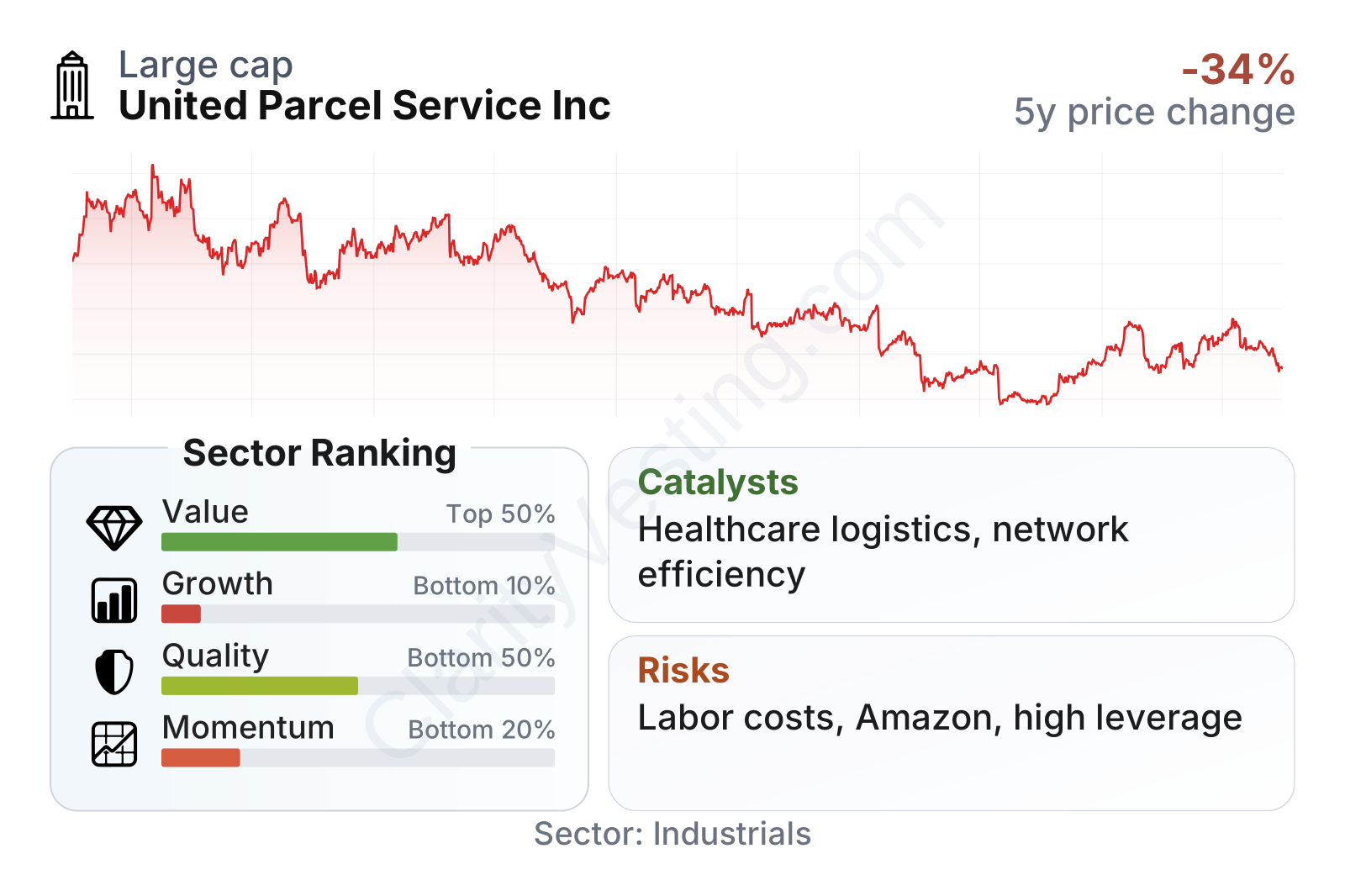
| 3Y Return ⓘ | -28.83% | +58.56% |
| 12M Return (excl. last month) ⓘ | +27.03% | +15.63% |
| 6M Return ⓘ | -1.88% | +4.19% |
| Price vs. 200-Day MA ⓘ | -8.80% | +0.93% |
UPS stands out as a very large company in its industry, with a share price history that has been much weaker than many industrial peers over the last three years. The latest factor profile is mixed. On valuation, the shares screen better than the sector on earnings multiple, free cash flow yield, and dividend yield. On growth and momentum, the picture is notably weaker, reflecting soft multi-year revenue and earnings trends and a stock that still sits below its longer-term trading range. Quality is uneven: returns on capital remain solid, but leverage is higher than the sector and current margins are below both the company’s own historical level and the industry median.
Growth
UPS operates in a sector with favorable long-term demand drivers. Global parcel volumes have been supported for years by e-commerce, faster delivery expectations, supply chain outsourcing, and the growing need for specialized logistics in areas such as healthcare. Those are structurally positive themes, even if shipping demand can be cyclical from year to year.
The challenge is that a growing sector does not automatically guarantee strong growth for every participant. UPS is coming off a period where package demand normalized after unusually strong pandemic conditions. Revenue growth turned negative through much of 2023 and parts of 2024 and 2025 before returning to a positive year-over-year rate more recently. That suggests the business may be moving from contraction toward stabilization, but not yet back to a consistently strong expansion phase.
Strategically, UPS has been emphasizing higher-quality revenue rather than pure volume. Management has highlighted efforts around healthcare logistics, small and medium-sized business customers, digital tools, and network efficiency. That approach makes sense for a mature company with a vast infrastructure base: chasing every low-margin package can hurt profitability, while more specialized or time-sensitive shipments can support better economics.
Healthcare logistics is one of the more important long-term opportunities. This area can include temperature-controlled shipping, lab and clinical logistics, and time-critical distribution where reliability matters more than price alone. That tends to create better customer stickiness and can reduce direct exposure to commoditized parcel competition.
Another important catalyst is operational efficiency. UPS has been redesigning parts of its network, automating facilities, and adjusting capacity to improve cost absorption. If shipping volumes recover while fixed costs are better controlled, profitability can improve faster than revenue. That operating leverage is one of the main reasons logistics companies can see meaningful earnings swings during recoveries.
Free cash flow has come down significantly from the unusually strong levels seen earlier in the decade, which shows that the business is not currently in a powerful cash generation upswing. Even so, UPS still produces several billion dollars of annual free cash flow, giving it room to fund capital spending, dividends, and debt obligations. The key question for long-term growth is whether the company can convert network improvements and specialized services into better cash generation than recent years have shown.
Recent company communications have also pointed to a broader reconfiguration of the network and cost base. For a business with UPS’s scale, even modest improvements in route density, automation, or mix can have a large earnings impact. That makes execution a major growth catalyst, even in a slower demand environment.
Risks
This article is for informational purposes only and does not constitute financial advice. Some content is AI-generated. See Disclaimer