Stock Analysis · Universal Music Group N.V (UNVGY)
Overview
Universal Music Group N.V. is one of the world’s largest music companies. It owns and manages recorded music catalogs, signs and develops artists, publishes song copyrights, and earns money when music is streamed, sold, licensed, performed, or used in advertising, film, games, and social platforms. Its roster and catalog include many globally recognized artists and labels, giving the company a large presence across pop, hip-hop, Latin, country, classical, and local-language music markets.
The business is mainly organized around recorded music, music publishing, and a smaller merchandising-related activity. Based on recent annual reporting, revenue is broadly distributed as follows:
- Recorded Music: about 78% to 80% of revenue. This includes subscription streaming, ad-supported streaming, physical sales such as vinyl and CDs, downloads, licensing, and artist services.
- Music Publishing: about 17% to 19% of revenue. This covers songwriting and composition rights, with income from streaming, radio, live performance, film/TV placement, games, and other licensing uses.
- Merchandising and Other: about 3% to 4% of revenue. This includes direct-to-consumer merchandise and related services.
Within recorded music, streaming is the most important driver by a wide margin. That matters because streaming tends to be recurring, global, and supported by long-lived catalogs, not just new releases. Publishing adds another layer of diversification because it is tied to the use of songs rather than only to sound recordings.
The business mix also helps explain why Universal Music Group is different from a typical entertainment company. It is less dependent on one-time box office or advertising cycles and more tied to the ongoing consumption of music across digital platforms. A large catalog means older songs can keep earning for many years, which can make revenue more durable than headline artist trends might suggest.
The profit flow shows a business that has expanded meaningfully since 2021, with revenue and operating income rising strongly through 2024. The 2025 picture looks less clean, with revenue still edging higher but profitability softer than the prior year, suggesting that growth remains intact while margins can still move around based on costs, mix, and payouts.
Key Figures
| Metric | Value | Sector ⓘ |
|---|---|---|
| Date | Oct 17, 2026 | |
| Context | ||
| Sector | Communication Services | |
| Industry | Entertainment | |
| Market Cap ⓘ | $30.86B | |
| Beta ⓘ | 0.78 | |
Value (Cheapness) | ||
| P/E Ratio ⓘ | 85.80 | 17.78 |
| FCF Yield ⓘ | 5.96% | 14.20% |
| Dividend Yield ⓘ | 3.50% | 2.74% |
| EBIT / EV ⓘ | N/A | 4.52% |
| PEG ⓘ | 2.28 | |
Growth (Business expansion) | ||
| Revenue Growth ⓘ | 5.30% | 5.50% |
| RPS Growth (5Y CAGR) ⓘ | 8.53% | 4.55% |
| EPS Growth (5Y CAGR) ⓘ | N/A | -18.24% |
| Margin Growth (5Y Trend) ⓘ | -0.14% | 1.03% |
| FCF Growth (5Y CAGR) ⓘ | 9.38% | 5.96% |
| DPS Growth (5Y CAGR) ⓘ | 3.45% | 5.00% |
Quality (Business durability) | ||
| ROIC (Latest) ⓘ | N/A | 8.59% |
| ROIC (5Y Median) ⓘ | 31.12% | 8.24% |
| Net Debt / EBIT (Latest) ⓘ | 1.43 | 1.89 |
| Net Debt / EBIT (5Y Median) ⓘ | 1.36 | 2.81 |
| Net Debt / EBITDA (Latest) ⓘ | 1.16 | 1.14 |
| Net Debt / Assets ⓘ | 27.59% | 18.62% |
| EBITDA / Interest ⓘ | N/A | 8.36 |
| Operating Margin (Latest) ⓘ | 16.35% | 15.53% |
| Operating Margin (5Y Median) ⓘ | 16.73% | 13.39% |
| Debt to Equity (Latest) ⓘ | 153.23% | 59.53% |
| Profit Margin (Latest) ⓘ | 2.52% | 8.77% |
| Free Cash Flow (Latest) ⓘ | $1.84B | |
Momentum (Price trend) | ||
| 3Y Return ⓘ | -29.55% | +44.75% |
| 12M Return (excl. last month) ⓘ | -40.44% | +2.72% |
| 6M Return ⓘ | -22.14% | +1.84% |
| Price vs. 200-Day MA ⓘ | -15.56% | +1.21% |
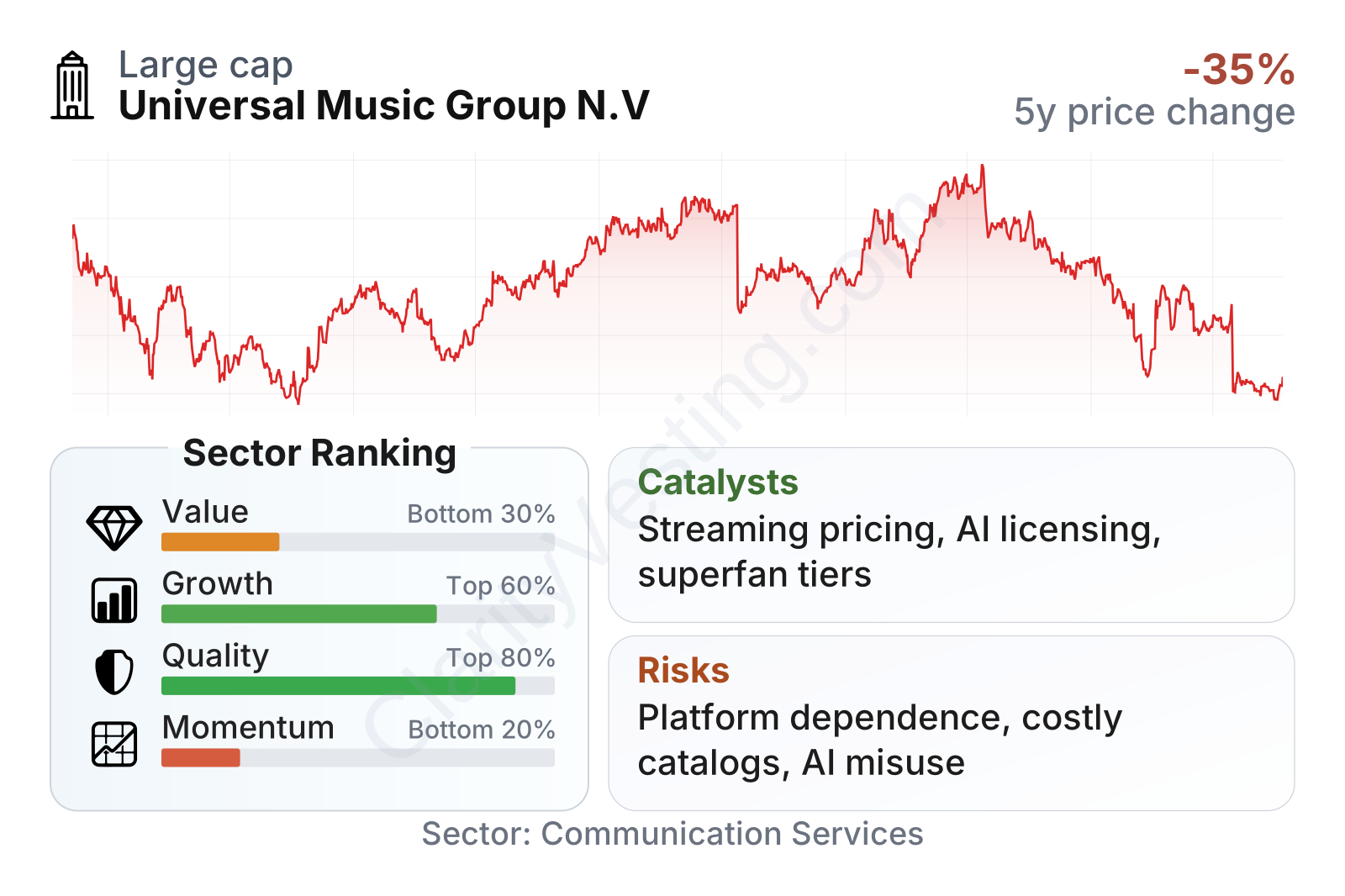
Universal Music Group is a large-cap company with a relatively low beta, which suggests the shares have tended to move less violently than the broader market. On quality, the business compares well with much of its sector: operating margins are slightly above the sector median, five-year returns on invested capital are notably strong, and leverage against earnings is manageable rather than stretched.
Growth metrics are more mixed but still respectable. Recent revenue growth is around the sector median, while five-year revenue-per-share growth and free-cash-flow growth are stronger than typical peers. The weaker point in the table is valuation: the earnings multiple is far above the sector median, and free-cash-flow yield is lower than what is common in the sector, which means the market price still embeds a premium despite a recent share-price decline.
The stock’s momentum has been weak. Multi-year and recent price performance has trailed the sector by a wide margin, and the shares have been trading below their longer-term trend. That combination often reflects a market that is waiting for clearer acceleration in growth or firmer confidence around the company’s medium-term earnings path.
Growth
Universal Music Group operates in a part of entertainment that still has structural growth behind it. Paid music streaming continues to expand globally, especially outside the most mature markets, and that creates a long runway for both recorded music and publishing income. The industry also benefits from repeated monetization: one song can generate revenue from premium streaming, ad-supported listening, short-form video, sync licensing, radio play, live performance, and future catalog reuse.
The company’s strategy is coherent for long-term expansion because it is built around scale, rights ownership, and global reach. A hit song can travel across many countries and platforms, while a deep catalog keeps earning long after release. Universal Music Group has also been investing in artist development, local repertoire, catalog management, and direct relationships with digital platforms. That matters because local-language music has become an important growth source in many regions, and strong catalog curation can improve monetization without needing blockbuster new releases every quarter.
Another important catalyst is the industry’s effort to improve monetization on streaming platforms. Major labels have pushed for pricing increases, better treatment of premium content, and models that reduce the economic value of low-quality or non-professional uploads. If those changes continue, large rights owners such as Universal Music Group could capture better revenue per stream over time even without explosive subscriber growth.
There is also a developing opportunity around artificial intelligence. For music companies, AI creates risks, but it also increases the value of authorized catalogs, voice rights, and licensing frameworks. A large owner of premium music rights is in a stronger position than smaller players to negotiate how songs and recordings are used in AI products. If the market shifts toward licensed rather than unlicensed training and generation, that could become a meaningful long-term tailwind.
Recent company communication has also highlighted continued focus on superfan monetization, direct-to-consumer initiatives, and deeper platform partnerships. These areas are not yet the core of the business, but they fit the broader idea that music consumption can be monetized in more ways than a standard monthly subscription alone.
Risks
This article is for informational purposes only and does not constitute financial advice. Some content is AI-generated. See Disclaimer


