Stock Analysis · Unum Group (UNM)
Overview
Unum Group is a U.S.-based insurance company focused mainly on income protection and employee benefits. In simple terms, it helps employers and individuals manage the financial impact of illness, injury, disability, death, and other life events. Its best-known products include disability insurance, life insurance, accident and critical illness coverage, and supplemental health benefits. The company operates primarily through three reporting segments: Unum US, Unum International, and Colonial Life, with a smaller closed block business that manages older policies no longer actively sold.
Its business model is relatively easy to understand: employers or individuals pay premiums, Unum invests part of that money, and over time it pays claims and expenses while aiming to earn an underwriting profit and investment income. That gives the company two broad economic engines: insurance premiums and returns on invested assets.
The main revenue sources are approximately the following, based on recent company reporting and segment mix:
- Unum US: about 65% to 70% of premium income. This is the core business and includes group disability, group life and accidental death, supplemental and voluntary benefits, and dental and vision products sold mainly through employers in the United States.
- Colonial Life: about 20% to 25%. This segment specializes in voluntary benefits, especially accident, sickness, indemnity, disability, and life products offered at the workplace.
- Unum International: about 8% to 12%. This business is centered largely in the United Kingdom and Poland, offering group protection and related employee benefits.
- Closed block and other: generally below 5%. This includes legacy long-term care and other older lines that are mostly managed for cash flow and risk control rather than active expansion.
- Net investment income: while not usually presented as a standalone operating segment, it remains an important contributor to overall earnings because insurers invest premium float in bonds and other assets.
Operationally, Unum has shown a multi-year pattern of fairly steady top-line expansion, with revenue rising from roughly $11.8 billion in 2021 to more than $13.0 billion in 2025. Profitability improved strongly through 2024 before becoming much weaker in 2025, when operating costs rose sharply and net income fell. That recent break in earnings momentum matters because it changes how stable the business appears after several years of improvement.
The long-term picture shows a business that expanded revenue and gross profit over several years, but 2025 stands out as a weaker year because operating income and net income dropped materially despite another increase in revenue. That suggests the key issue was not sales generation, but margin pressure and higher overall costs.
Key Figures
| Metric | Value | Sector ⓘ |
|---|---|---|
| Date | Nov 21, 2026 | |
| Context | ||
| Sector | Financial Services | |
| Industry | Insurance - Life | |
| Market Cap ⓘ | $11.84B | |
| Beta ⓘ | 0.23 | |
Value (Cheapness) | ||
| P/E Ratio ⓘ | 51.97 | 12.01 |
| P/B Ratio ⓘ | 1.14 | 1.48 |
| FCF Yield ⓘ | 13.73% | 8.77% |
| Dividend Yield ⓘ | 2.51% | 3.01% |
| EBIT / EV ⓘ | 3.34% | 8.31% |
| PEG ⓘ | 1.03 | |
Growth (Business expansion) | ||
| Revenue Growth ⓘ | -24.60% | 6.70% |
| RPS Growth (5Y CAGR) ⓘ | 6.91% | 12.35% |
| EPS Growth (5Y CAGR) ⓘ | 1.23% | -0.27% |
| BVPS Growth (5Y CAGR) ⓘ | 3.64% | 4.83% |
| Margin Growth (5Y Trend) ⓘ | -3.46% | -4.16% |
| FCF Growth (5Y CAGR) ⓘ | -18.79% | 4.69% |
| DPS Growth (5Y CAGR) ⓘ | 10.95% | 8.82% |
Quality (Business durability) | ||
| ROIC (Latest) ⓘ | 2.73% | 9.49% |
| ROE (Latest) ⓘ | 2.22% | 14.02% |
| ROA (Latest) ⓘ | 0.39% | 1.53% |
| ROIC (5Y Median) ⓘ | 11.17% | 7.80% |
| ROE (5Y Median) ⓘ | 13.04% | 12.09% |
| ROA (5Y Median) ⓘ | 2.06% | 1.28% |
| Net Debt / EBIT (Latest) ⓘ | 6.78 | 0.88 |
| Net Debt / EBIT (5Y Median) ⓘ | 1.79 | 0.73 |
| Net Debt / EBITDA (Latest) ⓘ | 5.27 | 0.71 |
| Operating Margin (Latest) ⓘ | 4.13% | 23.37% |
| Operating Margin (5Y Median) ⓘ | 14.91% | 24.29% |
| Debt to Equity (Latest) ⓘ | 34.99% | 59.34% |
| Profit Margin (Latest) ⓘ | 1.94% | 26.65% |
| Free Cash Flow (Latest) ⓘ | $1.63B | |
Momentum (Price trend) | ||
| 3Y Return ⓘ | +93.60% | +73.29% |
| 12M Return (excl. last month) ⓘ | +25.33% | +18.35% |
| 6M Return ⓘ | -9.07% | +3.24% |
| Price vs. 200-Day MA ⓘ | -8.92% | +2.17% |
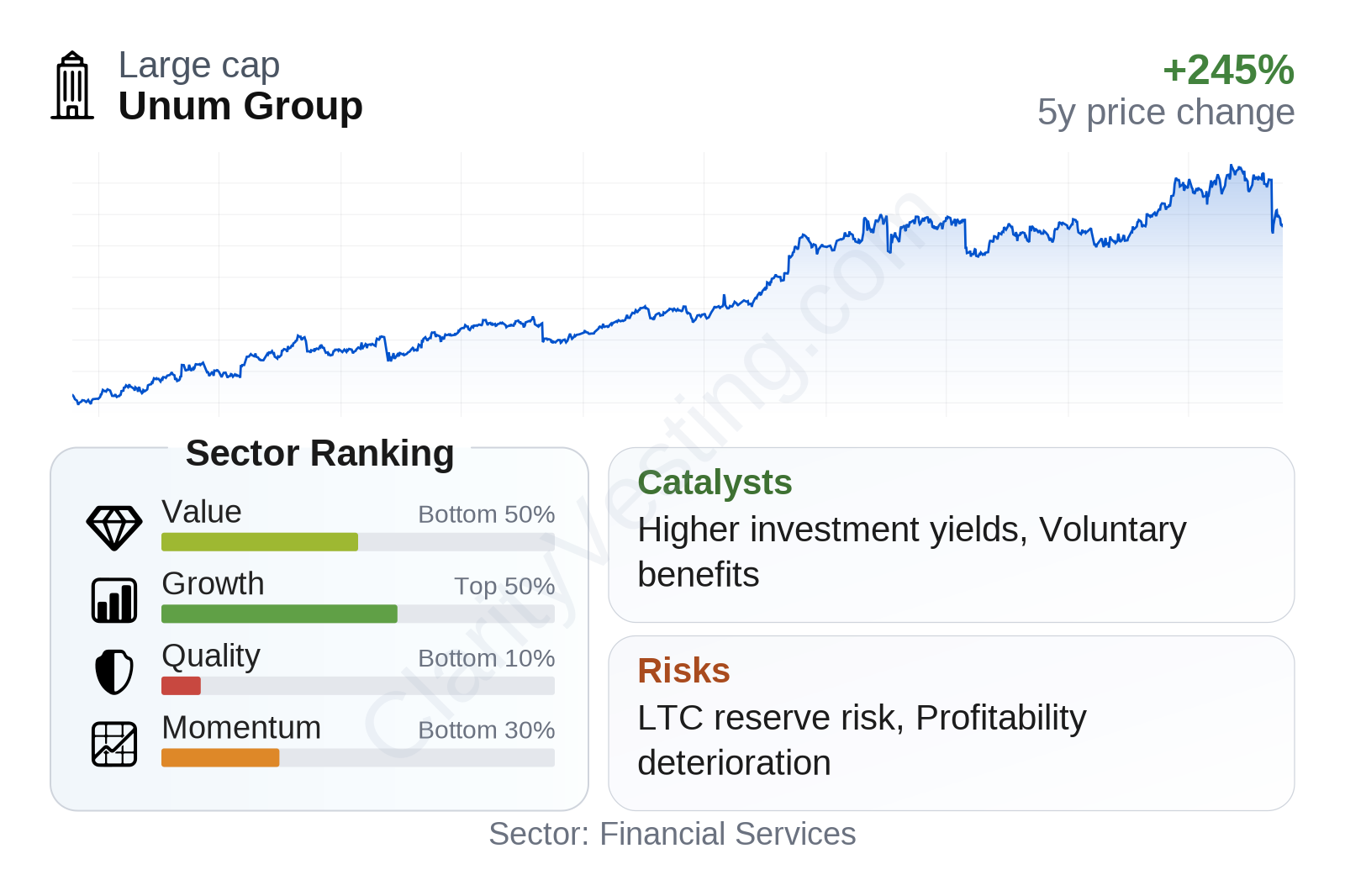
Unum is a mid-sized insurer with a low beta, which means its share price has historically moved less than the broader equity market. The stock has delivered a very strong multi-year price increase, although more recent momentum has cooled. The factor table points to a mixed profile: growth ranks around the middle of the sector, value screens less attractively than many peers because the trailing earnings multiple is distorted by weaker recent earnings, and quality looks weak on a trailing basis after returns on equity and assets fell sharply. One positive area is cash generation, with free cash flow yield above the sector median, and dividend growth over five years has also been strong even though the current yield is only around the sector average.
Growth
Unum operates in a part of insurance that benefits from durable demand rather than rapid disruption. Employers continue to use disability, life, and supplemental benefits to attract and retain workers, and employees often want more protection against gaps in health coverage and lost income. That makes the sector structurally relevant, especially as medical costs remain high and personal savings levels are often not enough to absorb major shocks. The opportunity is not tied to a single breakthrough product; it is tied to distribution strength, pricing discipline, claims management, and steady cross-selling.
Its strategy for future growth appears sensible. The company has been leaning on workplace benefits, voluntary products, and distribution relationships with employers and brokers. That matters because these products can be sold in bundles, which tends to improve retention and deepen client relationships. Colonial Life is particularly important here because voluntary benefits remain one of the clearest growth pockets in employer-sponsored insurance. International operations add some diversification, though they are not large enough to change the group’s overall profile on their own.
Earnings per share improved meaningfully from 2021 through 2024, then pulled back in 2025. That suggests Unum is capable of producing strong earnings growth when claims trends, pricing, and expenses cooperate, but it also shows that results are not perfectly smooth from year to year. For long-term analysis, the more encouraging point is that the business demonstrated strong earnings power before the recent setback rather than remaining permanently stuck at low profitability.
Book value per share has recovered well after the earlier decline seen in 2022 and has moved to new highs by 2025. For an insurer, this is an important sign because book value reflects the accumulated capital base supporting future business and absorbing shocks. A rising book value over time often supports resilience, especially when combined with disciplined share repurchases and dividend growth.
One notable catalyst is higher interest rates compared with the ultra-low-rate period earlier in the decade. Life and disability insurers generally benefit when new money can be invested at better yields, provided credit losses remain contained. Another useful driver is continued growth in employer-paid and employee-paid benefit elections, which can lift premium volume without requiring Unum to enter entirely new markets. The company has also continued returning capital through dividends and buybacks, which can support per-share results when underlying operations are stable.
Recent company updates have also highlighted ongoing premium growth in core businesses and the role of supplemental benefits in expanding customer relationships. The positive interpretation is that demand for workplace protection products remains intact even if near-term earnings fluctuate.
Risks
This article is for informational purposes only and does not constitute financial advice. Some content is AI-generated. See Disclaimer