Stock Analysis · Uniti Group Inc (UNIT)
Overview
Uniti Group Inc is a specialty real estate investment trust, or REIT, focused on communications infrastructure. In simple terms, it owns and develops physical network assets such as fiber routes, towers, and other telecom-related infrastructure, then leases or sells access to those assets to carriers, enterprises, and public-sector customers. The business sits at the intersection of real estate and digital connectivity: instead of owning apartments or offices, Uniti owns network infrastructure that helps move data.
Its revenue base has historically been anchored by long-term leasing and fiber-related services. Based on the company’s recent filings and investor materials, the business is organized mainly around fiber infrastructure and leasing arrangements, with additional revenue from construction and installation work tied to network expansion. The mix can shift from year to year depending on acquisitions, asset sales, and project activity, but the broad revenue picture can be summarized as follows.
- Uniti Fiber / wholesale and enterprise fiber services: approximately 45% to 55% of revenue in recent periods. This includes dark fiber, lit fiber, enterprise connectivity, small cell backhaul, and other bandwidth-related services.
- Leasing revenue, including master lease arrangements: approximately 35% to 45%. This is largely recurring rent from communications assets under long-term contracts.
- Towers and other infrastructure leasing: approximately 5% to 10%. This includes tower-related rent and other communications sites.
- Construction and other non-recurring project revenue: usually a smaller but variable share, often below 10%, depending on network builds and customer projects.
What stands out in Uniti’s model is the combination of recurring lease income and fiber expansion. That can create steadier cash generation than a pure construction business, while still leaving room for growth when demand for bandwidth and network densification rises.
The multi-year financial flow also shows a business with consistently high gross profit, but one where interest expense has been heavy. More recently, revenue and operating income appear to have expanded sharply, which helps explain why leverage metrics improved meaningfully after a long period of pressure.
Key Figures
| Metric | Value | Sector ⓘ |
|---|---|---|
| Date | Oct 17, 2026 | |
| Context | ||
| Sector | Real Estate | |
| Industry | REIT - Specialty | |
| Market Cap ⓘ | $1.37B | |
| Beta ⓘ | 1.43 | |
Value (Cheapness) | ||
| P/E Ratio ⓘ | 4.27 | 17.38 |
| P/B Ratio ⓘ | 9.40 | 0.85 |
| FCF Yield ⓘ | -62.46% | 7.38% |
| Dividend Yield ⓘ | N/A | 4.85% |
| EBIT / EV ⓘ | 13.22% | 3.78% |
| PEG ⓘ | 0.29 | |
Growth (Business expansion) | ||
| Revenue Growth ⓘ | 202.50% | 5.30% |
| RPS Growth (5Y CAGR) ⓘ | 4.95% | 6.02% |
| EPS Growth (5Y CAGR) ⓘ | N/A | -11.37% |
| BVPS Growth (5Y CAGR) ⓘ | N/A | 0.45% |
| Margin Growth (5Y Trend) ⓘ | 28.92% | -0.22% |
| FCF Growth (5Y CAGR) ⓘ | N/A | 5.40% |
| DPS Growth (5Y CAGR) ⓘ | N/A | 5.02% |
Quality (Business durability) | ||
| ROIC (Latest) ⓘ | 17.49% | 5.69% |
| ROE (Latest) ⓘ | 247.38% | 7.56% |
| ROA (Latest) ⓘ | 8.31% | 2.85% |
| ROIC (5Y Median) ⓘ | 20.46% | 4.22% |
| ROE (5Y Median) ⓘ | N/A | 6.03% |
| ROA (5Y Median) ⓘ | 1.81% | 2.44% |
| Net Debt / EBIT (Latest) ⓘ | 6.17 | 7.59 |
| Net Debt / EBIT (5Y Median) ⓘ | 9.61 | 8.40 |
| Net Debt / EBITDA (Latest) ⓘ | 3.72 | 5.27 |
| Net Debt / Assets ⓘ | 79.81% | 37.76% |
| EBITDA / Interest ⓘ | 3.83 | 4.10 |
| Operating Margin (Latest) ⓘ | 47.49% | 35.29% |
| Operating Margin (5Y Median) ⓘ | 50.34% | 37.31% |
| Debt to Equity (Latest) ⓘ | 6868.79% | 88.87% |
| Profit Margin (Latest) ⓘ | 30.45% | 19.61% |
| Free Cash Flow (Latest) ⓘ | -$855.10M | |
Momentum (Price trend) | ||
| 3Y Return ⓘ | -14.73% | +30.75% |
| 12M Return (excl. last month) ⓘ | +44.46% | +4.36% |
| 6M Return ⓘ | -45.66% | -2.52% |
| Price vs. 200-Day MA ⓘ | -37.41% | -2.34% |
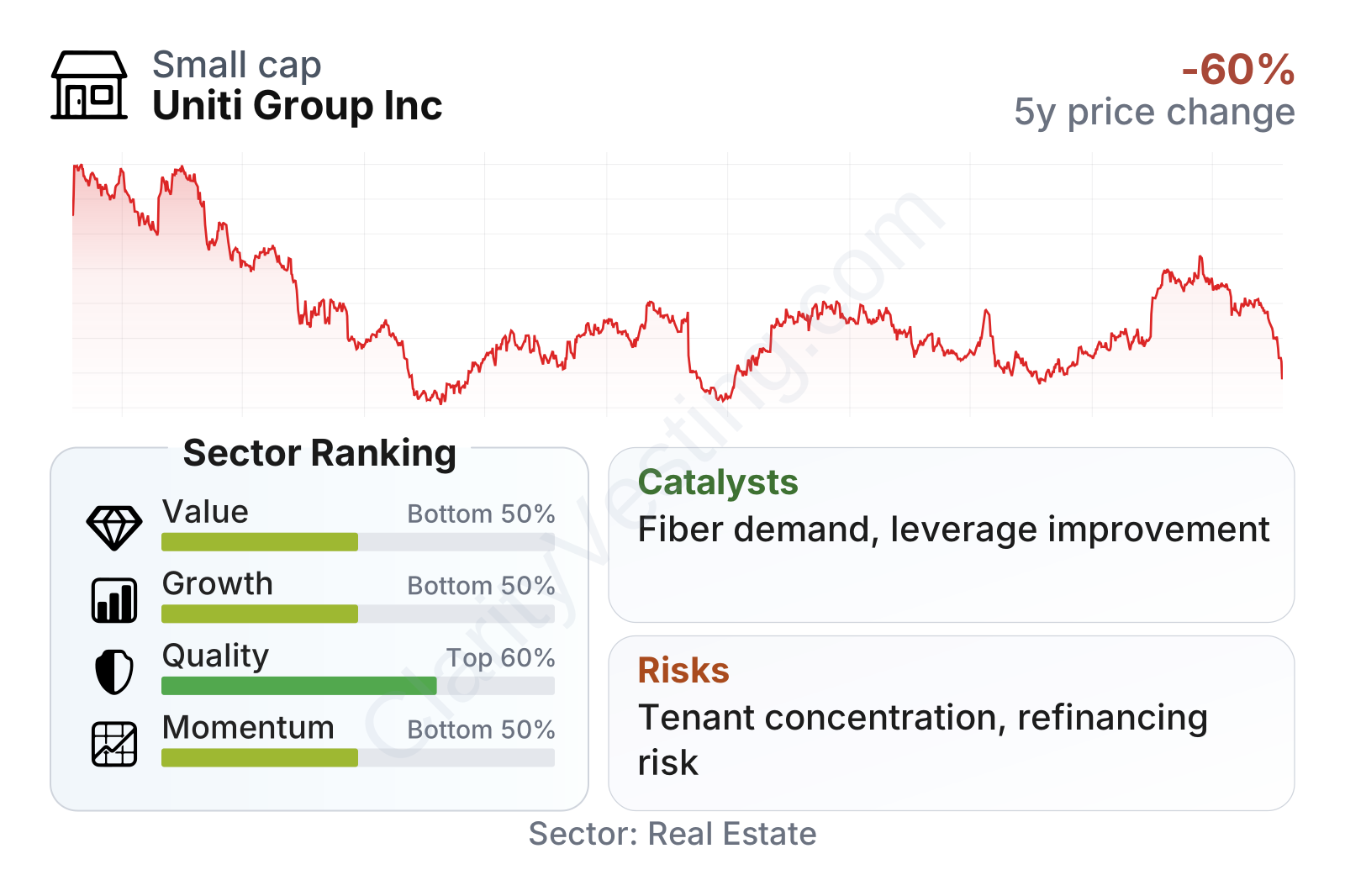
Uniti is a mid-sized public company with a stock that has been notably volatile over the last several years. The share price fell sharply from 2022 into 2023, then recovered strongly into 2026, which reflects how sensitive market sentiment has been to debt, tenant concentration, and refinancing progress.
The metrics table points to a mixed profile. On one hand, profitability and asset returns now look stronger than many peers in the specialty REIT space, with operating margin around the high-40% range and return on assets well above the sector median. On the other hand, value indicators send conflicting signals: earnings-based multiples look very low, but price-to-book is extremely elevated versus the sector, and free cash flow is currently negative. That combination usually means headline earnings are not telling the full balance-sheet or cash-flow story.
Growth metrics are also uneven. Revenue growth has accelerated sharply in the latest year, but the longer five-year pace is much more modest and sits below the sector median. Momentum remains relatively strong over the last year despite the stock trading below its 200-day average, suggesting the recovery has been real but not fully stable.
Growth
Uniti operates in a sector with durable long-term demand. Data traffic keeps rising, cloud usage continues to expand, wireless networks need more fiber backhaul, and businesses and institutions still require high-capacity connections. These are favorable conditions for owners of fiber and communications infrastructure, especially when assets are difficult and expensive to replicate.
The company’s strategy is broadly logical for that backdrop. Fiber is central to modern networks, and Uniti has continued to emphasize leasing, route expansion, and customer relationships tied to bandwidth growth. This is not a business dependent on a single technology cycle; it is tied more to the ongoing need for connectivity across mobile, enterprise, and public infrastructure.
Revenue per share has moved upward over the last five years, but the climb has been gradual rather than explosive. That suggests Uniti has been adding business, yet not at a pace that fully removes concerns around its capital structure. For long-term analysis, that matters: steady progress is useful, but this remains a company that still needs execution to turn sector tailwinds into clearly superior growth.
The dividend trend is important because REITs are often judged partly on payout stability. Uniti’s dividend per share has dropped materially and most recently fell to zero in the supplied history, which indicates a major shift in capital allocation. In practical terms, the company appears to be prioritizing balance-sheet flexibility and business funding over shareholder distributions. That can support future growth if capital is redeployed productively, but it also changes the investment profile versus income-oriented REITs.
A major catalyst is the company’s ability to use improved operating performance and a healthier leverage trend to expand its fiber platform. If management can keep adding contracted infrastructure revenue while reducing financing pressure, Uniti could increasingly look less like a distressed balance-sheet case and more like a communications infrastructure operator with recurring cash flows. Recent company updates around financing, asset activity, and network development are therefore more important than short-term earnings swings alone.
Risks
This article is for informational purposes only and does not constitute financial advice. Some content is AI-generated. See Disclaimer


