Stock Analysis · UnitedHealth Group Incorporated (UNH)
Overview
UnitedHealth Group is one of the largest healthcare companies in the United States. It operates through two closely connected businesses: health insurance and healthcare services. In simple terms, one side of the company pays for medical care through insurance plans, while the other side helps deliver care, manage prescriptions, support clinics, process claims, and provide technology and data tools to healthcare organizations.
Its structure matters because UnitedHealth is not just an insurer. Through UnitedHealthcare, it sells health benefits to employers, individuals, seniors, and government-sponsored programs. Through Optum, it runs pharmacy services, care delivery, and health technology operations. That combination gives the company exposure to multiple parts of the healthcare system rather than relying on a single activity.
The main sources of revenue are spread across its major operating platforms. Based on recent annual reporting, the mix is approximately as follows:
- Optum Rx: about 30% to 35% — pharmacy benefit management, prescription fulfillment, specialty pharmacy, and related services.
- UnitedHealthcare Employer & Individual: about 20% to 25% — commercial health plans for employers and individuals.
- Optum Health: about 20% to 25% — clinics, physician groups, ambulatory care, value-based care arrangements, and direct care services.
- UnitedHealthcare Medicare & Retirement: about 15% to 20% — Medicare Advantage, Medicare Supplement, and Part D plans for seniors.
- UnitedHealthcare Community & State: about 10% to 15% — Medicaid and other state-based public health plans.
- Optum Insight: about 5% — software, analytics, revenue cycle management, and technology services for hospitals, insurers, governments, and care providers.
This revenue mix shows a broad and diversified business. It also helps explain why UnitedHealth has historically been viewed as more resilient than a pure-play insurer: pharmacy services, care delivery, and technology can offset pressure in one insurance line, although recent results show that this diversification does not fully eliminate earnings volatility when medical costs rise.
The long-term financial picture still shows a very large enterprise with steadily rising revenue over the past several years, but with profit pressure more recently. Revenue climbed from roughly $288 billion in 2021 to about $448 billion in 2025, while net income and operating income moved in the opposite direction in 2024 and 2025 as costs increased faster than sales.
The visual flow highlights that sales kept expanding strongly over several years, but a larger share of those dollars was absorbed by medical costs, pharmacy-related expenses, administration, and interest. In other words, the business became bigger, but each dollar of revenue converted into less profit than before.
Key Figures
| Metric | Value | Sector ⓘ |
|---|---|---|
| Date | Oct 19, 2026 | |
| Context | ||
| Sector | Healthcare | |
| Industry | Healthcare Plans | |
| Market Cap ⓘ | $360.32B | |
| Beta ⓘ | 0.61 | |
Value (Cheapness) | ||
| P/E Ratio ⓘ | 25.82 | 24.87 |
| P/B Ratio ⓘ | 3.48 | 3.08 |
| FCF Yield ⓘ | 6.33% | 3.15% |
| Dividend Yield ⓘ | 0.54% | 1.94% |
| EBIT / EV ⓘ | 6.30% | 0.57% |
| PEG ⓘ | 1.01 | |
Growth (Business expansion) | ||
| Revenue Growth ⓘ | -0.40% | 7.45% |
| RPS Growth (5Y CAGR) ⓘ | 13.08% | 8.61% |
| EPS Growth (5Y CAGR) ⓘ | -5.01% | -17.81% |
| BVPS Growth (5Y CAGR) ⓘ | 7.34% | 3.72% |
| Margin Growth (5Y Trend) ⓘ | -4.16% | -0.62% |
| FCF Growth (5Y CAGR) ⓘ | -5.18% | 1.04% |
| DPS Growth (5Y CAGR) ⓘ | 12.03% | 6.77% |
Quality (Business durability) | ||
| ROIC (Latest) ⓘ | 9.98% | 3.24% |
| ROA (Latest) ⓘ | 5.10% | 3.01% |
| ROIC (5Y Median) ⓘ | 17.72% | 4.60% |
| ROA (5Y Median) ⓘ | 8.44% | 1.89% |
| Net Debt / EBIT (Latest) ⓘ | 2.04 | 1.34 |
| Net Debt / EBIT (5Y Median) ⓘ | 1.30 | 1.84 |
| Net Debt / EBITDA (Latest) ⓘ | 1.73 | 1.00 |
| Net Debt / Assets ⓘ | 15.50% | 5.45% |
| EBITDA / Interest ⓘ | 7.26 | 9.64 |
| Operating Margin (Latest) ⓘ | 5.28% | 9.27% |
| Operating Margin (5Y Median) ⓘ | 8.33% | 7.38% |
| Debt to Equity (Latest) ⓘ | 71.38% | 28.58% |
| Profit Margin (Latest) ⓘ | 3.53% | 3.59% |
| Free Cash Flow (Latest) ⓘ | $22.83B | |
Momentum (Price trend) | ||
| 3Y Return ⓘ | -20.34% | +42.80% |
| 12M Return (excl. last month) ⓘ | +13.38% | +18.50% |
| 6M Return ⓘ | +28.38% | +7.62% |
| Price vs. 200-Day MA ⓘ | +12.88% | +5.16% |
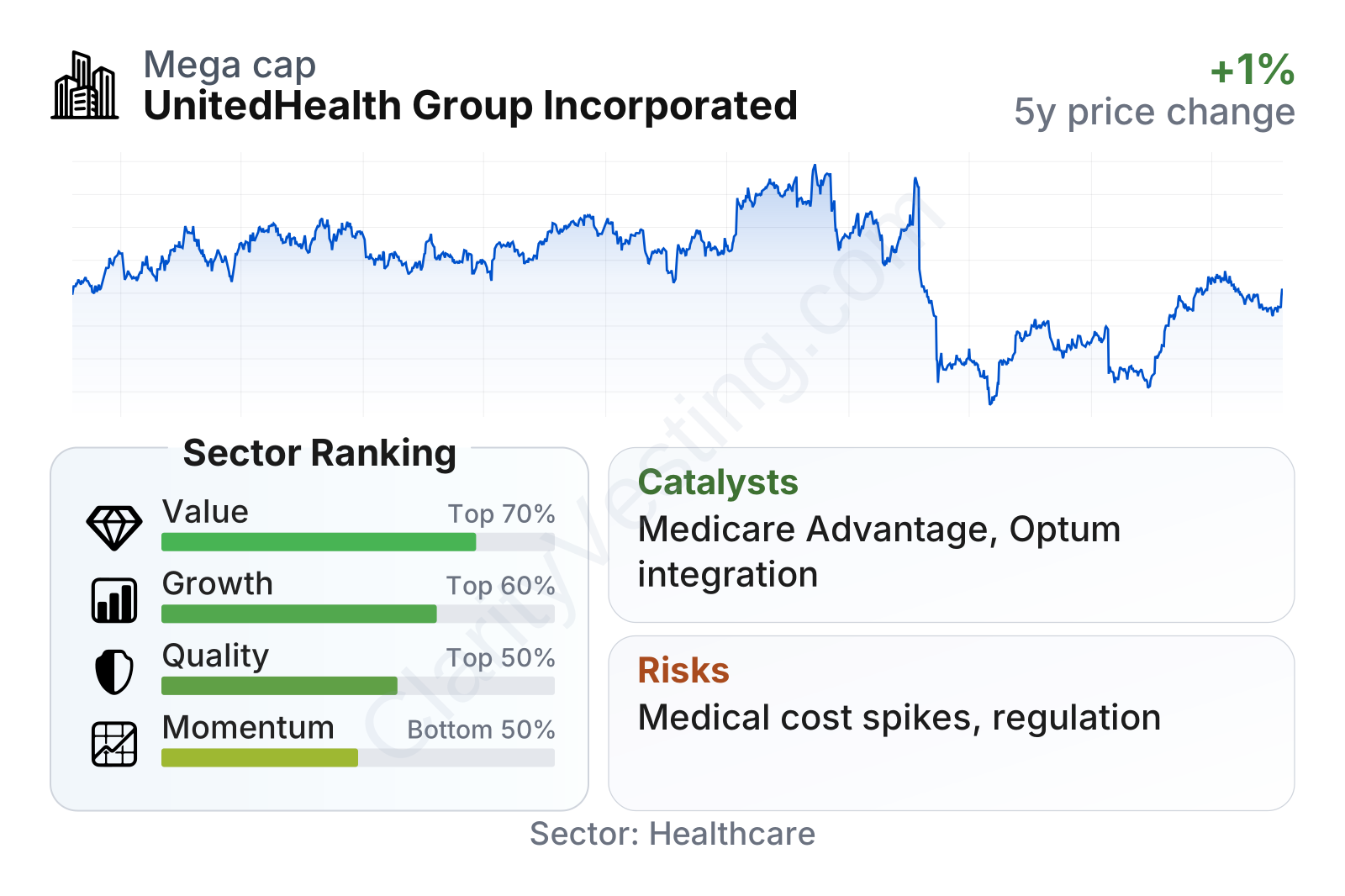
UnitedHealth remains one of the largest companies in healthcare, with a market value measured in the hundreds of billions of dollars and a relatively low beta, meaning its share price has historically moved less violently than the broader market. The recent factor profile is mixed. Quality remains solid, supported by returns on capital and assets that are still above many healthcare peers. Value looks roughly in line with the sector on earnings and book value, while cash generation remains comparatively strong. Growth metrics are less convincing in the short term because recent revenue growth has slowed sharply and multi-year free cash flow and margin trends have weakened. Momentum has improved from the 2025 lows, but the longer stock-price record is still lagging the sector.
Growth
Healthcare remains a structurally growing sector, mainly because populations are aging, chronic disease is widespread, healthcare spending continues to rise, and government-supported insurance programs cover a large and expanding number of people. These are favorable background conditions for a company with major positions in Medicare, Medicaid, employer-sponsored insurance, pharmacy management, and care delivery.
UnitedHealth’s strategy also makes industrial sense. The company is trying to connect financing, treatment, prescriptions, and data tools inside one ecosystem. That approach can help control costs, improve care coordination, and deepen relationships with employers, governments, physicians, and patients. Optum is especially important here because it gives UnitedHealth growth avenues beyond traditional insurance underwriting. Pharmacy services, physician platforms, outpatient care, and healthcare software are all areas where scale can matter.
The revenue trend shows why the company still attracts attention despite recent turbulence. Growth was consistently strong for several years, often in the high single digits to mid-teens range, before slowing dramatically in 2026 and turning slightly negative on the latest year-over-year reading. That slowdown is a clear break from the company’s earlier pattern and suggests that the next phase will depend less on simple membership and pricing expansion and more on restoring margin discipline and stabilizing utilization trends.
Cash generation is still substantial in absolute terms, with trailing free cash flow in the tens of billions of dollars, but the path has been uneven. That matters because strong cash flow supports acquisitions, technology investment, debt service, and shareholder returns. A business of this size does not need explosive growth to remain relevant, but it does need dependable cash conversion, and that has been less smooth recently than in earlier years.
A major long-term catalyst is Medicare Advantage, where private insurers manage care for seniors under the Medicare system. The aging U.S. population should keep this market important for years. Another catalyst is value-based care, where providers are rewarded more for outcomes and cost control than for the number of procedures performed. UnitedHealth has spent years building capabilities in this area through Optum Health. If it executes well, the company can benefit both as an insurer and as a care platform.
Recent company communications and filings have also emphasized digital tools, clinical integration, and continued investment in care delivery capacity. Those initiatives do not create overnight changes, but they are aligned with the broader industry direction toward more coordinated and data-driven healthcare.
Risks
This article is for informational purposes only and does not constitute financial advice. Some content is AI-generated. See Disclaimer


