Stock Analysis · United Natural Foods Inc (UNFI)
Overview
United Natural Foods Inc. is one of the largest grocery wholesalers in North America. It distributes food and everyday household products to supermarkets, independent retailers, natural food stores, e-commerce channels, and food service customers. The company is especially known for its role in natural, organic, fresh, and specialty products, but its reach is broader than that and also includes conventional grocery items, private-label products, wellness goods, and services such as transportation and retail support.
Its business is built mainly around wholesale distribution. Based on recent annual reporting, the revenue mix is heavily concentrated in product distribution, with only a small contribution from services and other activities. The largest sources of revenue can be summarized as follows:
- Wholesale product distribution: about 98% to 99% of total revenue. This includes grocery, perishables, frozen foods, natural and organic products, supplements, personal care items, and general merchandise sold to retailers and other customers.
- Services and other revenue: about 1% to 2% of total revenue. This generally includes logistics-related services, retail support, and other smaller commercial activities tied to customer operations.
Within wholesale distribution, management has historically described sales as being driven by a mix of grocery and center-store products, fresh and perishable items, and natural, organic, specialty, and wellness categories. A major customer relationship with Whole Foods Market remains important to the company’s scale, even though UNFI also serves a wide network of other grocery banners and independent stores.
What stands out in the business model is the sheer size of the network. Annual revenue is above $30 billion, but margins are very thin, which is typical in food distribution. That means execution matters more than headline sales growth: warehouse productivity, transportation efficiency, inventory discipline, and customer retention can have a large effect on profits.
The multi-year operating picture shows a familiar pattern for distributors: a very large revenue base, high cost of goods sold, and limited room for error. Revenue has expanded from the high-$20 billion range to above $31 billion over the last several years, while operating income and net income have been much more volatile. The recent improvement in operating income and lower interest expense are encouraging, but profitability remains narrow relative to the scale of the business.
Key Figures
| Metric | Value | Sector ⓘ |
|---|---|---|
| Date | Oct 10, 2026 | |
| Context | ||
| Sector | Consumer Defensive | |
| Industry | Food Distribution | |
| Market Cap ⓘ | $2.69B | |
| Beta ⓘ | 0.97 | |
Value (Cheapness) | ||
| P/E Ratio ⓘ | 33.23 | 17.64 |
| P/B Ratio ⓘ | 1.72 | 1.27 |
| FCF Yield ⓘ | 12.03% | 12.68% |
| Dividend Yield ⓘ | N/A | 2.85% |
| EBIT / EV ⓘ | 5.75% | 6.32% |
| PEG ⓘ | 1.09 | |
Growth (Business expansion) | ||
| Revenue Growth ⓘ | -0.70% | 3.85% |
| RPS Growth (5Y CAGR) ⓘ | 1.13% | 6.20% |
| EPS Growth (5Y CAGR) ⓘ | -12.34% | -14.31% |
| BVPS Growth (5Y CAGR) ⓘ | -3.18% | 3.33% |
| Margin Growth (5Y Trend) ⓘ | -0.44% | -0.17% |
| FCF Growth (5Y CAGR) ⓘ | 41.75% | 4.37% |
| DPS Growth (5Y CAGR) ⓘ | N/A | 6.68% |
Quality (Business durability) | ||
| ROIC (Latest) ⓘ | 7.86% | 12.58% |
| ROA (Latest) ⓘ | 1.15% | 6.32% |
| ROIC (5Y Median) ⓘ | 8.60% | 10.38% |
| ROA (5Y Median) ⓘ | 0.32% | 5.44% |
| Net Debt / EBIT (Latest) ⓘ | 9.25 | 1.92 |
| Net Debt / EBIT (5Y Median) ⓘ | 19.25 | 2.32 |
| Net Debt / EBITDA (Latest) ⓘ | 4.78 | 1.36 |
| Net Debt / Assets ⓘ | 42.17% | 21.29% |
| EBITDA / Interest ⓘ | 5.06 | 9.52 |
| Operating Margin (Latest) ⓘ | 1.04% | 8.88% |
| Operating Margin (5Y Median) ⓘ | 0.56% | 9.53% |
| Debt to Equity (Latest) ⓘ | 187.23% | 71.95% |
| Profit Margin (Latest) ⓘ | 0.27% | 5.37% |
| Free Cash Flow (Latest) ⓘ | $323.00M | |
Momentum (Price trend) | ||
| 3Y Return ⓘ | +223.52% | +18.12% |
| 12M Return (excl. last month) ⓘ | +51.74% | +2.64% |
| 6M Return ⓘ | -2.38% | +1.32% |
| Price vs. 200-Day MA ⓘ | -0.54% | +0.17% |
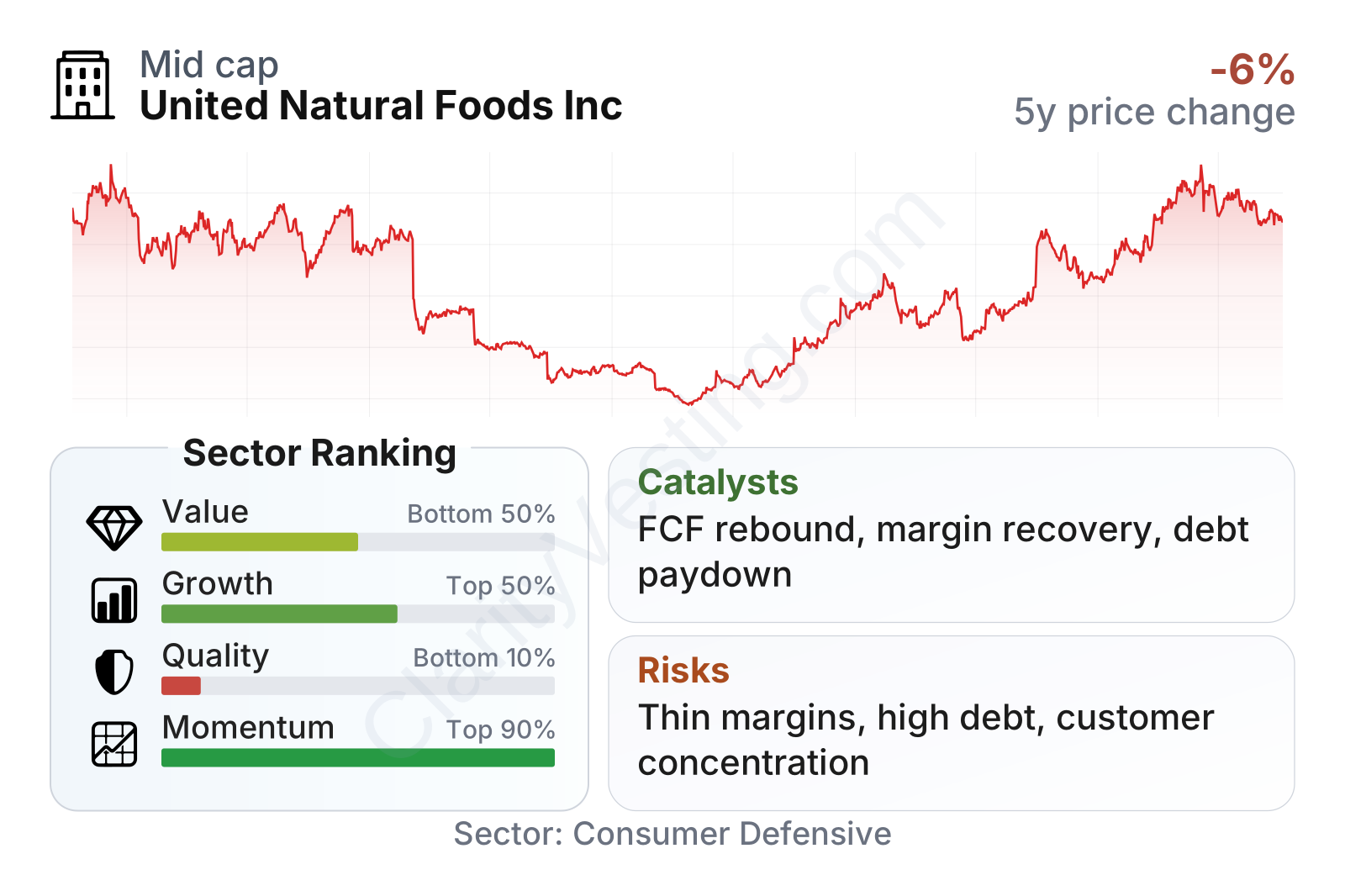
UNFI is a mid-sized public company by market value within the consumer defensive space. The stock’s recent price performance has been much stronger than the sector, but the fundamental profile is mixed. Growth and momentum indicators look better than the quality and valuation factors. In particular, profitability and balance-sheet strength still rank weakly versus sector norms, while the valuation multiples are not obviously cheap relative to that risk profile.
The table also highlights an important contrast: free cash flow generation has improved meaningfully, yet returns on capital, returns on assets, and leverage measures remain noticeably weaker than the sector median. That combination often points to a business in operational recovery rather than one already operating at a best-in-class level.
Growth
Food distribution is not a fast-growing industry, but it is a durable one. People continue buying groceries across economic cycles, and retailers need reliable supply-chain partners. That gives UNFI exposure to a resilient end market. The stronger long-term opportunity is not simply industry expansion, but the company’s ability to improve execution in a low-margin business where even modest gains in efficiency can materially lift earnings and cash flow.
UNFI’s strategy broadly makes sense for that environment. The company has been focused on simplifying operations, improving warehouse throughput, reducing costs, managing inventory more tightly, and strengthening free cash flow. Those priorities fit the economics of food distribution. Because margins are so thin, operational discipline can create more value than aggressive expansion.
Revenue growth has cooled after a stronger period earlier in the cycle. The recent pattern points to a business that is no longer benefiting from the same inflation and volume tailwinds seen in earlier years. The latest year-over-year change is slightly negative, which is below the sector median. That does not automatically indicate deterioration in the franchise, but it does show that the current phase is more about improving profitability than chasing top-line acceleration.
Free cash flow is one of the more constructive parts of the recent picture. After a volatile stretch, trailing cash generation has recovered sharply into the several-hundred-million-dollar range. For a distributor with meaningful debt, this matters a great deal because cash flow can support debt reduction, capital spending, and balance-sheet flexibility. It is also one of the clearest signs that management’s operational initiatives are having some real effect even while accounting earnings remain modest.
A notable catalyst is the company’s ongoing effort to modernize and streamline its distribution network and core systems. Better warehouse productivity, route optimization, and procurement discipline can have an outsized impact because the business operates on such narrow margins. Another potential opportunity is customer retention and expansion within natural and organic food distribution, where UNFI has long-standing market relevance and an established national footprint.
Recent company communications have also emphasized progress on cost savings, network efficiency, and cash generation. Those are not dramatic headline catalysts, but for this type of business they are the main drivers that can change financial outcomes over time. If execution continues improving, even small margin gains could translate into much larger changes in earnings.
Risks
This article is for informational purposes only and does not constitute financial advice. Some content is AI-generated. See Disclaimer