Stock Analysis · Unifirst Corporation (UNF)
Overview
UniFirst Corporation is a business services company focused on workplace uniforms and related facility products. Its core activity is straightforward: it supplies uniforms, protective clothing, floor mats, mops, restroom supplies, and first-aid and safety items to businesses, then picks them up, launders or replenishes them, and delivers them back on a recurring schedule. That recurring service model matters because it tends to create repeat revenue, long customer relationships, and day-to-day operational relevance for clients in manufacturing, healthcare, hospitality, retail, and other service industries.
The company’s revenue base is led by its laundry and uniform rental operations, with additional contributions from specialty garments and first-aid and safety products. Based on recent annual filings, the mix is approximately:
- Core laundry operations and uniform rental: about 89% of revenue. This includes rental and servicing of uniforms and workwear, plus related items such as floorcare and restroom products.
- Specialty garments and cleanroom services: about 6% of revenue. This unit serves customers needing more specialized apparel handling, including cleanroom and controlled-environment garments.
- First Aid products and services: about 5% of revenue. This includes first-aid cabinet service, safety supplies, and related workplace compliance products.
That mix shows a company still heavily anchored in its main route-based uniform business, while trying to broaden customer spending through add-on services. Revenue has grown meaningfully over the last several years, but the business remains labor-intensive, with a large share of costs tied to merchandise, transportation, processing, and local service operations.
A notable financial pattern is that sales increased from roughly $2.0 billion in fiscal 2022 to about $2.43 billion in fiscal 2025, while net income improved more modestly. This suggests UniFirst has grown its footprint, but cost pressure has limited how much of that growth has flowed through to shareholders.
The longer-term picture is one of rising revenue with more mixed profitability. Gross profit expanded through fiscal 2024, but cost of revenue and operating expenses also climbed, which helps explain why recent margin performance has looked less steady than top-line growth alone might suggest.
Key Figures
| Metric | Value | Sector ⓘ |
|---|---|---|
| Date | Oct 24, 2026 | |
| Context | ||
| Sector | Industrials | |
| Industry | Specialty Business Services | |
| Market Cap ⓘ | $4.82B | |
| Beta ⓘ | 0.61 | |
Value (Cheapness) | ||
| P/E Ratio ⓘ | 42.12 | 22.29 |
| P/B Ratio ⓘ | 1.64 | 1.98 |
| FCF Yield ⓘ | 1.81% | 6.26% |
| Dividend Yield ⓘ | 0.55% | 1.92% |
| EBIT / EV ⓘ | 3.02% | 4.83% |
| PEG ⓘ | 2.42 | |
Growth (Business expansion) | ||
| Revenue Growth ⓘ | 3.90% | 9.30% |
| RPS Growth (5Y CAGR) ⓘ | 8.08% | 7.76% |
| EPS Growth (5Y CAGR) ⓘ | 4.18% | -13.17% |
| BVPS Growth (5Y CAGR) ⓘ | 4.37% | 6.13% |
| Margin Growth (5Y Trend) ⓘ | -2.75% | 0.74% |
| FCF Growth (5Y CAGR) ⓘ | 15.78% | 10.79% |
| DPS Growth (5Y CAGR) ⓘ | 8.59% | 9.41% |
Quality (Business durability) | ||
| ROIC (Latest) ⓘ | 5.32% | 10.75% |
| ROA (Latest) ⓘ | 3.89% | 5.41% |
| ROIC (5Y Median) ⓘ | 6.93% | 9.37% |
| ROA (5Y Median) ⓘ | 5.42% | 4.95% |
| Net Debt / EBIT (Latest) ⓘ | -0.78 | 2.04 |
| Net Debt / EBIT (5Y Median) ⓘ | -0.49 | 2.27 |
| Net Debt / EBITDA (Latest) ⓘ | -0.39 | 1.39 |
| Net Debt / Assets ⓘ | -3.87% | 19.27% |
| EBITDA / Interest ⓘ | N/A | 9.58 |
| Operating Margin (Latest) ⓘ | 5.63% | 10.49% |
| Operating Margin (5Y Median) ⓘ | 7.80% | 10.30% |
| Debt to Equity (Latest) ⓘ | 3.64% | 64.82% |
| Profit Margin (Latest) ⓘ | 4.65% | 6.67% |
| Free Cash Flow (Latest) ⓘ | $87.09M | |
Momentum (Price trend) | ||
| 3Y Return ⓘ | +71.31% | +67.77% |
| 12M Return (excl. last month) ⓘ | +57.68% | +12.05% |
| 6M Return ⓘ | +5.18% | 0.00% |
| Price vs. 200-Day MA ⓘ | +6.29% | +0.67% |
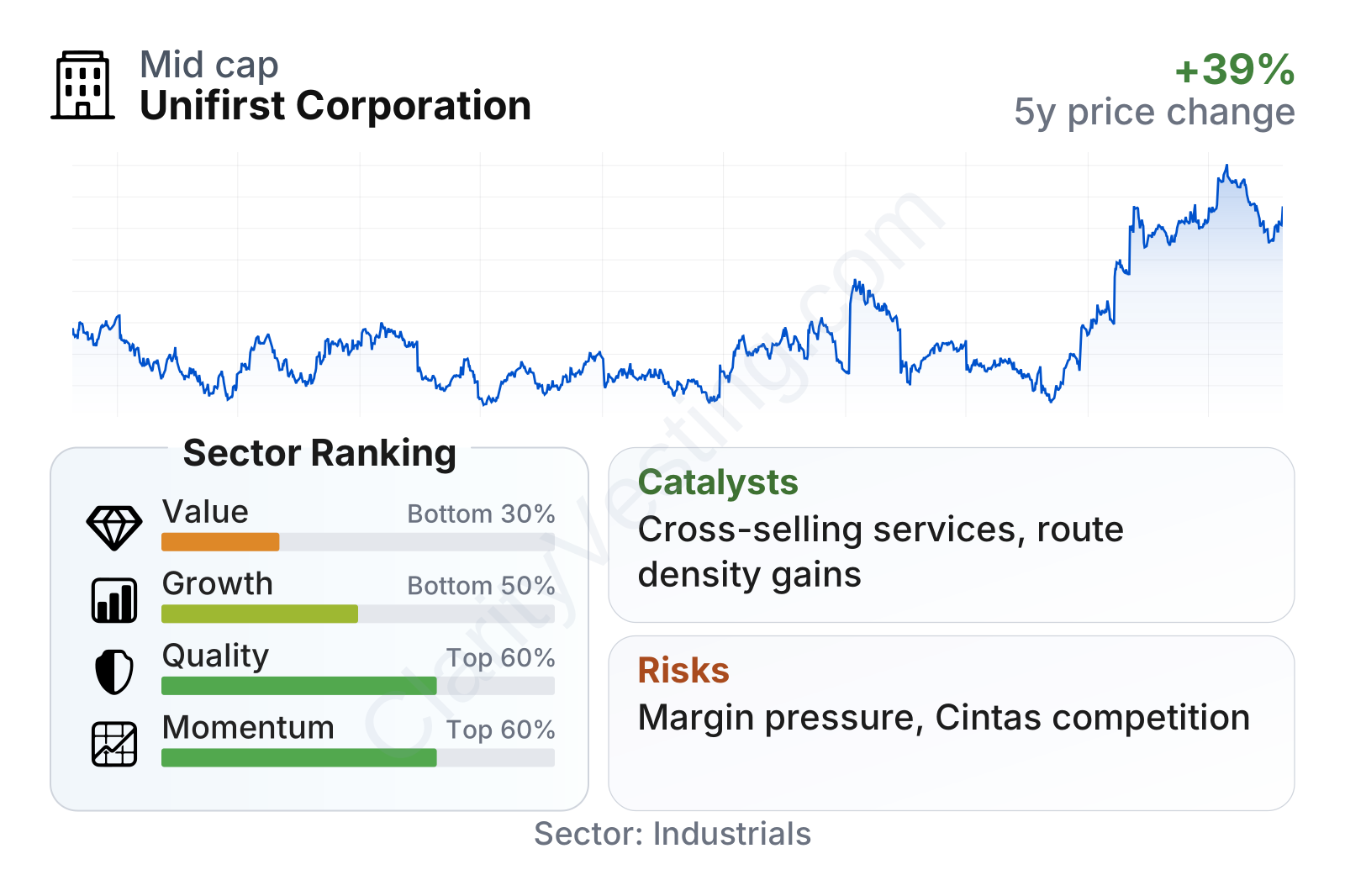
UniFirst is a mid-sized company in the public market, and its share price has been strong over the last year, even though some underlying operating indicators look more moderate. The balance sheet is a clear strength: debt is extremely low, and the company effectively operates with net cash rather than meaningful financial leverage. Quality is acceptable overall, but profitability ratios and returns on capital are below many peers in the broader industrial services universe. Growth is also mixed: five-year revenue-per-share growth has been decent, free cash flow has improved over time, but recent year-over-year sales growth has slowed and current valuation metrics look demanding versus the sector median.
Growth
UniFirst operates in a durable, non-glamorous, but still relevant sector. Uniform rental, facility services, and workplace safety products are not high-tech growth markets, yet they benefit from recurring operational demand. Businesses still need employees outfitted, facilities maintained, and basic compliance needs met. That gives the company exposure to steady replacement and service revenue rather than one-time product sales.
The main strategic logic for future growth is sensible. UniFirst can expand through new customer wins, improved route density, cross-selling first-aid and facility offerings into existing accounts, and selective acquisitions. Because service routes are local and recurring, density matters: adding customers in existing geographies can improve efficiency by spreading transportation, labor, and plant costs over more revenue.
Recent growth has clearly cooled from the double-digit pace seen earlier in the cycle. After a strong post-pandemic rebound and pricing support, revenue growth slowed into low single digits, with one weaker period before returning to a modest positive trend. That does not necessarily indicate a broken model, but it does suggest UniFirst is now operating in a more mature phase where execution and pricing discipline matter more than broad demand recovery.
Cash generation remains an important point to watch. Free cash flow has improved substantially from the weak levels seen a few years ago, although it has not moved in a straight line. For a company like UniFirst, stable cash conversion is important because the business requires continuous spending on garments, plants, delivery infrastructure, and customer service operations. The positive takeaway is that the company still produces meaningful cash while maintaining a conservative balance sheet.
One current catalyst is the company’s ability to keep broadening wallet share with existing customers. First-aid and safety products, facility service items, and specialty garments can deepen customer relationships without relying entirely on new account wins. Another is industry structure: the market remains fragmented outside the biggest national providers, leaving room for regional expansion and tuck-in acquisitions if management sees attractive targets.
There is also a simpler catalyst behind the recent market enthusiasm: investors appear to be giving more credit to UniFirst’s resilience, low leverage, and dependable service model after a period when many cyclical industrial names looked less predictable. That does not create growth by itself, but it can support a stronger valuation when operations remain steady.
Risks
This article is for informational purposes only and does not constitute financial advice. Some content is AI-generated. See Disclaimer


