Stock Analysis · UniCredit SpA (UNCRY)
Overview
UniCredit SpA is a large European commercial bank. It provides everyday banking services such as deposits, payments, lending, cards, wealth products, and corporate financing. The group is headquartered in Italy and operates across several European markets, with Italy and Germany standing out as the most important profit centers. For U.S. readers, UNCRY is the ADR representing the Italian-listed shares.
Like most banks, UniCredit does not make money from a single product. Its revenue mainly comes from the spread between what it earns on loans and securities and what it pays on deposits and funding, plus fees from services offered to retail, corporate, and wealthy clients. Based on recent annual reporting and segment disclosures, the broad revenue mix can be summarized as follows:
- Net interest income: about 55% to 65% — income from loans, mortgages, corporate credit, treasury activity, and the bank’s deposit base after funding costs.
- Fees and commissions: about 25% to 35% — current accounts, payments, cards, asset management distribution, custody, investment products, and advisory services.
- Trading and other market-related income: about 5% to 15% — treasury operations, hedging, trading gains or losses, and valuation effects.
- Other income: usually a small residual share — items such as insurance-related contributions, recoveries, and miscellaneous banking income.
Geographically, Italy is the largest contributor, while Germany, Central Europe, and Eastern Europe provide meaningful diversification. That matters because UniCredit is not only exposed to one local economy; it has a broader European footprint than many domestic banks.
The biggest business change in recent years has been profitability rather than expansion of the branch footprint. Higher interest rates lifted lending margins across Europe, while management also pushed cost discipline, capital returns, and tighter risk controls. That combination turned UniCredit into a much more profitable bank than it was a few years ago.
The business picture over the last several years shows a clear jump in revenue and profit after 2022, with operating expenses staying comparatively controlled. Even with some normalization in 2025 revenue, earnings remained strong, suggesting that the recent improvement has not come only from one-off cost cuts.
Key Figures
| Metric | Value | Sector ⓘ |
|---|---|---|
| Date | Nov 21, 2026 | |
| Context | ||
| Sector | Financial Services | |
| Industry | Banks - Regional | |
| Market Cap ⓘ | $133.17B | |
| Beta ⓘ | 1.10 | |
Value (Cheapness) | ||
| P/E Ratio ⓘ | 10.17 | 12.01 |
| P/B Ratio ⓘ | N/A | 1.48 |
| FCF Yield ⓘ | -8.90% | 8.77% |
| Dividend Yield ⓘ | 4.05% | 3.01% |
| EBIT / EV ⓘ | N/A | 8.31% |
| PEG ⓘ | 0.81 | |
Growth (Business expansion) | ||
| Revenue Growth ⓘ | 11.60% | 6.70% |
| RPS Growth (5Y CAGR) ⓘ | 24.13% | 12.35% |
| EPS Growth (5Y CAGR) ⓘ | 31.82% | -0.27% |
| BVPS Growth (5Y CAGR) ⓘ | 10.91% | 4.83% |
| Margin Growth (5Y Trend) ⓘ | 21.25% | -4.16% |
| FCF Growth (5Y CAGR) ⓘ | N/A | 4.69% |
| DPS Growth (5Y CAGR) ⓘ | 71.67% | 8.82% |
Quality (Business durability) | ||
| ROIC (Latest) ⓘ | N/A | 9.49% |
| ROE (Latest) ⓘ | 16.66% | 14.02% |
| ROA (Latest) ⓘ | 1.31% | 1.53% |
| ROIC (5Y Median) ⓘ | 5.08% | 7.80% |
| ROE (5Y Median) ⓘ | 14.96% | 12.09% |
| ROA (5Y Median) ⓘ | 1.16% | 1.28% |
| Net Debt / EBIT (Latest) ⓘ | N/A | 0.88 |
| Net Debt / EBIT (5Y Median) ⓘ | 4.38 | 0.73 |
| Net Debt / EBITDA (Latest) ⓘ | 4.39 | 0.71 |
| Operating Margin (Latest) ⓘ | N/A | 23.37% |
| Operating Margin (5Y Median) ⓘ | 27.51% | 24.29% |
| Debt to Equity (Latest) ⓘ | 142.37% | 59.34% |
| Profit Margin (Latest) ⓘ | 45.07% | 26.65% |
| Free Cash Flow (Latest) ⓘ | -$11.86B | |
Momentum (Price trend) | ||
| 3Y Return ⓘ | +272.66% | +73.29% |
| 12M Return (excl. last month) ⓘ | +18.31% | +18.35% |
| 6M Return ⓘ | +4.29% | +3.24% |
| Price vs. 200-Day MA ⓘ | +1.85% | +2.17% |
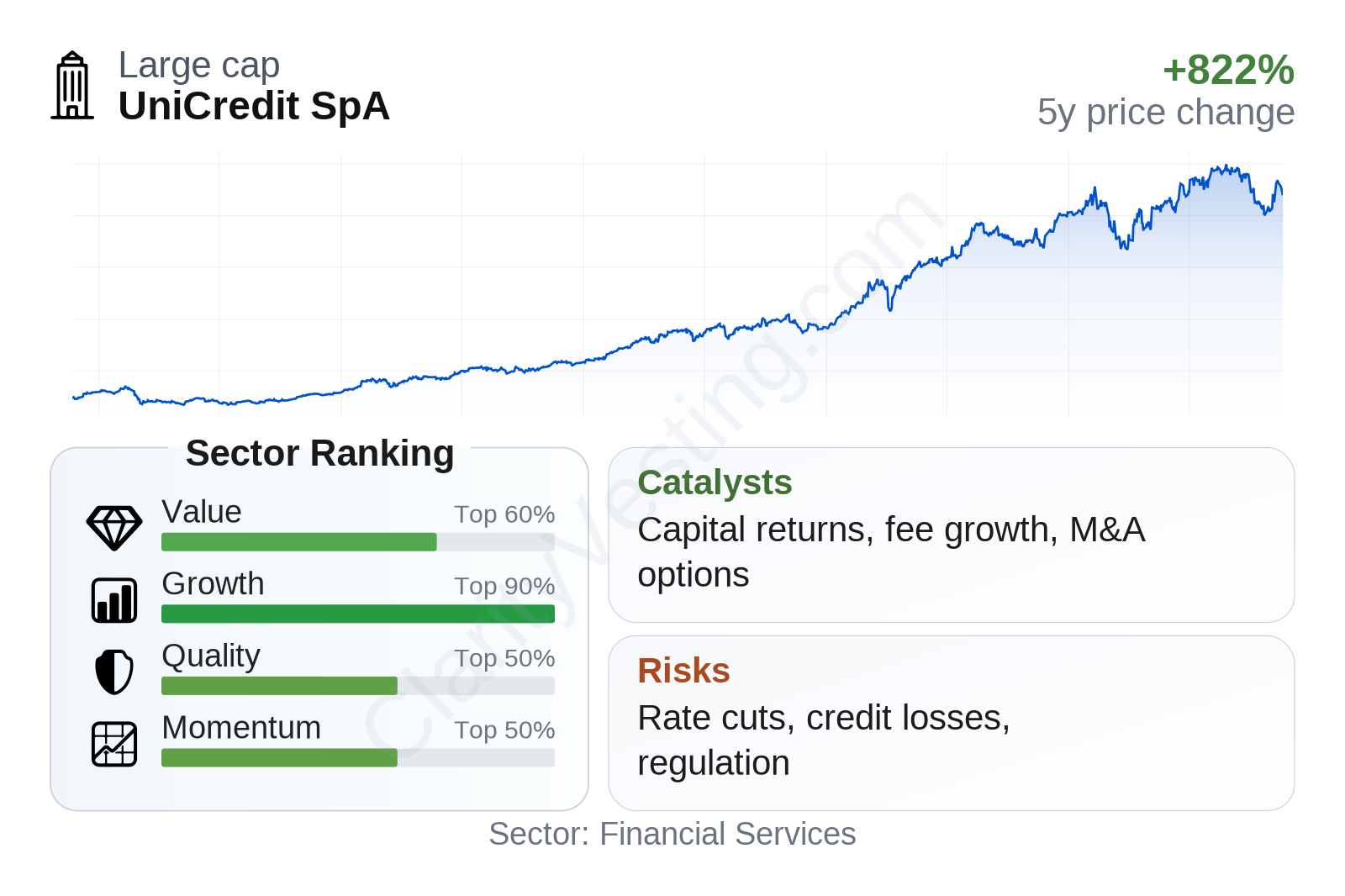
UniCredit is now a very large bank by market value, and the share price has risen sharply since 2022. The metrics table points to an unusual mix: strong growth, solid profitability, and a valuation that still does not look stretched versus the broader regional bank group. The value profile sits around the middle of the sector rather than the cheapest end, but that is happening alongside much stronger growth than most peers.
The quality picture is more mixed. Return on equity is above the sector median, and profit margin is notably strong for a bank, which supports the idea that the recent earnings improvement is real. However, return on assets is a bit below the sector median, and leverage-related ratios appear high, which is common in banking but still worth watching closely. Momentum also remains favorable, as the stock has outperformed the sector over one, three, and shorter trailing periods.
Growth
Banking is not usually seen as a fast-growth industry, but European banking has been in a recovery phase after years of weak rates and low profitability. Higher interest rates helped many banks, yet UniCredit has done more than simply benefit from the rate cycle. It has improved efficiency, raised returns, simplified parts of the business, and used excess capital to support per-share results.
That can be seen clearly in earnings per share. The long-term trend has moved up sharply from 2021 through 2025, reflecting both higher profit and a lower share count from buybacks.
Book value per share has also been climbing at a healthy pace. For a bank, this matters because book value represents the capital base supporting future lending, resilience, and shareholder distributions. Steady growth here suggests UniCredit has not been boosting results by hollowing out its balance sheet.
The company’s strategy for future growth is relatively pragmatic. It is not built around aggressive empire-building. Instead, management has emphasized stronger client activity, digital improvements, cross-selling in wealth and payments, selective lending, and disciplined use of capital. That approach makes sense in a mature banking market where reckless loan growth often creates problems later.
A meaningful catalyst is continued capital distribution capacity, assuming regulation and profitability remain supportive. Another is the bank’s ability to keep fee income growing so that earnings do not rely only on interest rates. UniCredit has also used acquisitions and stake-building selectively in the past when they strengthened positioning, and any future deal activity in European banking could create opportunities if pricing and execution remain disciplined.
Recent company communications in 2026 have continued to highlight resilient underlying performance, strong capital generation, and confidence in shareholder distribution plans. The broader industry backdrop also remains constructive compared with the ultra-low-rate era, even if the peak rate benefit has likely passed.
Risks
This article is for informational purposes only and does not constitute financial advice. Some content is AI-generated. See Disclaimer