Stock Analysis · Umicore SA (UMICF)
Overview
Umicore is a Belgian materials technology and recycling company. Its activities sit at the intersection of clean mobility, emissions control, metal refining, and circular economy services. In simple terms, the company takes complex metals and industrial materials, transforms them into specialized products, and also recovers valuable metals from used devices, industrial residues, and catalytic materials.
The business has historically been organized around three major pillars: catalysts, battery materials, and recycling. Catalysts include products used in automotive emission-control systems and precious-metals chemistry. Battery materials focus on components for rechargeable batteries, especially for electric vehicles. Recycling covers the recovery and refining of precious and specialty metals from industrial by-products, spent batteries, and other complex waste streams.
Based on the company’s recent business mix, revenue is mainly driven by activities tied to metal-rich products and services. Exact percentages can move sharply from year to year because reported revenue is heavily influenced by metal prices and by pass-through metal value, but the broad order of importance is:
- Catalysis: approximately 40% to 50% of group revenue in recent years. This includes automotive catalysts for gasoline and diesel vehicles, heavy-duty applications, fuel-cell catalysts, and precious-metals chemistry.
- Recycling: approximately 25% to 35%. This includes precious metals refining and recovery from industrial residues, end-of-life materials, jewelry scrap, electronic scrap, and battery-related feedstock.
- Battery Materials: approximately 15% to 25%. This includes cathode materials and precursor activities linked to electric-vehicle batteries and energy storage.
- Other specialty materials activities: generally a smaller share, including cobalt and specialty materials operations not captured above.
One important point for long-term readers: revenue alone can be misleading for Umicore. Metal prices can inflate or compress sales without saying much about the underlying health of the business. Profitability, cash generation, and the quality of project execution matter more than top-line movements.
The long-term pattern shows just how cyclical and project-sensitive the company can be. Revenue fell materially from 2022 to 2024, while profitability deteriorated sharply in 2024 because operating expenses rose far faster than gross profit. In 2025, operating income recovered strongly, which suggests that the 2024 weakness was not a normal steady-state year, but it also highlights how volatile earnings can become when battery-material investments and market conditions move against the company.
Key Figures
| Metric | Value | Sector ⓘ |
|---|---|---|
| Date | Oct 24, 2026 | |
| Context | ||
| Sector | Industrials | |
| Industry | Waste Management | |
| Market Cap ⓘ | $5.46B | |
| Beta ⓘ | 0.92 | |
Value (Cheapness) | ||
| P/E Ratio ⓘ | 9.46 | 22.29 |
| P/B Ratio ⓘ | 2.33 | 1.98 |
| FCF Yield ⓘ | 13.10% | 6.26% |
| Dividend Yield ⓘ | 2.20% | 1.92% |
| EBIT / EV ⓘ | N/A | 4.83% |
| PEG ⓘ | N/A | |
Growth (Business expansion) | ||
| Revenue Growth ⓘ | 60.10% | 9.30% |
| RPS Growth (5Y CAGR) ⓘ | -5.21% | 7.76% |
| EPS Growth (5Y CAGR) ⓘ | -7.45% | -13.17% |
| BVPS Growth (5Y CAGR) ⓘ | -8.19% | 6.13% |
| Margin Growth (5Y Trend) ⓘ | 1.67% | 0.74% |
| FCF Growth (5Y CAGR) ⓘ | -20.61% | 10.79% |
| DPS Growth (5Y CAGR) ⓘ | -24.00% | 9.41% |
Quality (Business durability) | ||
| ROIC (Latest) ⓘ | 23.22% | 10.75% |
| ROA (Latest) ⓘ | 6.33% | 5.41% |
| ROIC (5Y Median) ⓘ | 13.39% | 9.37% |
| ROA (5Y Median) ⓘ | 4.07% | 4.95% |
| Net Debt / EBIT (Latest) ⓘ | 13.32 | 2.04 |
| Net Debt / EBIT (5Y Median) ⓘ | 1.25 | 2.27 |
| Net Debt / EBITDA (Latest) ⓘ | 2.27 | 1.39 |
| Net Debt / Assets ⓘ | 14.42% | 19.27% |
| EBITDA / Interest ⓘ | 2.23 | 9.58 |
| Operating Margin (Latest) ⓘ | 0.27% | 10.49% |
| Operating Margin (5Y Median) ⓘ | 3.29% | 10.30% |
| Debt to Equity (Latest) ⓘ | 135.07% | 64.82% |
| Profit Margin (Latest) ⓘ | 1.98% | 6.67% |
| Free Cash Flow (Latest) ⓘ | $715.84M | |
Momentum (Price trend) | ||
| 3Y Return ⓘ | +8.86% | +67.77% |
| 12M Return (excl. last month) ⓘ | +72.99% | +12.05% |
| 6M Return ⓘ | +12.89% | 0.00% |
| Price vs. 200-Day MA ⓘ | +3.81% | +0.67% |
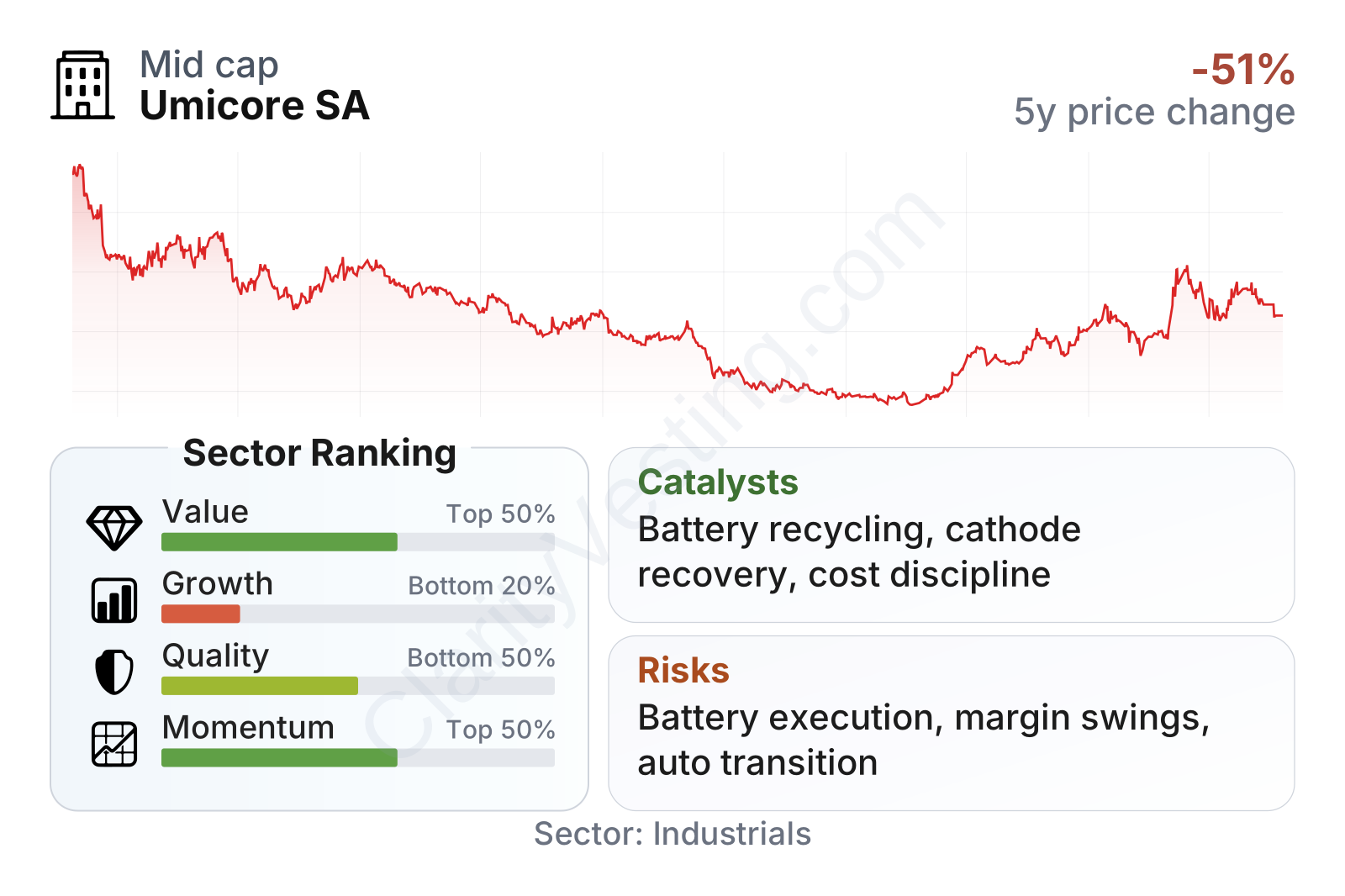
Umicore is a mid-sized industrial company with a share price that has been extremely volatile over the last several years. After a long decline from 2021 into 2025, the stock rebounded sharply over the last 12 months, clearly outperforming much of the sector in recent price momentum.
The valuation profile looks inexpensive on earnings and cash flow compared with the sector median. The P/E ratio sits well below the sector median, and free-cash-flow yield is notably stronger than typical peers. At the same time, the quality picture is mixed. Returns on capital are healthy, but current operating margin is unusually weak for the sector, leverage versus equity is elevated, and interest coverage is decent rather than strong.
The weakest area is long-term growth. Recent year-over-year revenue growth looks impressive, but the five-year record remains poor, with declines in revenue per share, free cash flow, and dividends. That combination suggests a company coming off a depressed base rather than one that has already established a stable multi-year growth runway.
Growth
Umicore operates in sectors that should remain relevant for many years. Recycling of scarce metals, tighter environmental rules, cleaner transport, and battery supply-chain localization are all structural themes rather than short-lived trends. That gives the company exposure to industries with durable demand drivers, especially where Europe and North America want more local processing capacity for strategic materials.
The main growth debate is not about whether these markets exist. It is about whether Umicore can convert them into profitable growth. The company’s strategy makes industrial sense: combine materials know-how, refining expertise, and recycling capabilities in markets where customers increasingly care about supply security and sustainability. In theory, that creates a powerful loop: metals are sourced, used in advanced materials, then recovered and refined again.
The clearest long-term catalyst is battery materials and battery recycling. If electric-vehicle production keeps expanding and local battery supply chains deepen outside China, Umicore has a credible role to play because it already has technical capabilities in cathode chemistry and metal recovery. Another catalyst is stricter recycling regulation, which can increase the economic value of established refining assets and know-how.
There is also a shorter-term operational catalyst. After a very weak 2024, the rebound in 2025 operating income indicates that earnings can recover meaningfully when execution improves and exceptional pressures ease. That does not eliminate uncertainty, but it shows the business still has earnings power when major disruptions are not dominating results.
Recent company communication has also emphasized portfolio sharpening, capital discipline, and a more selective approach to large investment projects. For a company that disappointed the market with battery expansion economics, this shift matters. Future growth now depends less on ambitious volume targets and more on whether management can earn acceptable returns on the capital already committed.
Risks
This article is for informational purposes only and does not constitute financial advice. Some content is AI-generated. See Disclaimer


