Stock Analysis · UMH Properties Inc (UMH)
Overview
UMH Properties Inc is a real estate investment trust, or REIT, focused on manufactured home communities. In simple terms, it owns neighborhoods where residents place manufactured homes, and it earns recurring income from renting home sites. The company also owns rental homes within those communities and, to a smaller extent, sells manufactured homes to residents. Its portfolio is concentrated in the Eastern and Midwestern United States, with a strong presence in states such as New Jersey, Ohio, Pennsylvania, Indiana, and Michigan.
This business model is built around affordable housing. Manufactured housing is often one of the lowest-cost forms of unsubsidized housing in the U.S., which gives UMH exposure to a part of the housing market that can remain resilient when conventional homeownership becomes less affordable. REIT status also means the company is structured to distribute a large share of taxable income to shareholders through dividends.
Based on recent company filings, UMH’s revenue is mainly generated from property operations, with smaller contributions from manufactured home sales and finance-related income. The broad mix can be summarized as follows:
- Community and rental income: about 90% to 94% — rent from developed home sites, rental homes, and other property-related income inside manufactured home communities.
- Sales of manufactured homes: about 5% to 9% — revenue from selling homes to new or existing residents, which can also help fill vacant sites and support future recurring rent.
- Other income: about 1% to 3% — includes items such as interest and ancillary property-related revenue.
That mix matters because the largest part of the business comes from recurring rent rather than one-time transactions. Home sales can help occupancy growth, but the long-term economics depend mostly on site rent, rental home income, and steady community expansion.
Over the last several years, total revenue has trended upward, while operating income and net income have been more uneven. That pattern suggests the company is expanding its asset base, but the benefit to profitability has been partly offset by higher operating and financing costs.
Key Figures
| Metric | Value | Sector ⓘ |
|---|---|---|
| Date | Oct 17, 2026 | |
| Context | ||
| Sector | Real Estate | |
| Industry | REIT - Residential | |
| Market Cap ⓘ | $1.28B | |
| Beta ⓘ | 0.97 | |
Value (Cheapness) | ||
| P/E Ratio ⓘ | 125.25 | 17.38 |
| P/B Ratio ⓘ | 1.47 | 0.85 |
| FCF Yield ⓘ | 2.54% | 7.38% |
| Dividend Yield ⓘ | 5.92% | 4.85% |
| EBIT / EV ⓘ | 2.01% | 3.78% |
| PEG ⓘ | 0.72 | |
Growth (Business expansion) | ||
| Revenue Growth ⓘ | 7.70% | 5.30% |
| RPS Growth (5Y CAGR) ⓘ | -6.00% | 6.02% |
| EPS Growth (5Y CAGR) ⓘ | N/A | -11.37% |
| BVPS Growth (5Y CAGR) ⓘ | -9.32% | 0.45% |
| Margin Growth (5Y Trend) ⓘ | -16.36% | -0.22% |
| FCF Growth (5Y CAGR) ⓘ | 5.91% | 5.40% |
| DPS Growth (5Y CAGR) ⓘ | -4.54% | 5.02% |
Quality (Business durability) | ||
| ROIC (Latest) ⓘ | 2.86% | 5.69% |
| ROE (Latest) ⓘ | 2.32% | 7.56% |
| ROA (Latest) ⓘ | 1.87% | 2.85% |
| ROIC (5Y Median) ⓘ | 1.80% | 4.22% |
| ROE (5Y Median) ⓘ | 0.31% | 6.03% |
| ROA (5Y Median) ⓘ | 1.45% | 2.44% |
| Net Debt / EBIT (Latest) ⓘ | 15.69 | 7.59 |
| Net Debt / EBIT (5Y Median) ⓘ | 12.32 | 8.40 |
| Net Debt / EBITDA (Latest) ⓘ | 6.40 | 5.27 |
| Net Debt / Assets ⓘ | 44.41% | 37.76% |
| EBITDA / Interest ⓘ | 3.38 | 4.10 |
| Operating Margin (Latest) ⓘ | 17.87% | 35.29% |
| Operating Margin (5Y Median) ⓘ | 20.26% | 37.31% |
| Debt to Equity (Latest) ⓘ | 88.65% | 88.87% |
| Profit Margin (Latest) ⓘ | 11.56% | 19.61% |
| Free Cash Flow (Latest) ⓘ | $32.50M | |
Momentum (Price trend) | ||
| 3Y Return ⓘ | +24.72% | +30.75% |
| 12M Return (excl. last month) ⓘ | +9.03% | +4.36% |
| 6M Return ⓘ | +2.37% | -2.52% |
| Price vs. 200-Day MA ⓘ | +0.13% | -2.34% |
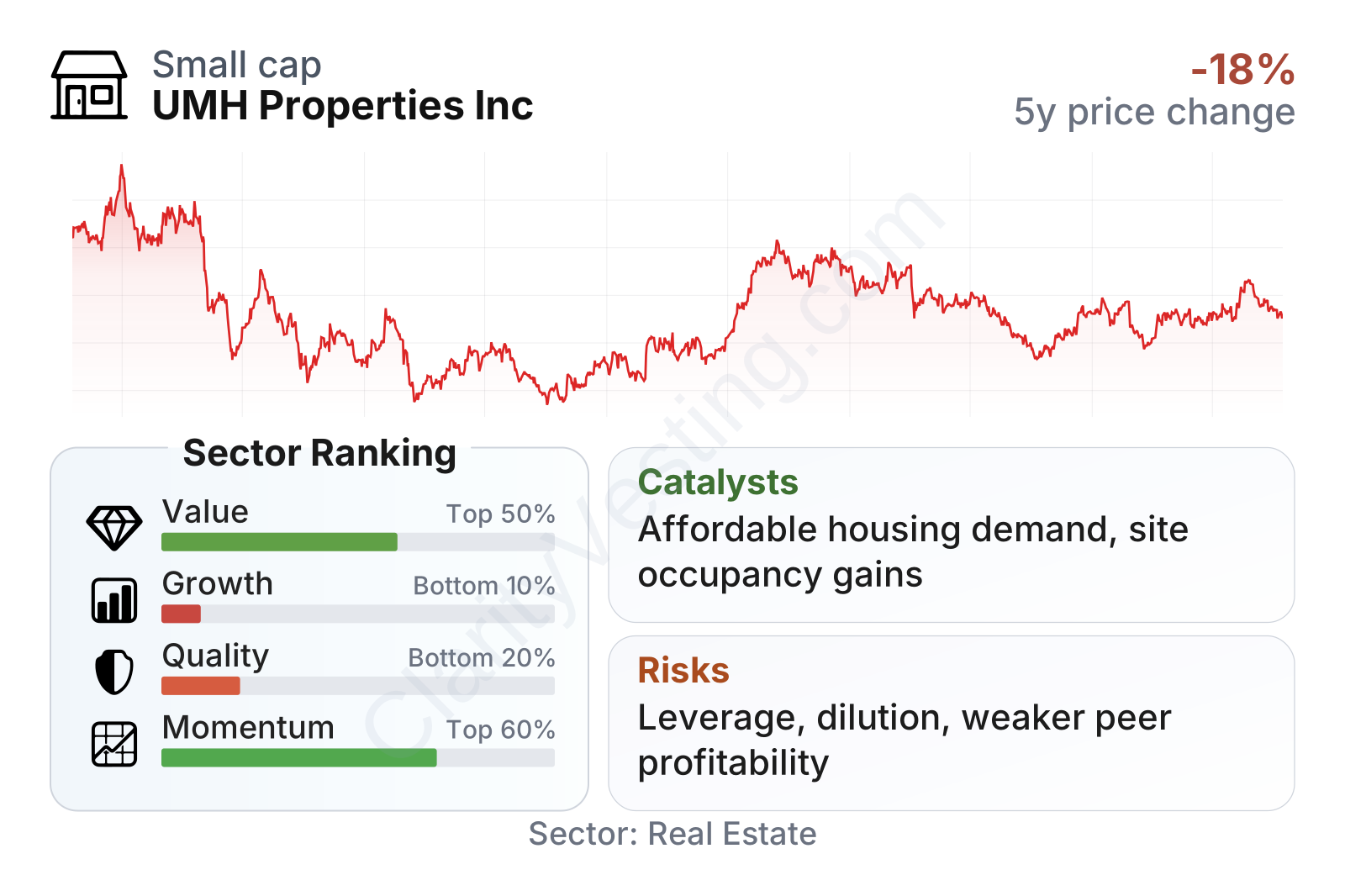
UMH is a small-cap residential REIT with a dividend yield above its sector median, but the rest of the profile is more mixed. Valuation looks demanding on earnings and somewhat above the sector on book value, while profitability and balance-sheet quality rank below many peers. Recent share-price momentum has been better than the sector median, yet long-term growth per share has been weak, which is an important distinction for a REIT that has regularly raised capital to expand.
The stock history shows a sharp decline during the 2022 rate shock, followed by a partial recovery. That is typical for rate-sensitive real estate businesses: changes in borrowing costs and property valuations can move the stock even when the underlying communities remain occupied.
Growth
UMH operates in a segment with an attractive long-term backdrop. Manufactured housing benefits from the U.S. affordability gap, limited supply of low-cost housing, and high replacement costs for site-built homes. These conditions can support demand for lower-cost living arrangements, especially in regions where household budgets are under pressure.
UMH’s strategy is also fairly logical for this niche. The company acquires and develops communities, brings in homes to fill vacant sites, and converts those placements into recurring rent over time. This approach can create a long runway for internal growth if occupancy rises and if the company can improve rent collections and operating efficiency. Unlike some property types that face heavy new supply, manufactured home communities are relatively hard to replicate because zoning and local approvals are often restrictive.
One caution is that revenue per share has moved in the wrong direction over the last five years even though total revenue has increased. That usually means expansion has been funded in part with new shares, so the business has grown in size without creating the same level of growth on a per-share basis. For long-term analysis, that is more important than total revenue alone.
The dividend per share also declined over the longer period before showing some stabilization. Even so, the current yield remains relatively high, reflecting the REIT structure and the market’s focus on income. A high yield can support attention to the stock, but in UMH’s case it should be viewed alongside the company’s modest profitability and capital needs.
A notable growth catalyst is the company’s ability to turn vacant or underused sites into occupied lots. In manufactured housing, each new occupied site can add recurring income with relatively attractive incremental economics once basic infrastructure is already in place. UMH has also emphasized rental homes and home sales as tools to accelerate occupancy. If these communities continue filling up, revenue growth can remain solid even without aggressive rent increases.
Another favorable factor is the broader housing environment. Elevated prices for traditional homes and limited affordable inventory can keep manufactured housing competitive. For a company focused on this niche, that creates a structural demand tailwind rather than a short-lived trend.
Risks
This article is for informational purposes only and does not constitute financial advice. Some content is AI-generated. See Disclaimer


