Stock Analysis · Universal Music Group N.V (UMGNF)
Overview
Universal Music Group N.V. is one of the largest music companies in the world. It owns and manages a vast catalog of recorded music and music publishing rights, works with global artists and songwriters, and earns money when music is streamed, sold, performed, licensed, or used in advertising, film, games, and social platforms. Its scale matters because hit songs and valuable catalogs can keep generating royalties for many years, creating a business model with both new releases and recurring income from older music.
The company’s revenue is mainly split between recorded music, music publishing, and a smaller merchandising and other activities segment. Based on recent annual reporting, the mix is approximately:
- Recorded Music: about 78% of revenue. This includes subscription and ad-supported streaming, physical sales such as vinyl and CDs, downloads, licensing, and artist services.
- Music Publishing: about 17% of revenue. This covers royalties from songwriting rights, including streaming, radio, live performance, synchronization, and other uses of compositions.
- Merchandising and Other: about 5% of revenue. This includes merchandise sales and related direct-to-fan activities.
Within recorded music, subscription streaming is the most important driver. That matters because subscription streaming tends to be more recurring and more predictable than physical sales. It also gives UMG broad exposure to the long-term growth of paid music consumption worldwide.
UMG’s catalog includes major labels and major publishing assets, giving it deep leverage with streaming services, advertisers, and distribution partners. For a long-term review, the key point is that the company is not dependent on a single artist or one-time product cycle in the way many entertainment businesses are.
The profit flow over recent years shows a business that has expanded revenue steadily while also improving operating profitability over time, even though net income can move around more because of taxes, financing costs, and one-off items. Gross profit has also grown meaningfully, reinforcing the value of the catalog and the scale of the distribution platform.
Key Figures
| Metric | Value | Sector ⓘ |
|---|---|---|
| Date | Oct 03, 2026 | |
| Context | ||
| Sector | Communication Services | |
| Industry | Entertainment | |
| Market Cap ⓘ | $29.84B | |
| Beta ⓘ | 0.78 | |
Value (Cheapness) | ||
| P/E Ratio ⓘ | 82.97 | 18.20 |
| FCF Yield ⓘ | 6.16% | 14.71% |
| Dividend Yield ⓘ | 1.68% | 2.86% |
| EBIT / EV ⓘ | N/A | 4.85% |
| PEG ⓘ | 2.29 | |
Growth (Business expansion) | ||
| Revenue Growth ⓘ | 5.30% | 5.50% |
| RPS Growth (5Y CAGR) ⓘ | 9.62% | 4.55% |
| EPS Growth (5Y CAGR) ⓘ | N/A | -18.01% |
| Margin Growth (5Y Trend) ⓘ | 2.88% | 1.32% |
| FCF Growth (5Y CAGR) ⓘ | 10.48% | 5.96% |
| DPS Growth (5Y CAGR) ⓘ | 4.49% | 5.09% |
Quality (Business durability) | ||
| ROIC (Latest) ⓘ | N/A | 8.64% |
| ROIC (5Y Median) ⓘ | 27.92% | 8.11% |
| Net Debt / EBIT (Latest) ⓘ | 1.43 | 1.92 |
| Net Debt / EBIT (5Y Median) ⓘ | 1.57 | 2.85 |
| Net Debt / EBITDA (Latest) ⓘ | 1.16 | 1.25 |
| Net Debt / Assets ⓘ | 27.59% | 18.77% |
| EBITDA / Interest ⓘ | N/A | 8.75 |
| Operating Margin (Latest) ⓘ | 16.36% | 15.58% |
| Operating Margin (5Y Median) ⓘ | 16.56% | 13.53% |
| Debt to Equity (Latest) ⓘ | 153.23% | 59.53% |
| Profit Margin (Latest) ⓘ | 2.52% | 8.78% |
| Free Cash Flow (Latest) ⓘ | $1.84B | |
Momentum (Price trend) | ||
| 3Y Return ⓘ | -31.41% | +43.39% |
| 12M Return (excl. last month) ⓘ | -37.85% | +1.92% |
| 6M Return ⓘ | -8.15% | +2.94% |
| Price vs. 200-Day MA ⓘ | -21.26% | +0.74% |
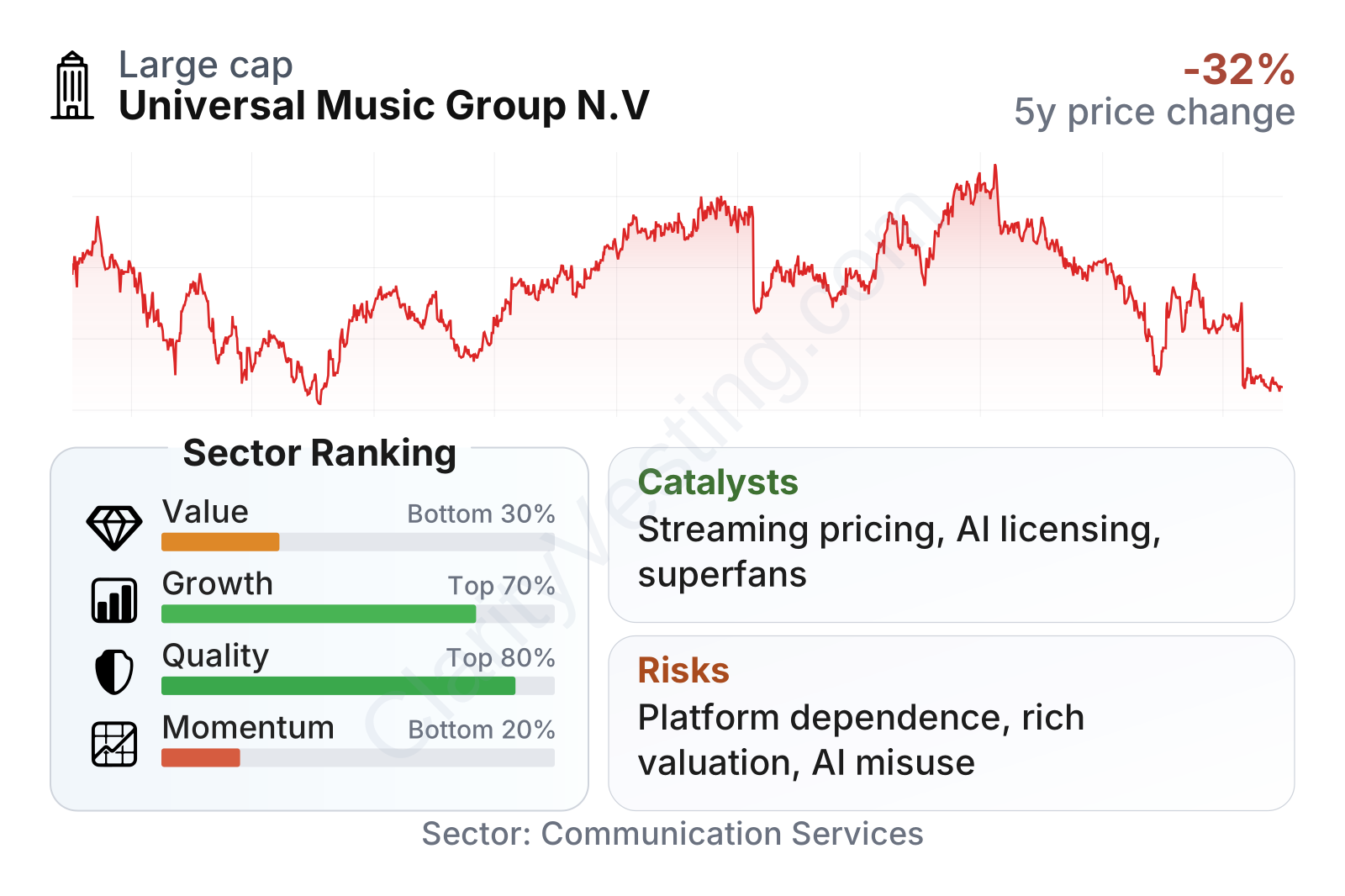
UMG stands out more on business quality than on headline cheapness. Profitability and returns on invested capital have been strong versus much of the sector, and leverage against earnings remains fairly controlled despite a balance sheet that looks more debt-heavy on an equity basis. Growth has also been solid over a multiyear period, especially in revenue per share, free cash flow, and margin improvement. The weaker area is valuation, where the earnings multiple is elevated and cash flow yield sits below sector norms. Price performance has also lagged recently, which suggests the market has become more cautious on growth expectations and valuation at the same time.
The stock chart shows a company whose share price had a strong phase through 2024 and then lost momentum into 2026. That softer trading pattern does not change the operating profile by itself, but it does show that sentiment has cooled even while the underlying business remains sizable, cash generative, and relatively defensive compared with many media names. Beta below 1 also points to less volatility than the broader market.
Growth
UMG operates in a part of the entertainment industry that still has room to expand. Global music consumption continues to shift toward paid streaming, and that trend can support higher royalty pools over time. The business also benefits from the growing number of ways music is monetized: short-form video, gaming, fitness, social media, film, television, and brand partnerships all widen the number of commercial uses for songs and recordings.
The company’s strategy is coherent for long-term growth because it combines three attractive characteristics: a large catalog of evergreen content, a pipeline of new releases, and ownership of publishing rights that earn money across many platforms. This creates a mix of recurring revenue and fresh demand. It also means UMG can capture value from both the recording and the composition side of the same song in many cases.
A major catalyst is the continued expansion of paid streaming outside the most mature markets. As more users move from free listening to subscriptions, the economics usually improve. Another important catalyst is pricing: when streaming services raise subscription prices, rights holders such as UMG can benefit if higher pricing flows through to royalty pools. Catalog monetization is also becoming broader as older tracks are reused across digital platforms and licensed more often.
Artificial intelligence is another important area to watch. For UMG, AI is both a challenge and an opportunity. The opportunity is that official licensing frameworks for AI music tools could create a new royalty stream and strengthen the value of rights ownership. The company has been vocal about protecting artists and songwriters while seeking licensed uses of music in new digital products. If licensing standards become more formalized across the industry, large rights owners are likely to be in a stronger negotiating position than smaller independents.
Recent company communication has also emphasized superfan monetization, direct artist engagement, and the continued strength of subscription streaming. These themes are meaningful because they point toward revenue per fan increasing over time, not just listener growth alone.
Risks
This article is for informational purposes only and does not constitute financial advice. Some content is AI-generated. See Disclaimer