Stock Analysis · Universal Health Services Inc (UHS)
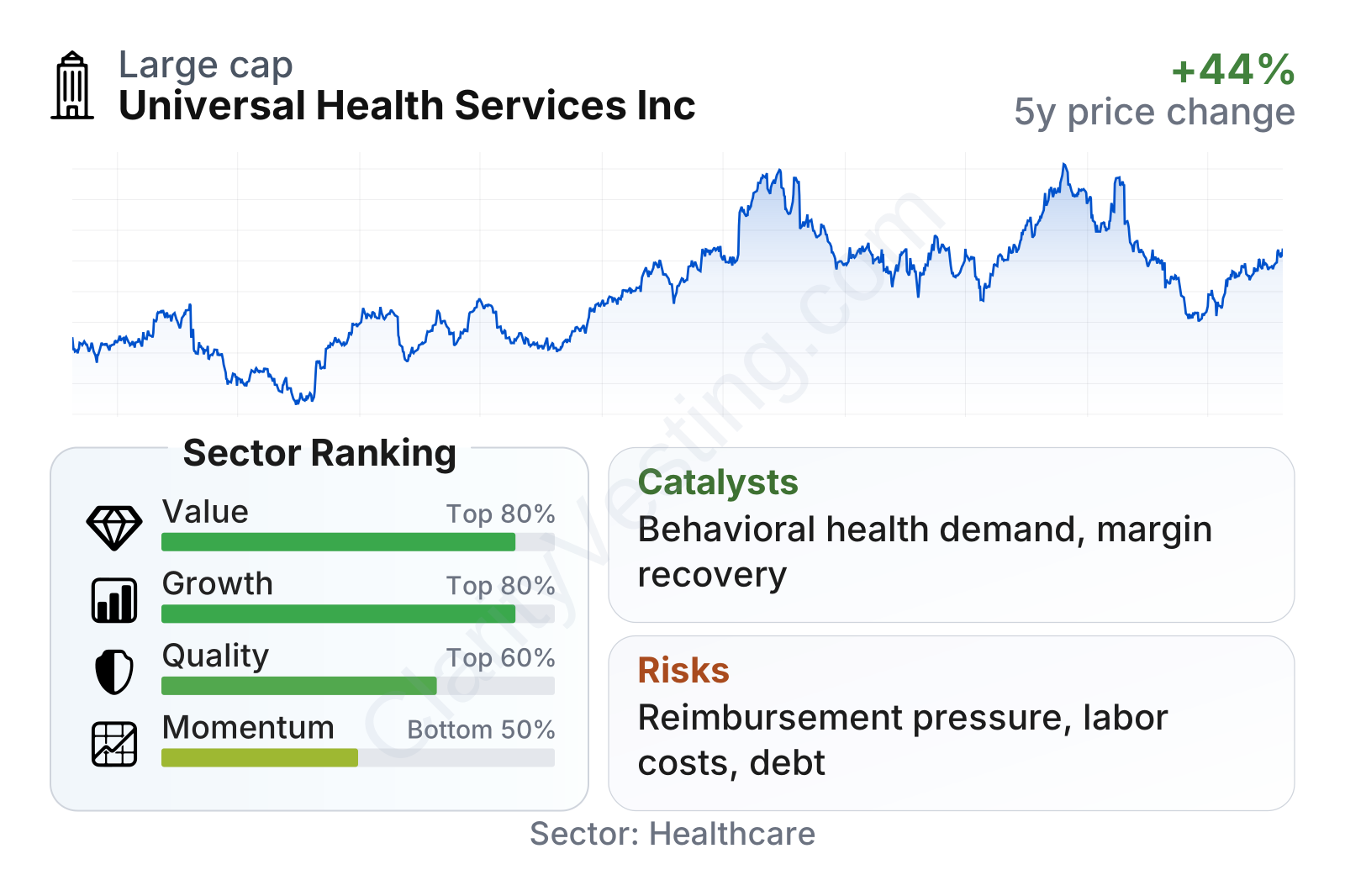
Overview
Universal Health Services, Inc. is a large U.S. healthcare operator that runs hospitals and related care facilities. Its business is centered on two major areas: acute care hospitals, which treat medical and surgical patients, and behavioral health facilities, which provide mental health and substance use disorder services. The company operates in the United States and also has a smaller presence in the United Kingdom through behavioral health facilities.
This is not a biotech or medical device company that depends on one product launch. UHS is a facility operator, which means its results are driven by patient volumes, pricing, labor costs, reimbursement rates from insurers and government programs, and the efficiency of running hospitals and behavioral care networks.
Based on recent company reporting, revenue is mainly split between the acute care hospital segment and the behavioral health segment.
- Acute Care Hospital Services: about 59% to 60% of revenue — general and specialty hospitals, emergency care, outpatient services, and other medical services.
- Behavioral Health Care Services: about 40% to 41% of revenue — inpatient and outpatient mental health services, addiction treatment, and related care programs in the U.S. and U.K.
The business mix matters because behavioral health tends to have different demand patterns than standard hospital care. It can provide some diversification inside healthcare, especially as mental health treatment demand continues to receive more policy attention and broader social acceptance.
Over the last several years, revenue has moved steadily higher, while profitability dipped in 2022 and 2023 before recovering strongly in 2024 and 2025. That pattern suggests the company absorbed a period of pressure, likely tied to labor and operating costs, and then rebuilt margins as pricing and operations improved.
The long-term picture shows a business with rising sales, expanding operating income, and a much stronger earnings profile in the most recent years than in the post-pandemic cost-pressure period.
Key Figures
| Metric | Value | Sector ⓘ |
|---|---|---|
| Date | Oct 24, 2026 | |
| Context | ||
| Sector | Healthcare | |
| Industry | Medical Care Facilities | |
| Market Cap ⓘ | $10.78B | |
| Beta ⓘ | 1.03 | |
Value (Cheapness) | ||
| P/E Ratio ⓘ | 7.46 | 25.42 |
| P/B Ratio ⓘ | 1.53 | 3.08 |
| FCF Yield ⓘ | 7.67% | 3.12% |
| Dividend Yield ⓘ | 0.43% | 1.85% |
| EBIT / EV ⓘ | 13.89% | 0.56% |
| PEG ⓘ | 1.21 | |
Growth (Business expansion) | ||
| Revenue Growth ⓘ | 8.30% | 7.50% |
| RPS Growth (5Y CAGR) ⓘ | 15.56% | 8.60% |
| EPS Growth (5Y CAGR) ⓘ | 4.29% | -17.73% |
| BVPS Growth (5Y CAGR) ⓘ | 11.56% | 3.72% |
| Margin Growth (5Y Trend) ⓘ | 1.34% | -0.57% |
| FCF Growth (5Y CAGR) ⓘ | 134.60% | 0.96% |
| DPS Growth (5Y CAGR) ⓘ | 0.25% | 6.69% |
Quality (Business durability) | ||
| ROIC (Latest) ⓘ | 13.77% | 3.17% |
| ROA (Latest) ⓘ | 9.76% | 2.98% |
| ROIC (5Y Median) ⓘ | 10.28% | 4.56% |
| ROA (5Y Median) ⓘ | 7.46% | 1.87% |
| Net Debt / EBIT (Latest) ⓘ | 2.35 | 1.34 |
| Net Debt / EBIT (5Y Median) ⓘ | 3.23 | 1.86 |
| Net Debt / EBITDA (Latest) ⓘ | 1.82 | 1.00 |
| Net Debt / Assets ⓘ | 32.15% | 5.06% |
| EBITDA / Interest ⓘ | 18.11 | 9.55 |
| Operating Margin (Latest) ⓘ | 12.03% | 9.25% |
| Operating Margin (5Y Median) ⓘ | 10.62% | 7.33% |
| Debt to Equity (Latest) ⓘ | 70.03% | 26.68% |
| Profit Margin (Latest) ⓘ | 8.42% | 3.34% |
| Free Cash Flow (Latest) ⓘ | $826.72M | |
Momentum (Price trend) | ||
| 3Y Return ⓘ | +52.54% | +51.61% |
| 12M Return (excl. last month) ⓘ | -7.26% | +19.90% |
| 6M Return ⓘ | +4.37% | +10.10% |
| Price vs. 200-Day MA ⓘ | +6.03% | +6.44% |
UHS stands out as a mid-to-large healthcare operator with unusually strong profitability for its sector and a valuation that sits well below typical healthcare multiples. Recent growth measures are solid rather than explosive, but the five-year record for revenue per share, margins, and free cash flow points to meaningful operating improvement. The weaker area is market momentum, as the share price has lagged the broader healthcare group over the last several months despite better-than-median quality and growth characteristics.
Growth
Healthcare services is generally a durable sector for long-term growth because demand is tied to demographics, chronic conditions, and ongoing need for treatment rather than discretionary spending. Within that broad market, behavioral health is one of the more favorable niches. Mental health and addiction treatment continue to receive increasing attention from health systems, insurers, and public policy. That creates a supportive backdrop for UHS because behavioral health is not a side business for the company; it is a major revenue engine.
UHS also benefits from having two growth levers at once. The acute care business can expand through admissions, outpatient activity, and reimbursement increases, while behavioral health can grow through bed additions, occupancy gains, and broader treatment demand. This combination gives the company more than one path to increase revenue.
Revenue growth has been consistently positive and has recently run in the high single digits to low double digits, which is slightly ahead of the sector median. That is a healthy pace for a hospital operator, especially in a business that is normally considered mature rather than high-growth.
Cash generation is another encouraging element. Free cash flow weakened earlier in the period but rebounded sharply and remains strong on a trailing basis. For a hospital company, this matters because cash flow supports capital spending, debt service, and strategic flexibility without relying too heavily on external financing.
Strategically, the company’s model makes sense for future growth because it already has scale, local market presence, and operating experience in two service lines where demand remains structurally important. A major catalyst is the continued normalization of staffing conditions after the labor disruptions that affected many hospital operators. If labor costs remain more manageable while reimbursement and patient activity stay firm, earnings can improve faster than revenue.
Another meaningful opportunity is behavioral health capacity expansion. The need for mental health services remains high across many regions, and barriers to care are still significant. Operators with existing infrastructure and clinical expertise are in a stronger position to add beds, open units, or deepen referral relationships with health systems and payers.
Risks
This article is for informational purposes only and does not constitute financial advice. Some content is AI-generated. See Disclaimer


