Stock Analysis · U-Haul Holding Company (UHAL)
Overview
U-Haul Holding Company is best known for do-it-yourself moving. Through the U-Haul brand, it rents trucks, trailers, towing devices, and moving equipment to households and small businesses. The company also operates a large self-storage network and sells moving supplies. Beyond moving and storage, it owns a property and casualty insurance business that mainly supports its core operations.
Its model is built around a large fleet, a broad neighborhood dealer network, and dense real estate coverage in North America. That scale matters because one-way moving rentals work best when a company has enough locations and equipment to reposition vehicles efficiently and keep utilization high. In simple terms, U-Haul is not just renting trucks; it is operating a logistics network tied to household mobility.
Based on the latest annual filing, revenue comes primarily from the Moving and Storage segment, with insurance providing a smaller but meaningful contribution. Within the main segment, the mix is broadly concentrated in a few categories:
- Self-moving equipment rentals: approximately 44% of total revenue. This includes truck, trailer, towing, and related rental activity.
- Self-storage revenues: approximately 18% of total revenue. This covers storage unit rentals and related fees.
- Sales of self-moving and self-storage products: approximately 16% of total revenue. This includes moving supplies, propane, hitches, and other related products and services.
- Property management fees: approximately 5% of total revenue.
- Life insurance and property & casualty insurance premiums and other insurance revenue: together roughly 17% of total revenue, depending on period mix.
The recent financial flow also shows an important pattern: revenue has held up near prior peaks, but operating income and net income have fallen sharply over the last few years as expenses and interest costs increased. That means the top line has been relatively resilient, while profitability has become much thinner.
Key Figures
| Metric | Value | Sector ⓘ |
|---|---|---|
| Date | Oct 24, 2026 | |
| Context | ||
| Sector | Industrials | |
| Industry | Rental & Leasing Services | |
| Market Cap ⓘ | $11.02B | |
| Beta ⓘ | 1.11 | |
Value (Cheapness) | ||
| P/E Ratio ⓘ | 402.64 | 22.29 |
| P/B Ratio ⓘ | 1.43 | 1.98 |
| FCF Yield ⓘ | -11.19% | 6.26% |
| Dividend Yield ⓘ | N/A | 1.92% |
| EBIT / EV ⓘ | 2.74% | 4.83% |
| PEG ⓘ | 2.35 | |
Growth (Business expansion) | ||
| Revenue Growth ⓘ | 3.20% | 9.30% |
| RPS Growth (5Y CAGR) ⓘ | 1.27% | 7.76% |
| EPS Growth (5Y CAGR) ⓘ | -49.71% | -13.17% |
| BVPS Growth (5Y CAGR) ⓘ | 6.34% | 6.13% |
| Margin Growth (5Y Trend) ⓘ | -20.73% | 0.74% |
| FCF Growth (5Y CAGR) ⓘ | N/A | 10.79% |
| DPS Growth (5Y CAGR) ⓘ | 4.66% | 9.41% |
Quality (Business durability) | ||
| ROIC (Latest) ⓘ | 2.69% | 10.75% |
| ROA (Latest) ⓘ | 0.21% | 5.41% |
| ROIC (5Y Median) ⓘ | 6.74% | 9.37% |
| ROA (5Y Median) ⓘ | 3.21% | 4.95% |
| Net Debt / EBIT (Latest) ⓘ | 15.05 | 2.04 |
| Net Debt / EBIT (5Y Median) ⓘ | 4.37 | 2.27 |
| Net Debt / EBITDA (Latest) ⓘ | 3.97 | 1.39 |
| Net Debt / Assets ⓘ | 32.54% | 19.27% |
| EBITDA / Interest ⓘ | 4.65 | 9.58 |
| Operating Margin (Latest) ⓘ | 7.69% | 10.49% |
| Operating Margin (5Y Median) ⓘ | 19.48% | 10.30% |
| Debt to Equity (Latest) ⓘ | 106.33% | 64.82% |
| Profit Margin (Latest) ⓘ | 1.05% | 6.67% |
| Free Cash Flow (Latest) ⓘ | -$1.23B | |
Momentum (Price trend) | ||
| 3Y Return ⓘ | +8.10% | +67.77% |
| 12M Return (excl. last month) ⓘ | +12.62% | +12.05% |
| 6M Return ⓘ | +4.13% | 0.00% |
| Price vs. 200-Day MA ⓘ | -4.47% | +0.67% |
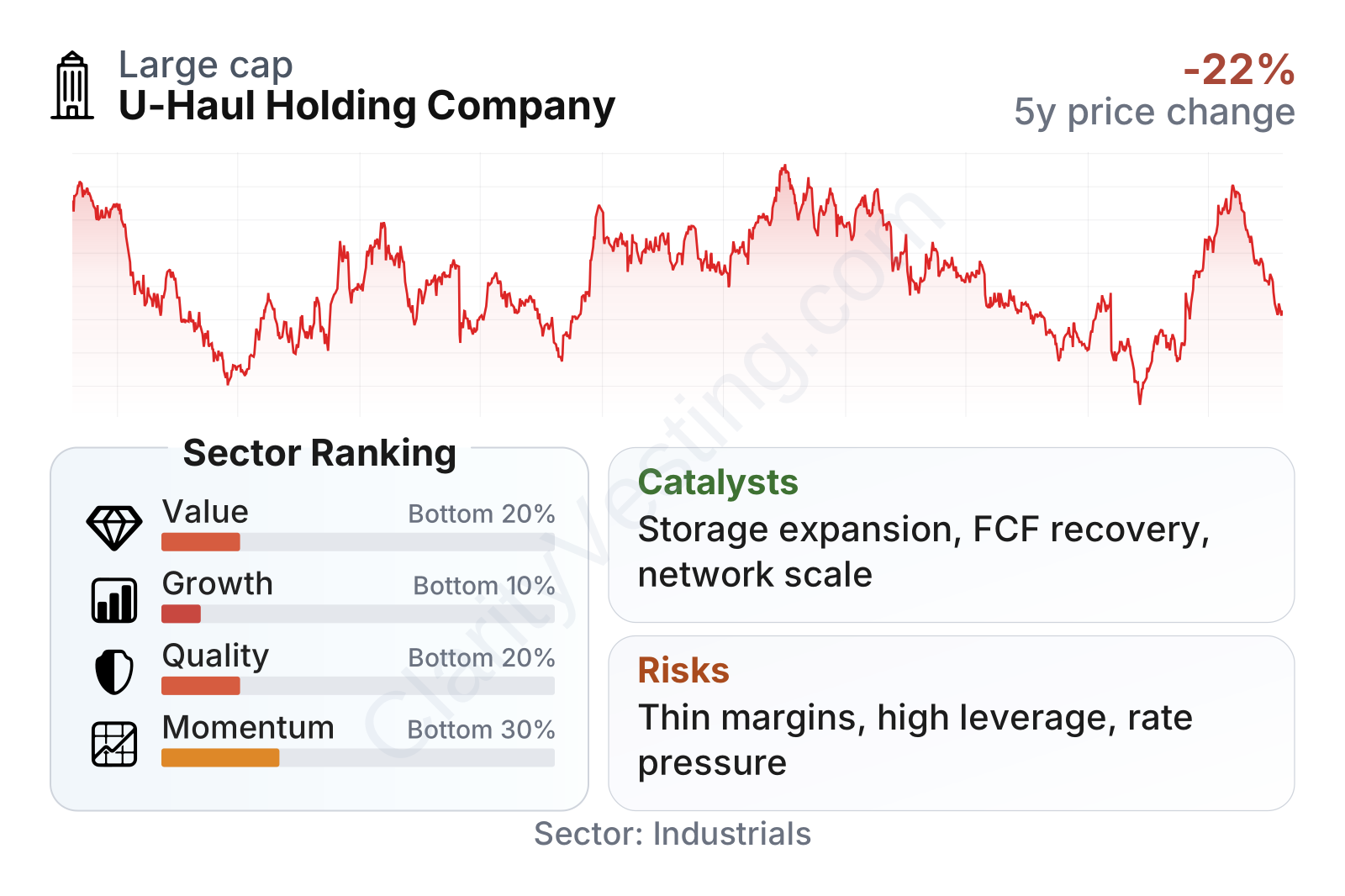
U-Haul is a mid-to-large sized company in its sector, and the recent share price recovery has been stronger over the last six months than for many peers. Still, the broader fundamental profile is mixed. Value, growth, and quality metrics rank in the lower end of the sector, largely because earnings have compressed, free cash flow has been weak, and leverage is above normal. The stock’s very high earnings multiple is mainly a reflection of depressed recent profits rather than a traditionally high-margin business.
Growth
U-Haul operates in markets with durable long-term demand. People continue to move for jobs, affordability, family reasons, and retirement, while self-storage has remained a widely used service for both residential and small business customers. Those are not fast-changing technology markets, but they are large, recurring, and supported by demographic mobility and housing turnover over time.
The company’s growth strategy is straightforward and easy to understand: add more storage capacity, improve local availability of trucks and trailers, and keep cross-selling customers across moving, storage, and related services. This strategy makes industrial sense because each additional owned location can serve multiple needs at once. A customer may rent a truck, buy supplies, use storage, and return later, which raises lifetime value without requiring a completely new customer acquisition process.
Recent revenue growth suggests the business has moved past the contraction seen in 2023 and early 2024. Growth has returned to low-single-digit to low-teens territory depending on the quarter, which is an improvement from the prior slump. Even so, it still trails the broader sector median, so the current picture looks more like stabilization than a high-growth phase.
Cash generation has also been improving after a long period of negative free cash flow. That matters because U-Haul has been spending heavily on fleet and real estate. A move from deeply negative free cash flow toward break-even is a constructive sign, even if the latest trailing level remains very small in absolute terms. For a company with asset-heavy operations, future growth depends not only on demand but on whether new assets start producing enough returns to justify the capital committed.
A practical catalyst is the company’s continuing expansion of self-storage capacity. Storage can be attractive because it is usually more recurring and often less operationally volatile than truck rentals. If new storage properties mature well, they could gradually improve the earnings mix. Another potential support is any normalization in used equipment values, fleet costs, or financing pressure, since those have weighed on profitability.
Risks
This article is for informational purposes only and does not constitute financial advice. Some content is AI-generated. See Disclaimer


