Stock Analysis · UGI Corporation (UGI)
Overview
UGI Corporation is an energy distribution and utility company focused on natural gas, propane, and related energy services. Its business mixes regulated utility operations, which tend to be steadier and overseen by state regulators, with non-regulated energy distribution activities that are more exposed to commodity prices, weather, and economic conditions. The company operates primarily in the United States and Europe, serving households, businesses, industrial customers, and wholesale buyers.
Based on UGI’s latest annual reporting structure, revenue comes from several main segments. Because energy prices can move sharply from year to year, these shares can shift meaningfully even when volumes are more stable. Using the latest annual revenue mix as a practical guide, the largest sources are approximately:
- AmeriGas Propane: about 38% of revenue. This segment distributes propane to residential, commercial, industrial, agricultural, and motor-fuel customers across the United States.
- UGI International: about 30% of revenue. This business mainly includes LPG distribution and energy marketing activities in Europe.
- Midstream & Marketing: about 20% of revenue. This includes energy marketing, natural gas gathering, processing, transportation, storage, and power-related activities.
- UGI Utilities: about 12% of revenue. This is the regulated natural gas and electric utility operation in Pennsylvania.
That mix shows an important point for long-term readers: UGI is not a pure regulated utility. A meaningful share of revenue comes from propane and energy marketing businesses that can create more earnings volatility than a traditional gas utility, but also give the company more ways to grow beyond a single service territory.
The business flow over recent years also shows how sensitive reported revenue is to commodity prices. Sales peaked when energy prices were elevated, then normalized, while profitability recovered after a difficult 2023 period. That makes headline revenue less informative on its own than margins, cash flow, and balance-sheet trends.
Revenue has come down from the 2022 spike as energy prices normalized, but operating profit and net income improved meaningfully after the 2023 disruption. The recent picture looks more stable than the headline sales trend alone would suggest.
Key Figures
| Metric | Value | Sector ⓘ |
|---|---|---|
| Date | Oct 17, 2026 | |
| Context | ||
| Sector | Utilities | |
| Industry | Utilities - Regulated Gas | |
| Market Cap ⓘ | $8.08B | |
| Beta ⓘ | 0.95 | |
Value (Cheapness) | ||
| P/E Ratio ⓘ | 12.51 | 17.28 |
| P/B Ratio ⓘ | 1.54 | 1.51 |
| FCF Yield ⓘ | 2.32% | 0.65% |
| Dividend Yield ⓘ | 3.98% | 3.77% |
| EBIT / EV ⓘ | 6.76% | 5.01% |
| PEG ⓘ | 48.82 | |
Growth (Business expansion) | ||
| Revenue Growth ⓘ | -4.50% | 6.10% |
| RPS Growth (5Y CAGR) ⓘ | -1.35% | 3.87% |
| EPS Growth (5Y CAGR) ⓘ | 1.57% | -11.30% |
| BVPS Growth (5Y CAGR) ⓘ | -3.40% | 4.23% |
| Margin Growth (5Y Trend) ⓘ | -15.60% | 3.57% |
| FCF Growth (5Y CAGR) ⓘ | -16.20% | -8.84% |
| DPS Growth (5Y CAGR) ⓘ | 2.53% | 4.84% |
Quality (Business durability) | ||
| ROIC (Latest) ⓘ | 6.53% | 6.53% |
| ROA (Latest) ⓘ | 4.32% | 3.20% |
| ROIC (5Y Median) ⓘ | 9.27% | 5.95% |
| ROA (5Y Median) ⓘ | 4.44% | 2.75% |
| Net Debt / EBIT (Latest) ⓘ | 6.38 | 7.13 |
| Net Debt / EBIT (5Y Median) ⓘ | 5.16 | 7.23 |
| Net Debt / EBITDA (Latest) ⓘ | 4.05 | 4.31 |
| Net Debt / Assets ⓘ | 39.90% | 38.42% |
| EBITDA / Interest ⓘ | 3.52 | 4.58 |
| Operating Margin (Latest) ⓘ | 13.40% | 20.83% |
| Operating Margin (5Y Median) ⓘ | 15.27% | 20.08% |
| Debt to Equity (Latest) ⓘ | 128.77% | 137.69% |
| Profit Margin (Latest) ⓘ | 9.20% | 11.37% |
| Free Cash Flow (Latest) ⓘ | $187.00M | |
Momentum (Price trend) | ||
| 3Y Return ⓘ | +102.30% | +52.37% |
| 12M Return (excl. last month) ⓘ | +13.13% | +8.84% |
| 6M Return ⓘ | +2.04% | -3.95% |
| Price vs. 200-Day MA ⓘ | +3.46% | -0.79% |
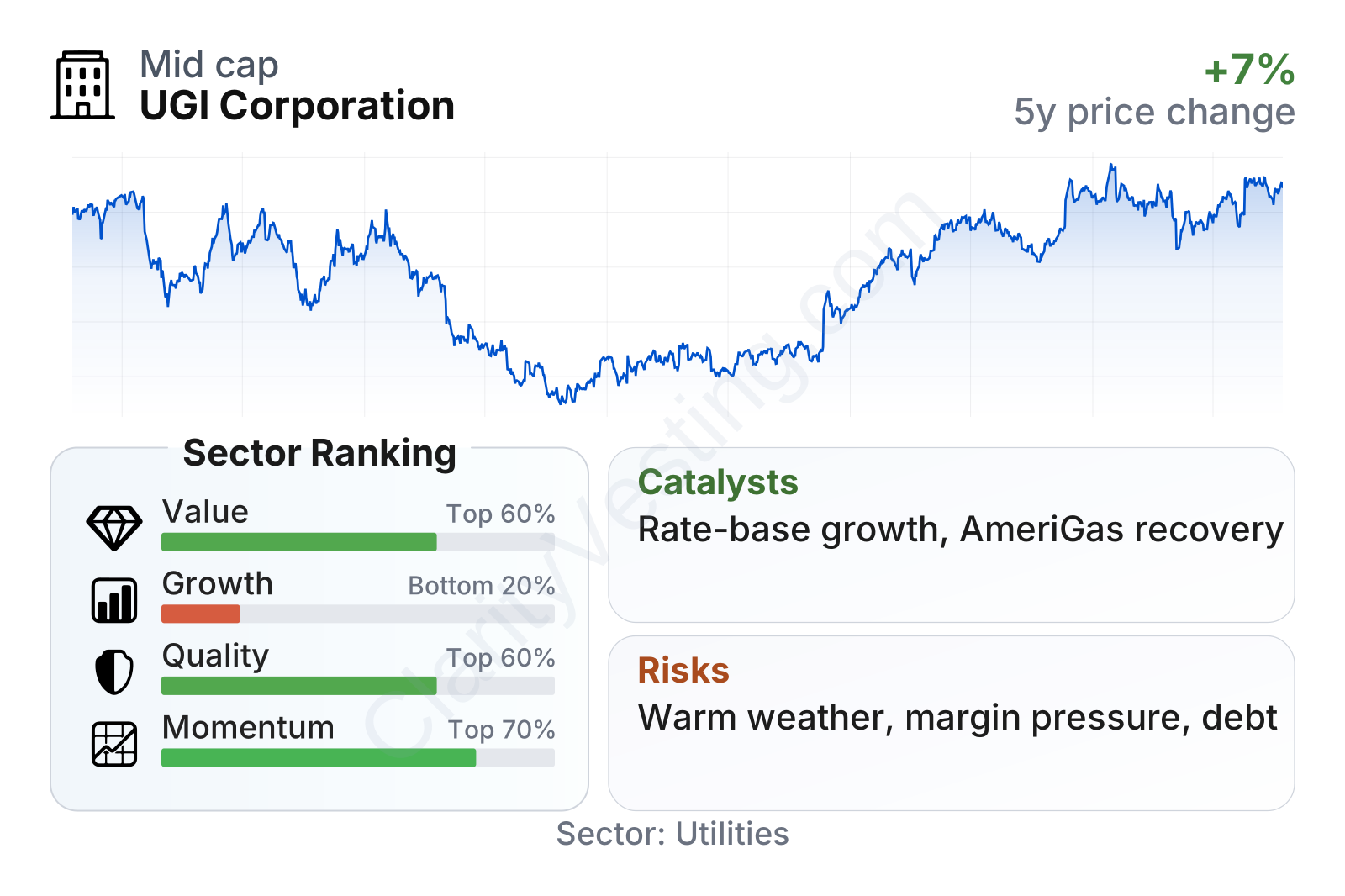
UGI sits in the mid-sized range within the utility space. The overall profile is mixed: valuation looks lighter than the sector on earnings-based measures, quality metrics are around the middle of the pack, and share-price momentum has been better than many peers over the last three years. The weak spot is growth, where revenue, free cash flow, and book value trends have generally trailed the sector median.
The stock price history also reflects that uneven path. After a deep decline into 2023, the shares recovered strongly through 2025 and into 2026. That rebound suggests the market has become more comfortable with the company’s post-reset earnings base, but it also means the easy part of the recovery may already be behind it.
Growth
UGI operates in parts of the energy market that are mature rather than high-growth. Regulated gas utilities usually grow slowly through rate-base investment, customer additions, and approved rate increases. Propane distribution is more mature and often depends on weather, acquisitions, service quality, and operational efficiency rather than rapid structural expansion. European LPG and energy distribution can offer a broader runway, but they remain influenced by demand cycles and energy-price movements.
For future growth, the company’s strategy is sensible if judged on durability rather than speed. UGI has continued investing in regulated utility infrastructure, where earnings can expand through capital spending that regulators allow into rates over time. It also continues to optimize AmeriGas and its international distribution network, while using its midstream and marketing capabilities to diversify cash generation. This is a practical strategy for a company in a stable industry, although it is unlikely to produce fast top-line expansion.
Revenue per share has been trending below its earlier peak, which supports the view that UGI is still in a normalization phase rather than a broad expansion cycle. The key question is not whether sales return to the unusually high levels seen during the energy price spike, but whether the company can steadily improve earnings quality from its current base.
Cash generation has been positive but uneven. Free cash flow recovered well after turning negative in 2023, then pulled back again more recently. For a long-term assessment, this matters because UGI supports a sizable dividend, carries meaningful debt, and still needs ongoing capital spending. A steadier free-cash-flow pattern would strengthen the growth profile more than revenue gains alone.
One notable catalyst is the company’s regulated utility investment pipeline, which can support incremental earnings with lower business risk than propane or marketing activities. Another is continued operational improvement at AmeriGas after a period of underperformance. If margins there stabilize and customer retention improves, the segment could become less of a drag on group results. UGI has also emphasized cost control, portfolio discipline, and capital allocation, all of which are important for a business where efficiency can matter as much as volume growth.
Recent company communications in 2026 continued to point to execution around utility rate recovery, infrastructure spending, and operating improvements across the propane platform. None of these are transformational on their own, but together they support a more stable earnings outlook than the company had a few years ago.
Risks
This article is for informational purposes only and does not constitute financial advice. Some content is AI-generated. See Disclaimer


