Stock Analysis · UFP Technologies Inc (UFPT)
Overview
UFP Technologies is a specialized manufacturer of components, devices, and packaging used mainly in medical markets. The company works with engineered foams, molded fiber, films, plastics, and other advanced materials to design products that protect sensitive devices, help with infection prevention, support surgical procedures, and package healthcare products safely. While it also serves other end markets, healthcare has become the center of the business.
The company’s revenue mix has shifted heavily toward medical devices and related healthcare applications through both organic growth and acquisitions. Based on recent annual reporting, the business is largely concentrated in one segment, but its end uses can be broken down more clearly as follows:
- Medical products and components: approximately 85% to 90% of revenue. This includes patient-contact components, single-use medical device parts, surgical and infection-prevention products, and packaging or protection solutions for medical devices.
- Other industrial, automotive, aerospace, defense, and consumer applications: approximately 10% to 15% of revenue. These products use many of the same converting and material-engineering capabilities but serve non-medical customers.
Within healthcare, UFP’s activities include protective packaging for high-value medical equipment, custom components used inside devices, and single-use products designed around sterility, patient safety, and regulatory requirements. That niche focus matters because customers in these categories often value quality systems, validation, manufacturing consistency, and long production relationships more than simply choosing the lowest-cost supplier.
The business has also become much larger over the last several years. Revenue rose from a little above $200 million in 2021 to more than $600 million in 2025, while profitability also expanded. The broad pattern is not just sales growth: a larger share of revenue is turning into operating profit and cash flow than a few years ago.
The flow of revenue into profit has improved meaningfully over time. Sales have increased sharply since 2021, and operating income as well as net income have grown faster than revenue, showing better scale and a stronger mix of business. Interest expense has risen after acquisitions, but the company is still converting a healthy share of sales into earnings.
Key Figures
| Metric | Value | Sector ⓘ |
|---|---|---|
| Date | Oct 17, 2026 | |
| Context | ||
| Sector | Healthcare | |
| Industry | Medical Devices | |
| Market Cap ⓘ | $2.25B | |
| Beta ⓘ | 1.03 | |
Value (Cheapness) | ||
| P/E Ratio ⓘ | 31.44 | 24.79 |
| P/B Ratio ⓘ | 5.01 | 3.08 |
| FCF Yield ⓘ | 2.72% | 3.15% |
| Dividend Yield ⓘ | N/A | 1.94% |
| EBIT / EV ⓘ | 4.13% | 0.57% |
| PEG ⓘ | 3.80 | |
Growth (Business expansion) | ||
| Revenue Growth ⓘ | 15.10% | 7.45% |
| RPS Growth (5Y CAGR) ⓘ | 29.94% | 8.61% |
| EPS Growth (5Y CAGR) ⓘ | 13.40% | -17.81% |
| BVPS Growth (5Y CAGR) ⓘ | 20.77% | 3.72% |
| Margin Growth (5Y Trend) ⓘ | 5.02% | -0.62% |
| FCF Growth (5Y CAGR) ⓘ | 72.61% | 1.04% |
| DPS Growth (5Y CAGR) ⓘ | N/A | 6.77% |
Quality (Business durability) | ||
| ROIC (Latest) ⓘ | 13.89% | 3.24% |
| ROA (Latest) ⓘ | 10.83% | 3.01% |
| ROIC (5Y Median) ⓘ | 15.41% | 4.60% |
| ROA (5Y Median) ⓘ | 11.42% | 1.89% |
| Net Debt / EBIT (Latest) ⓘ | 1.32 | 1.34 |
| Net Debt / EBIT (5Y Median) ⓘ | 1.45 | 1.84 |
| Net Debt / EBITDA (Latest) ⓘ | 1.10 | 1.00 |
| Net Debt / Assets ⓘ | 18.67% | 5.45% |
| EBITDA / Interest ⓘ | 14.94 | 9.64 |
| Operating Margin (Latest) ⓘ | 15.26% | 9.27% |
| Operating Margin (5Y Median) ⓘ | 15.31% | 7.38% |
| Debt to Equity (Latest) ⓘ | 29.48% | 28.58% |
| Profit Margin (Latest) ⓘ | 11.45% | 3.59% |
| Free Cash Flow (Latest) ⓘ | $61.42M | |
Momentum (Price trend) | ||
| 3Y Return ⓘ | +90.71% | +42.80% |
| 12M Return (excl. last month) ⓘ | +35.01% | +18.50% |
| 6M Return ⓘ | +51.46% | +7.57% |
| Price vs. 200-Day MA ⓘ | +20.47% | +5.12% |
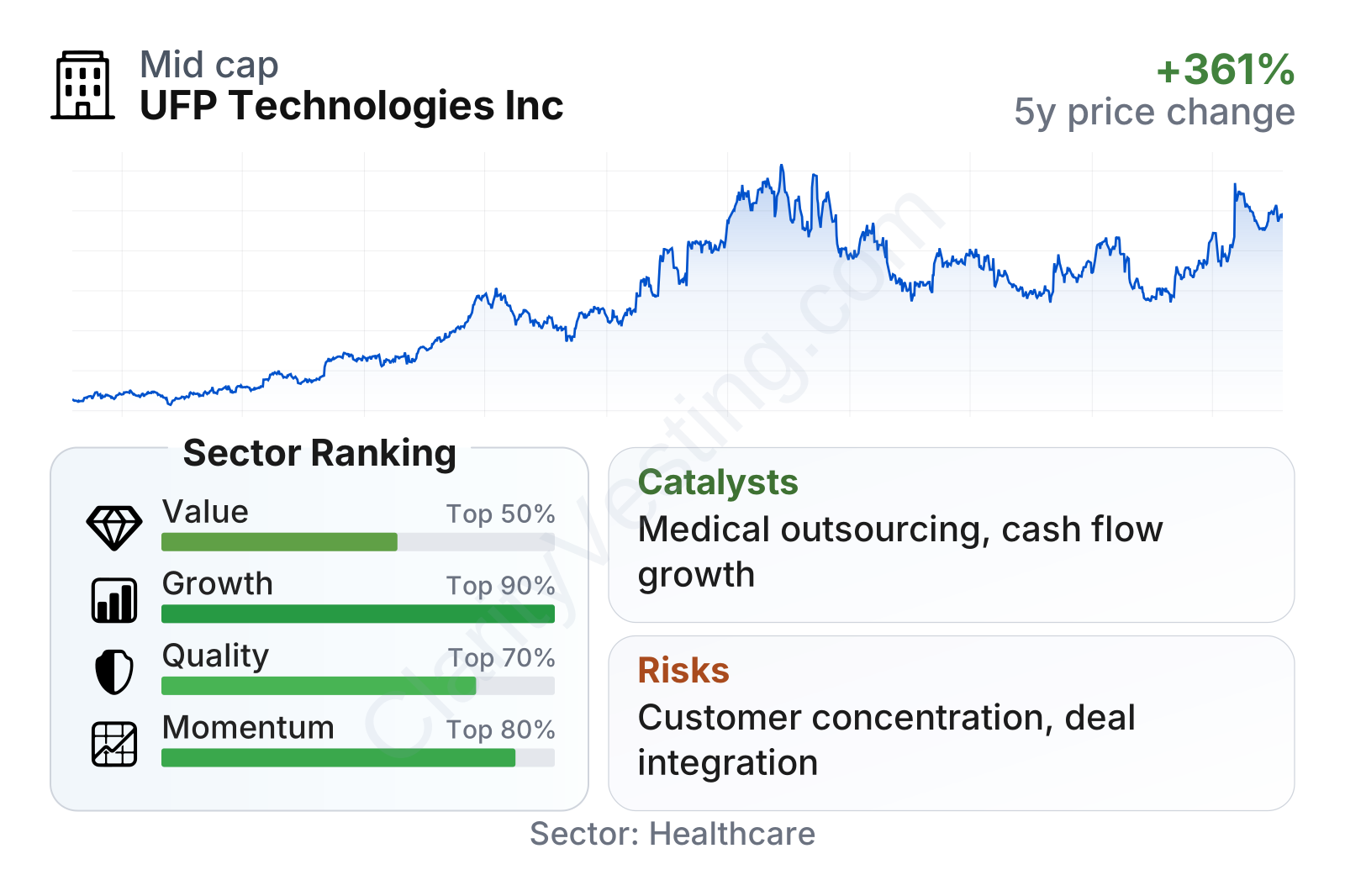
UFP Technologies stands out most on growth and profitability. Revenue growth is running above the healthcare sector median, long-term revenue per share growth has been especially strong, and margins are well above typical sector levels. Returns on capital and assets are also notably stronger than many peers. On valuation, the picture is less straightforward: earnings and book-value multiples are above sector medians, which suggests the market is already recognizing a good part of the company’s quality and expansion profile.
Growth
UFP Technologies operates in an attractive part of healthcare: outsourced medical device components, protective packaging, and single-use products tied to procedures, infection control, and specialized equipment. These areas tend to benefit from long-term demand drivers such as aging populations, rising procedure volumes, continued device innovation, and the push by large medical manufacturers to rely on specialized suppliers rather than build every component internally.
The company’s strategy is fairly easy to understand. It combines three growth engines: deeper relationships with medical customers, added manufacturing capabilities, and acquisitions that expand its reach into adjacent niches. This approach has made strategic sense so far because UFP is not trying to compete across all medical devices; it is building scale in highly specific product categories where material know-how, clean manufacturing, and customer approvals create friction for newcomers.
Revenue growth has moderated from the exceptional spikes seen after earlier acquisitions, but recent performance still shows a business growing faster than many healthcare peers. The latest year-over-year pace sits around the mid-teens, which is solid for a company of this size and suggests demand remains healthy even after a period of unusually strong expansion.
Cash generation has improved substantially over the past few years. Trailing free cash flow moved from very low levels in 2022 to roughly $60 million to $70 million more recently. That matters because it gives the company more flexibility to fund capital spending, support integration work, reduce leverage, and pursue future deals without depending entirely on external financing.
A notable catalyst has been the company’s continued push into medical markets through acquisitions and capacity expansion. UFP has spent the last several years broadening its portfolio in areas such as medical packaging, patient interface products, and single-use systems. If these acquired businesses are integrated well, they can deepen customer relationships and lift the amount of revenue tied to recurring or regulated programs. The company has also highlighted demand tied to complex medical devices and procedure-driven consumables, which are generally more resilient than discretionary end markets.
Risks
This article is for informational purposes only and does not constitute financial advice. Some content is AI-generated. See Disclaimer


