Stock Analysis · Ufp Industries Inc (UFPI)
Overview
UFP Industries is a manufacturer and distributor of wood, wood-alternative, and other building and industrial products. While it is often associated with lumber, the company is broader than a pure sawmill business. It designs, manufactures, and supplies components, packaging, and finished products used in construction, retail, and industrial end markets. Its operations are spread across North America, Europe, Asia, and Australia, but the United States remains the core market.
The business is organized around three main operating segments. Based on the latest annual filing for 2026 reporting and the recent business mix, revenue is approximately distributed as follows:
- UFP Retail Solutions: about 34% of revenue. This segment supplies products sold through home centers, e-commerce channels, and other retailers. It includes pressure-treated lumber, decking and outdoor living products, fencing, garden items, and other packaged building materials.
- UFP Packaging: about 33% of revenue. This unit serves industrial customers with pallets, crates, boxes, protective packaging, and site-built packaging solutions used in manufacturing, machinery, and logistics.
- UFP Construction: about 33% of revenue. This segment provides roof trusses, wall panels, engineered wood components, and other materials used in residential and commercial construction.
This balanced structure matters because it reduces reliance on a single market. Housing, repair-and-remodel activity, retail demand, and industrial production do not always move in the same direction, so diversification can soften downturns in one area. At the same time, all three segments still carry some exposure to lumber prices and general economic activity, which makes the company cyclical even if it is less concentrated than many wood-product peers.
Over the last several years, revenue and earnings have moved down from the unusually strong levels reached during the post-pandemic building boom. The broad pattern has been lower sales, lower gross profit, and lower net income since the 2022 peak, showing how quickly pricing and demand can normalize in this industry. Even so, the company has remained profitable and cash generative.
The profit flow highlights a business that still converts a meaningful portion of sales into earnings, but with noticeably slimmer results than in 2021-2022. The main takeaway is not distress; it is normalization after an exceptional cycle.
Key Figures
| Metric | Value | Sector ⓘ |
|---|---|---|
| Date | Oct 17, 2026 | |
| Context | ||
| Sector | Basic Materials | |
| Industry | Lumber & Wood Production | |
| Market Cap ⓘ | $4.18B | |
| Beta ⓘ | 1.22 | |
Value (Cheapness) | ||
| P/E Ratio ⓘ | 17.32 | 16.90 |
| P/B Ratio ⓘ | 1.40 | 1.65 |
| FCF Yield ⓘ | 6.33% | 5.76% |
| Dividend Yield ⓘ | 1.88% | 2.13% |
| EBIT / EV ⓘ | 7.79% | 6.30% |
| PEG ⓘ | 2.67 | |
Growth (Business expansion) | ||
| Revenue Growth ⓘ | 2.60% | 11.10% |
| RPS Growth (5Y CAGR) ⓘ | -6.97% | 4.49% |
| EPS Growth (5Y CAGR) ⓘ | -33.59% | -13.47% |
| BVPS Growth (5Y CAGR) ⓘ | 12.70% | 5.51% |
| Margin Growth (5Y Trend) ⓘ | -2.19% | -1.54% |
| FCF Growth (5Y CAGR) ⓘ | -6.48% | 0.37% |
| DPS Growth (5Y CAGR) ⓘ | 20.33% | 6.08% |
Quality (Business durability) | ||
| ROIC (Latest) ⓘ | 7.50% | 9.26% |
| ROA (Latest) ⓘ | 5.97% | 4.91% |
| ROIC (5Y Median) ⓘ | 17.03% | 7.70% |
| ROA (5Y Median) ⓘ | 13.38% | 3.86% |
| Net Debt / EBIT (Latest) ⓘ | -1.08 | 1.40 |
| Net Debt / EBIT (5Y Median) ⓘ | -1.07 | 1.70 |
| Net Debt / EBITDA (Latest) ⓘ | -0.72 | 0.95 |
| Net Debt / Assets ⓘ | -8.88% | 13.69% |
| EBITDA / Interest ⓘ | 49.69 | 12.34 |
| Operating Margin (Latest) ⓘ | 5.43% | 13.20% |
| Operating Margin (5Y Median) ⓘ | 8.57% | 11.80% |
| Debt to Equity (Latest) ⓘ | 7.66% | 40.56% |
| Profit Margin (Latest) ⓘ | 3.99% | 6.43% |
| Free Cash Flow (Latest) ⓘ | $264.64M | |
Momentum (Price trend) | ||
| 3Y Return ⓘ | -19.40% | +68.89% |
| 12M Return (excl. last month) ⓘ | -16.56% | +30.21% |
| 6M Return ⓘ | -20.50% | -4.16% |
| Price vs. 200-Day MA ⓘ | -15.67% | -1.27% |
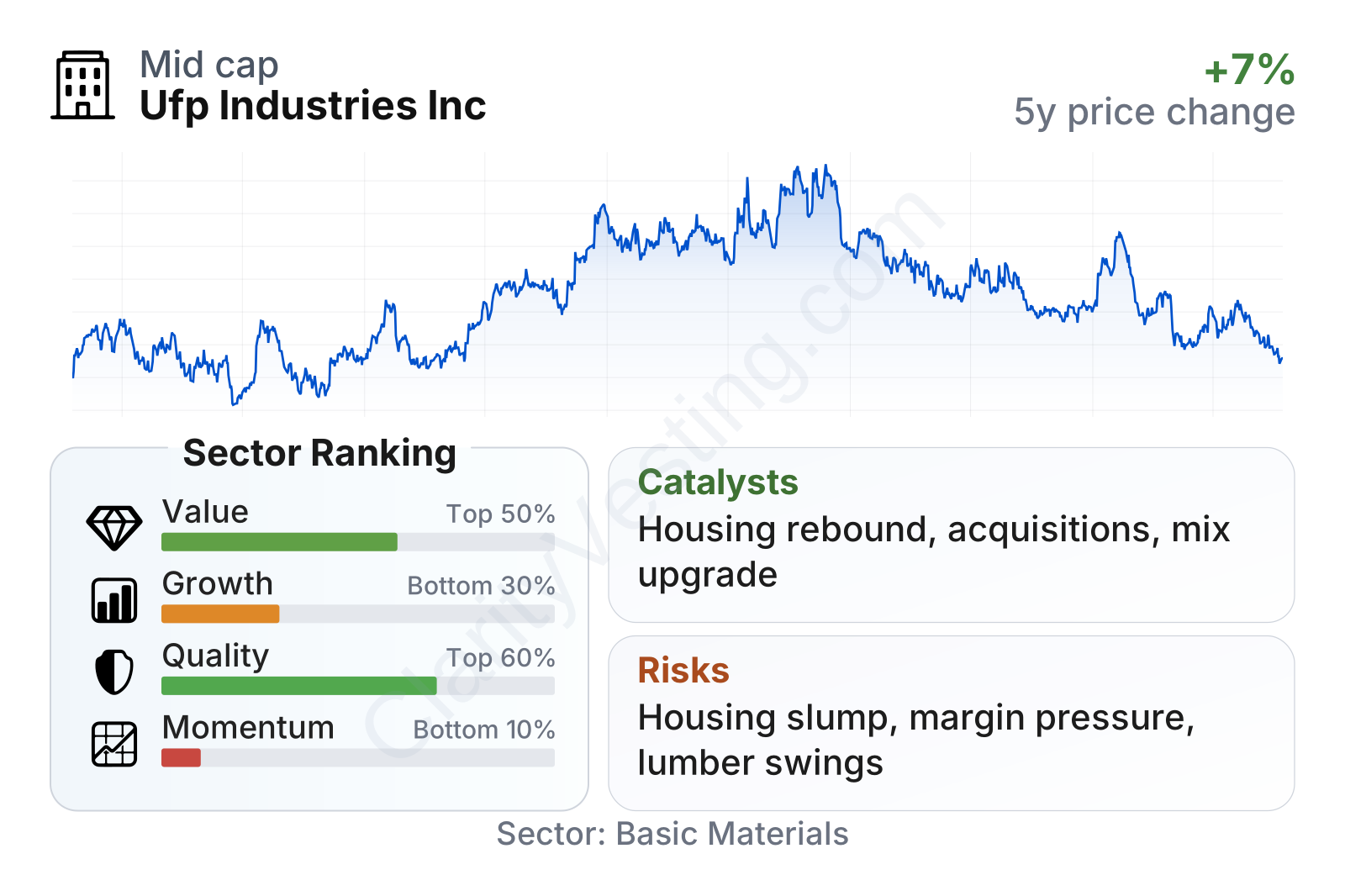
UFP Industries sits in the mid-cap range and shows a mixed profile. Valuation is close to sector norms on earnings, somewhat cheaper on book value, and slightly better than the sector median on free-cash-flow yield and EBIT relative to enterprise value. Quality looks stronger than growth: the balance sheet is unusually conservative for the sector, while long-term growth measures remain weak because results are being compared with the very high pandemic-era base. Share-price momentum has also been notably soft.
One of the clearest strengths in the current metrics is financial resilience. Debt levels are low, net debt metrics are negative because cash exceeds debt, and interest coverage is far above typical sector levels. That gives management flexibility for acquisitions, dividends, buybacks, and investment through weaker parts of the cycle.
Growth
UFP Industries operates in markets that can grow over time, but not usually in a straight line. Repair and remodel spending, outdoor living, value-added packaging, and factory-built or component-based construction all offer long-run support. These are not fast-changing technology markets; they are mature end markets where execution, scale, product mix, and customer relationships matter more than disruption.
The company’s strategy makes sense for that setting. Management has spent years pushing the business toward more value-added products rather than simple commodity lumber resale. That means more fabricated components, branded retail items, engineered solutions, and industrial packaging services. In theory, this should help margins, reduce dependence on raw wood price swings, and create stickier customer relationships.
Recent revenue growth still shows how hard the reset has been. After very strong gains in 2021 and early 2022, the company went through an extended period of declines before returning to modest positive growth in the latest period. That rebound is encouraging, but it is small compared with the prior contraction and still trails the broader sector’s recent pace.
Cash generation remains an important positive. Free cash flow has come down sharply from the extraordinary levels seen a few years ago, but it remains solid in absolute terms. For a cyclical manufacturer, staying meaningfully cash generative during a weaker earnings phase is a constructive sign.
A practical catalyst is any improvement in U.S. housing activity, repair-and-remodel demand, and industrial production. Lower interest rates, if they support construction and consumer spending on home projects, could help volumes. Another catalyst is acquisitions. UFP has a long history of buying smaller businesses and integrating them into its network, and its strong balance sheet leaves room for more deals.
Recent company communications have also emphasized ongoing investment in automation, product innovation, and segment mix improvement. None of these changes is likely to transform results overnight, but together they support the idea that future growth can come from market share gains and better product mix, not only from higher lumber prices.
Risks
This article is for informational purposes only and does not constitute financial advice. Some content is AI-generated. See Disclaimer


