Stock Analysis · United Fire Group Inc (UFCS)
Overview
United Fire Group Inc is a U.S. property and casualty insurer. Through its insurance subsidiaries, the company underwrites commercial and personal insurance policies and also earns income from investing the premium float it holds before claims are paid. In simple terms, it collects premiums, invests part of that money, and aims to make a profit after paying claims, operating costs, and taxes.
The business is centered on property and casualty coverage, with a stronger emphasis on commercial lines than on personal lines. Based on the company’s recent annual disclosures, revenue is driven mainly by net premiums earned, while a smaller portion comes from net investment income and other insurance-related items.
The main revenue sources are broadly organized as follows:
- Commercial insurance premiums: approximately 75% to 85% of total insurance premium volume. This typically includes business property, liability, commercial auto, workers’ compensation, inland marine, and specialty coverages.
- Personal insurance premiums: approximately 10% to 20% of total insurance premium volume. This generally includes homeowners and personal auto products.
- Reinsurance assumed and other underwriting-related items: a smaller contribution, usually in the low single-digit to high single-digit range depending on the period and business mix.
- Net investment income: usually around 5% to 10% of total revenue. This comes mainly from the company’s bond portfolio and other invested assets that support insurance reserves and capital.
For long-term readers, the key point is that UFCS is not a high-growth technology company. It is a mid-sized insurer whose results depend on disciplined underwriting, pricing, catastrophe exposure, reserve accuracy, and investment returns. That makes the business easier to understand, but also more cyclical and more sensitive to weather losses and insurance market conditions than many other financial companies.
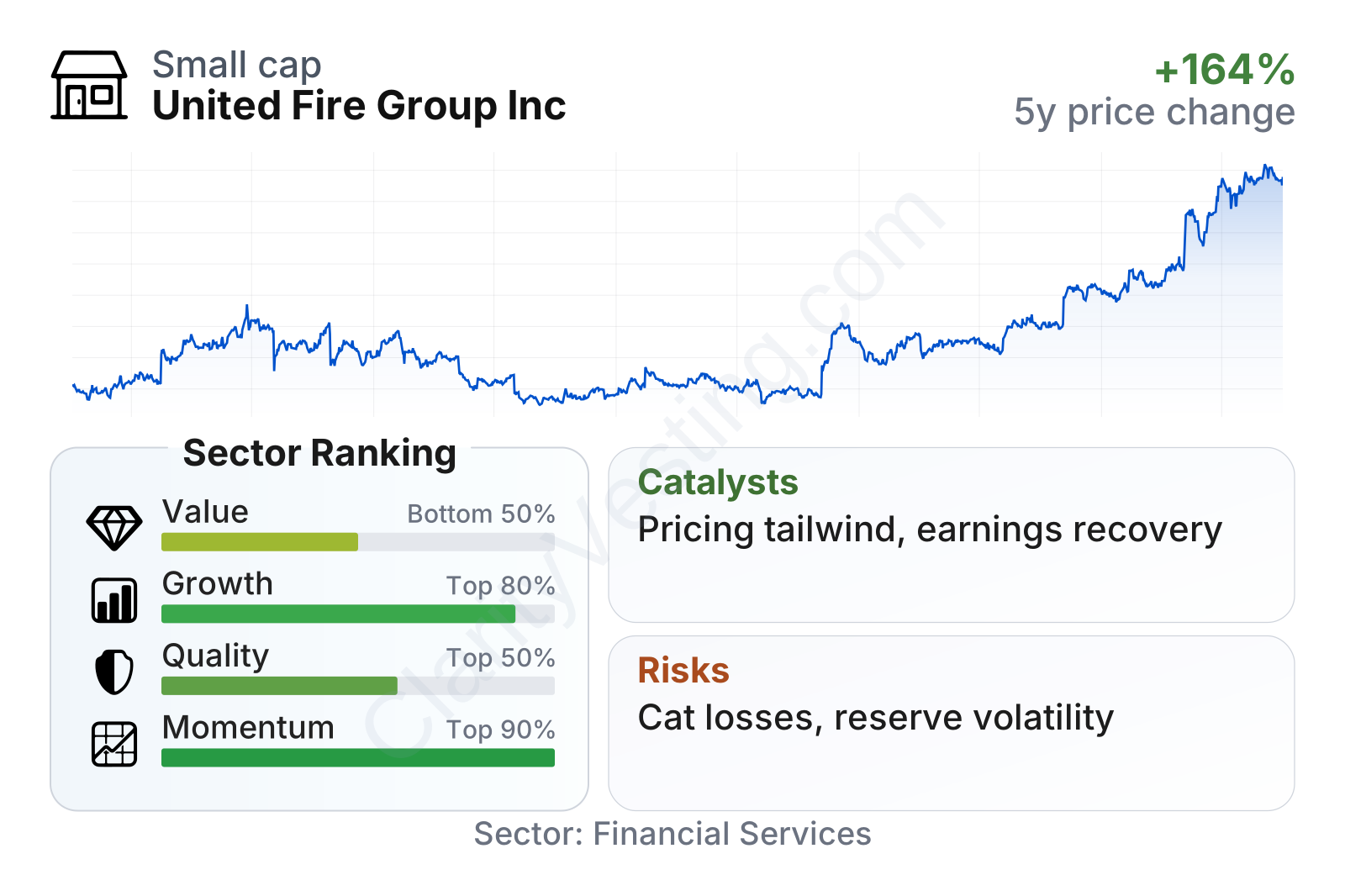
The profit picture has been volatile over the last several years. Revenue has moved upward overall, but profitability swung from healthy earnings in 2021 to a loss in 2023 before rebounding strongly in 2024 and 2025. That pattern suggests the current improvement is real, but it also shows how quickly results can change in this industry when claims severity, catastrophe losses, or reserve development move the wrong way.
Key Figures
| Metric | Value | Sector ⓘ |
|---|---|---|
| Date | Oct 03, 2026 | |
| Context | ||
| Sector | Financial Services | |
| Industry | Insurance - Property & Casualty | |
| Market Cap ⓘ | $1.39B | |
| Beta ⓘ | 0.51 | |
Value (Cheapness) | ||
| P/E Ratio ⓘ | 10.01 | 12.60 |
| P/B Ratio ⓘ | 1.43 | 1.23 |
| FCF Yield ⓘ | 19.36% | 10.16% |
| Dividend Yield ⓘ | 1.37% | 2.96% |
| EBIT / EV ⓘ | 13.67% | 7.77% |
| PEG ⓘ | 1.41 | |
Growth (Business expansion) | ||
| Revenue Growth ⓘ | 14.40% | 9.50% |
| RPS Growth (5Y CAGR) ⓘ | 5.70% | 12.10% |
| EPS Growth (5Y CAGR) ⓘ | 24.43% | -9.45% |
| BVPS Growth (5Y CAGR) ⓘ | -25.69% | 5.01% |
| Margin Growth (5Y Trend) ⓘ | 2.01% | -4.07% |
| FCF Growth (5Y CAGR) ⓘ | 101.60% | 4.96% |
| DPS Growth (5Y CAGR) ⓘ | 0.73% | 8.79% |
Quality (Business durability) | ||
| ROIC (Latest) ⓘ | 13.88% | 9.60% |
| ROE (Latest) ⓘ | 15.03% | 13.84% |
| ROA (Latest) ⓘ | 3.63% | 1.53% |
| ROIC (5Y Median) ⓘ | 8.06% | 7.86% |
| ROE (5Y Median) ⓘ | 2.72% | 12.20% |
| ROA (5Y Median) ⓘ | 1.87% | 1.29% |
| Net Debt / EBIT (Latest) ⓘ | 0.04 | 0.91 |
| Net Debt / EBIT (5Y Median) ⓘ | -0.91 | 0.74 |
| Net Debt / EBITDA (Latest) ⓘ | 0.02 | 0.97 |
| Operating Margin (Latest) ⓘ | 12.87% | 22.12% |
| Operating Margin (5Y Median) ⓘ | 6.74% | 24.39% |
| Debt to Equity (Latest) ⓘ | 14.97% | 60.37% |
| Profit Margin (Latest) ⓘ | 9.57% | 26.62% |
| Free Cash Flow (Latest) ⓘ | $268.44M | |
Momentum (Price trend) | ||
| 3Y Return ⓘ | +198.81% | +89.23% |
| 12M Return (excl. last month) ⓘ | +78.69% | +17.35% |
| 6M Return ⓘ | +48.22% | +10.00% |
| Price vs. 200-Day MA ⓘ | +21.95% | +3.73% |
UFCS is a relatively small public insurer, with a market value around the lower end of the listed insurance space, and its low beta indicates that the stock has historically moved less than the broader market. The recent metric mix is notable: growth, quality, and momentum look strong relative to much of the sector, while the value profile is more mixed because the shares no longer look as cheap on book value as they did in prior years. Profitability and returns on capital have improved meaningfully, balance-sheet leverage remains modest, and cash generation looks strong, but the dividend yield is below the sector median and margins still trail many peers.
Growth
Property and casualty insurance is a mature industry, but it can still produce attractive growth when pricing conditions are favorable. The current environment has generally supported premium rate increases across many commercial lines, especially where claims inflation and catastrophe costs have pushed insurers to reprice risk. That backdrop can help well-capitalized carriers expand written premiums without taking on reckless underwriting.
UFCS appears to be benefiting from that environment. Recent revenue growth has outpaced the sector median, and earnings have recovered sharply from the 2023 downturn. The company’s strategy has centered on improving underwriting quality, refining risk selection, and restoring profitability rather than chasing volume at any price. For an insurer, that is usually the more durable path to growth because premium expansion only creates value when claim costs stay under control.
The earnings trend shows a clear turnaround: results fell from positive earnings in 2021 and 2022 to a loss in 2023, then recovered strongly in 2024 and improved further in 2025. That rebound matters because it suggests the business was able to reprice business and regain underwriting traction rather than merely relying on temporary investment gains.
Book value per share is especially important for insurers because it reflects the capital base supporting underwriting. After a steep drop earlier in the period, book value has been rebuilding. That recovery is encouraging because it indicates that recent profits are again adding to shareholder equity, although the earlier decline is a reminder that capital can be hit hard when underwriting performance deteriorates.
A practical catalyst for future growth is the combination of firmer premium pricing and higher investment income. Insurers invest large pools of assets, and higher yields on fixed-income portfolios can support earnings over time as bonds mature and are reinvested at better rates. If underwriting discipline remains intact, UFCS could benefit from both sides of the model at once: better insurance margins and stronger investment returns.
Another favorable sign is stock market momentum. The share price has risen sharply over the last year and over a multi-year period, reflecting a market reassessment after the earlier weak phase. That does not guarantee future business progress, but it often signals that operating results have improved enough to materially change sentiment around the company.
Risks
This article is for informational purposes only and does not constitute financial advice. Some content is AI-generated. See Disclaimer