Stock Analysis · Uranium Energy Corp (UEC)
Overview
Uranium Energy Corp is a U.S.-based uranium company focused on acquiring, developing, extracting, and selling uranium concentrates used as fuel for nuclear power plants. The company emphasizes domestic supply, with a portfolio centered on in-situ recovery projects in Texas and Wyoming, plus physical uranium inventories and a large pipeline of exploration and development assets in the United States, Canada, and Paraguay. In simple terms, it is building a uranium platform designed to benefit if nuclear fuel demand rises and utilities seek more supply from politically stable jurisdictions.
Its revenue can be unusually uneven from year to year because uranium producers often sell material in batches rather than through smooth monthly deliveries. Based on the latest public filings and recent annual results, revenue has mainly come from uranium-related activities, but the mix can change materially depending on inventory sales, delivered volumes, and timing.
- Uranium sales and related activities: approximately 100% of recent revenue. This includes sales of uranium concentrates and, depending on the period, sales from physical inventory positions.
- Other operating sources: currently immaterial based on recent filings. The company is not meaningfully diversified into other business lines at this stage.
That concentration makes the business easy to understand: Uranium Energy Corp is largely a direct vehicle on uranium prices, production restart timing, and the value of its asset base. It also means reported results can swing sharply when the company is building inventory, advancing projects, or waiting for better contract conditions rather than maximizing near-term sales.
The recent financial flow shows how volatile this business can be. Revenue has moved sharply from year to year, while operating expenses have remained elevated as the company expands its project base and prepares assets for future production. That helps explain why accounting profits have been weak even during periods when uranium market conditions improved.
Key Figures
| Metric | Value | Sector ⓘ |
|---|---|---|
| Date | Oct 17, 2026 | |
| Context | ||
| Sector | Energy | |
| Industry | Uranium | |
| Market Cap ⓘ | $4.08B | |
| Beta ⓘ | 1.39 | |
Value (Cheapness) | ||
| P/E Ratio ⓘ | N/A | 15.44 |
| P/B Ratio ⓘ | 2.78 | 1.73 |
| FCF Yield ⓘ | -0.22% | 8.20% |
| Dividend Yield ⓘ | N/A | 3.59% |
| EBIT / EV ⓘ | -3.17% | 7.46% |
| PEG ⓘ | 1.37 | |
Growth (Business expansion) | ||
| Revenue Growth ⓘ | -59.40% | 26.90% |
| RPS Growth (5Y CAGR) ⓘ | -2.60% | 6.90% |
| EPS Growth (5Y CAGR) ⓘ | N/A | -15.73% |
| BVPS Growth (5Y CAGR) ⓘ | 23.86% | 6.07% |
| Margin Growth (5Y Trend) ⓘ | N/A | 0.58% |
| FCF Growth (5Y CAGR) ⓘ | -36.55% | 1.86% |
| DPS Growth (5Y CAGR) ⓘ | N/A | 16.79% |
Quality (Business durability) | ||
| ROIC (Latest) ⓘ | -7.49% | 11.40% |
| ROA (Latest) ⓘ | -9.34% | 6.06% |
| ROIC (5Y Median) ⓘ | -7.88% | 10.30% |
| ROA (5Y Median) ⓘ | -4.70% | 5.42% |
| Net Debt / EBIT (Latest) ⓘ | N/A | 1.64 |
| Net Debt / EBIT (5Y Median) ⓘ | N/A | 1.83 |
| Net Debt / EBITDA (Latest) ⓘ | N/A | 1.08 |
| Net Debt / Assets ⓘ | -32.79% | 17.29% |
| EBITDA / Interest ⓘ | N/A | 9.64 |
| Operating Margin (Latest) ⓘ | -362.41% | 16.27% |
| Operating Margin (5Y Median) ⓘ | -133.14% | 20.39% |
| Debt to Equity (Latest) ⓘ | 0.13% | 54.76% |
| Profit Margin (Latest) ⓘ | N/A | 8.82% |
| Free Cash Flow (Latest) ⓘ | -$8.78M | |
Momentum (Price trend) | ||
| 3Y Return ⓘ | +49.51% | +67.38% |
| 12M Return (excl. last month) ⓘ | -13.56% | +49.19% |
| 6M Return ⓘ | -45.51% | +7.07% |
| Price vs. 200-Day MA ⓘ | -40.32% | +9.56% |
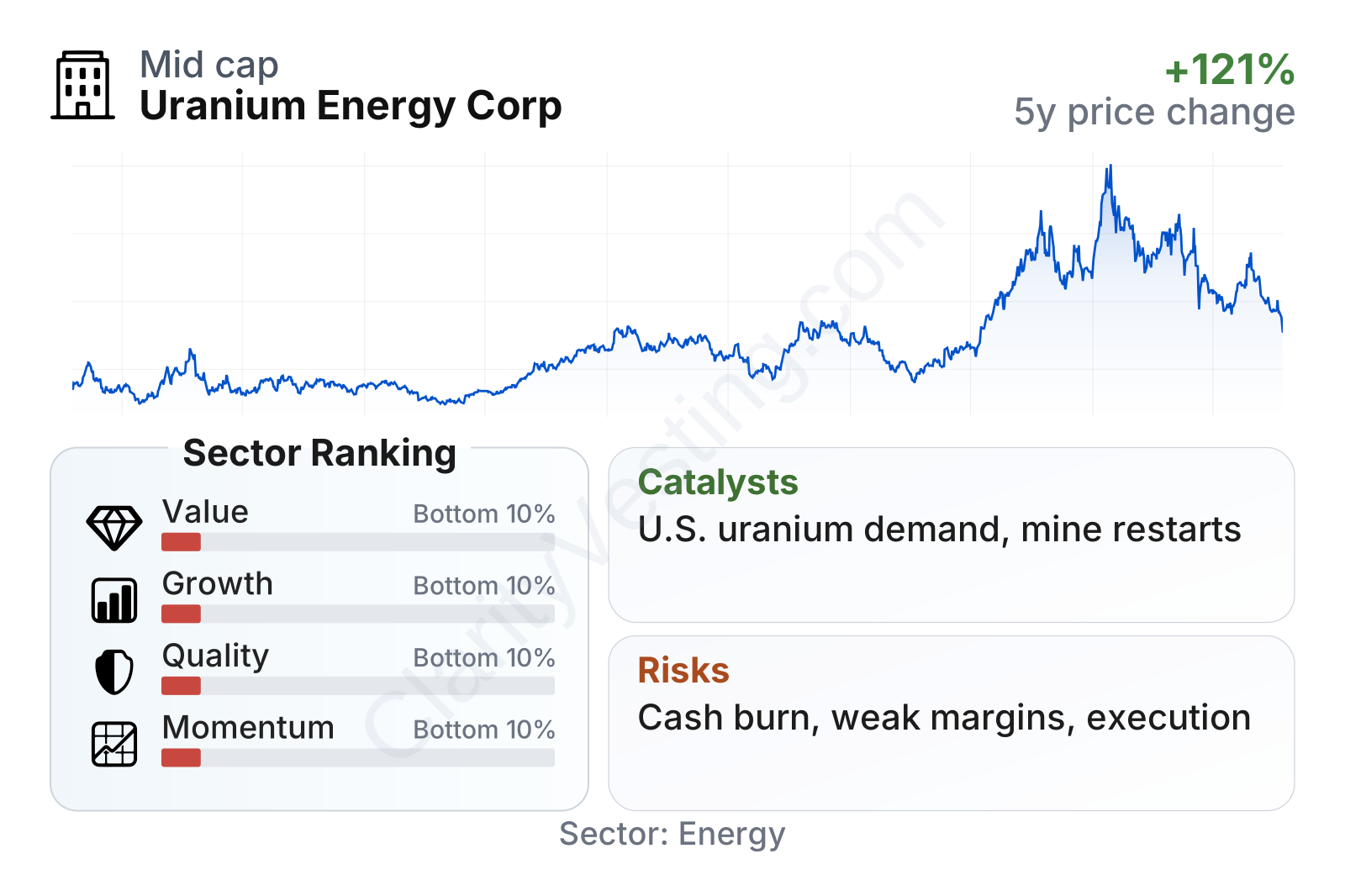
Uranium Energy Corp is a mid-sized uranium company with a stock that has been highly sensitive to changes in uranium sentiment. The long-term share performance has been strong over the past three years, but the more recent trend has weakened, with the stock trading well below its 200-day average. In the factor snapshot, valuation, quality, and momentum all rank in the lower end of the sector, while growth is harder to judge because revenue is lumpy and strongly affected by transaction timing rather than steady operating output.
The table also highlights a very unusual combination: extremely low leverage alongside negative cash flow and weak profitability. In other words, the balance sheet carries very little debt, but the business is still consuming cash as it develops projects and scales its uranium platform.
Growth
The broader sector backdrop is favorable. Nuclear power has been regaining policy support in many countries because it provides low-carbon baseload electricity, supports grid stability, and helps energy security goals. At the same time, uranium supply has been constrained for years by underinvestment, permitting complexity, and the long lead times required to develop mines. That combination has created a more constructive setup for uranium producers and developers than in much of the previous decade.
Uranium Energy Corp’s strategy is built around that theme. Rather than relying on one flagship mine, it has assembled a broad asset base with near-term restart potential, especially in U.S. in-situ recovery operations. This method generally requires lower upfront capital than large conventional mines and can allow faster production response once permits, wellfields, and processing infrastructure are in place. The company has also used acquisitions to expand its resource base and strategic relevance in North America.
Revenue growth has been extremely volatile, with periods of explosive increases followed by sharp declines. That does not necessarily mean demand is collapsing; it more often reflects a business that recognizes sales in large steps rather than through a stable recurring model. For a long-term view, the more important question is whether the company can translate its resource base and uranium market tailwinds into sustained production and contracted deliveries.
Free cash flow remains a weak point. Recent years show persistent cash outflows, and the trailing twelve-month figure is deeply negative. That is consistent with a company still in buildout mode rather than harvest mode. If uranium prices remain supportive and more projects move toward production, today’s cash burn could be seen as part of a scaling phase. If operational ramp-up takes longer, that same pattern could become a larger financing issue.
A meaningful catalyst is the push for domestic uranium supply in the United States. Utilities and policymakers have become more focused on reducing dependence on foreign sources across the nuclear fuel chain. Uranium Energy Corp’s U.S.-centered asset portfolio gives it a clear way to fit that trend. Another important catalyst is the company’s physical uranium holdings and production-ready infrastructure, which can offer flexibility when market conditions improve. Recent company updates have also emphasized project advancement, permitting progress, and operational readiness at key U.S. assets, all of which matter because uranium equities often rerate when a developer moves from optionality to visible production pathways.
Risks
This article is for informational purposes only and does not constitute financial advice. Some content is AI-generated. See Disclaimer


